The Political Perils of “Big Data”

In “Every Little Byte Counts,” a recent review of two books on “advances in our ability to store, analyze and profit from vast amounts of data generated by our gadgets” (otherwise known as Big Data), Evgeny Morozov makes two observations to which I want to draw your attention. 

The first of these he makes with the help of the Italian philosopher, Giorgio Agamben. Here are Morozov’s first two paragraphs: 

In “On What We Can Not Do,” a short and pungent essay published a few years ago, the Italian philosopher Giorgio Agamben outlined two ways in which power operates today. There’s the conventional type that seeks to limit our potential for self-­development by restricting material resources and banning certain behaviors. But there’s also a subtler, more insidious type, which limits not what we can do but what we can not do. What’s at stake here is not so much our ability to do things but our capacity not to make use of that very ability.

While each of us can still choose not to be on Facebook, have a credit history or build a presence online, can we really afford not to do any of those things today? It was acceptable not to have a cellphone when most people didn’t have them; today, when almost everybody does and when our phone habits can even be used to assess whether we qualify for a loan, such acts of refusal border on the impossible.

This is a profoundly important observation, and it is hardly ever made. In his brief but insightful book, Nature and Altering It, ethicist Allen Verhey articulated a similar concern. Verhey discusses a series of myths that underlie our understanding of nature (earlier he cataloged 16 uses of the idea of “nature”). While discussing one of these myths, the myth of the project of liberal society, Verhey writes,

“Finally, however, the folly of the myth of liberal society is displayed in the pretense that ‘maximizing freedom’ is always morally innocent. ‘Maximizing freedom,’ however, can ironically increase our bondage. What is introduced as a way to increase our options can become socially enforced. The point can easily be illustrated with technology. New technologies are frequently introduced as ways to increase our options, as ways to maximize our freedom, but they can become socially enforced. The automobile was introduced as an option, as an alternative to the horse, but it is now socially enforced …. The technology that surrounds our dying was introduced to give doctors and patients options in the face of disease and death, but such ‘options’ have become socially enforced; at least one sometimes still hears, “We have no choice!” And the technology that may come to surround birth, including pre-natal diagnosis, for example, may come to be socially enforced. ‘What? You knew you were at risk for bearing a child with XYZ, and you did nothing about it? And now you expect help with this child?’ Now it is possible, of course, to claim that cars and CPR and pre-natal diagnosis are the path of progress, but then the argument has shifted from the celebration of options and the maximizing of freedom to something else, to the meaning of progress.”

The second point from Morozov’s review that I want to draw your attention to involves the political consequences of tools that harness the predictive power of Big Data, a power divorced from understanding:

“The predictive models Tucker celebrates are good at telling us what could happen, but they cannot tell us why. As Tucker himself acknowledges, we can learn that some people are more prone to having flat tires and, by analyzing heaps of data, we can even identify who they are — which might be enough to prevent an accident — but the exact reasons defy us.

Such aversion to understanding causality has a political cost. To apply such logic to more consequential problems — health, education, crime — could bias us into thinking that our problems stem from our own poor choices. This is not very surprising, given that the self-tracking gadget in our hands can only nudge us to change our behavior, not reform society at large. But surely many of the problems that plague our health and educational systems stem from the failures of institutions, not just individuals.”

Moreover, as Hannah Arendt put it in The Human Condition, politics is premised on the ability of human beings to “talk with and make sense to each other and to themselves.” Divorcing action from understanding jeopardizes the premise upon which democratic self-governance is founded, the possibility of deliberative judgment. Is it an exaggeration to speak of the prospective tyranny of the algorithm?

I’ll give Morozov the penultimate word:

“It may be that the first kind of power identified by Agamben is actually less pernicious, for, in barring us from doing certain things, it at least preserves, even nurtures, our capacity to resist. But as we lose our ability not to do — here Agamben is absolutely right — our capacity to resist goes away with it. Perhaps it’s easier to resist the power that bars us from using our smartphones than the one that bars us from not using them. Big Data does not a free society make, at least not without basic political judgment.”

I draw your attention to these concerns not because I have an adequate response to them, but because I am increasingly convinced that they are among the most pressing concerns we must grapple with in the years ahead.

On the Merits of Inconclusive Debates

On social media, criticism too often takes the form of aggressively ironic derision performed for those who are already prone to agree. It can also be challenging, although not impossible, to find sustained discussions that are both civil and well-reasoned. Relatedly, one of the complaints I frequently hear about online debates, one that I’ve made myself, is that no one ever changes their mind as a result of their online exchanges, no matter how prolonged or passionate those exchanges might be.

Of course, there are many reasons for this. For instance, we are, it seems to me, much less likely to surrender our positions, particularly our cherished convictions, in a public forum. Most of us are not so humble. Moreover, shifts in perspective or intellectual reversals tend to happen gradually. So much so, that one may not even be able to pinpoint the moment of conversion. In any case, they rarely happen in the heat of intellectual battle. And that last metaphor is also part of the problem. There’s a tendency to characterize our intellectual life as a quest to vanquish all foes rather than as a mutual, dialectical pursuit of knowledge and wisdom. A change of mind, then, is experienced as a defeat rather than a step toward better understanding.

All of this is really just a way of introducing the following passage from Oliver O’Donovan’s Self, World, and Time. O’Donovan reminds us, reminds me, that there is value even in an inconclusive debate or conversation, because, again, the point is not to be proven right.

“Let us suppose that I disapprove of the death penalty, and take up the cudgels against someone who defends it. As our discussion proceeds, certain things will become clear. One is that there are various reasons for disapproving of the death penalty, some of which may plausibly claim a perennial moral truth, while others are more circumstantial. If my opponent forces me to think hard, I shall understand better what social and historical conditions have made the death penalty appear reasonable to past generations, and I shall have to ask if those conditions could ever recur. I shall come to see that my view of the matter is part and parcel of a wider philosophy of penal justice and governmental responsibility, and I shall be forced to elucidate that philosophy more fully and to test its capacity to shed illumination on other questions, too. None of this could I have gained from talking to those who agreed with me. What it amounts to is that if at the end of the argument I still say, ‘I disapprove of the death penalty!’ I know much better than before what I mean by it.”

Thanks to Alastair Roberts for drawing my attention to it. 

Beyond Analog v. Digital

“If it’s not Scottish, it’s crap!” This was the slogan of a store called All Things Scottish featured in a recurring Mike Myers skit on SNL in the mid-90s. Sometimes discussion of digital technology takes a similar turn. “If it’s not digital, it’s crap!” proponents seem to say. “If it’s not analog, it crap!” critics might retort.

In fact, concluding that all things digital superior to all things analog turns out to be just as misguided as the opposite judgment. After we’ve concluded that digital practices are no less “real” than analog practices and that a preference for analog practices is not necessarily an instance of naive or pretentious fetishism, then the harder, more interesting work of begins. That work involves figuring out what tools best fit the job and the person. As an interesting instance of this process I submit an exchange that unfolded yesterday on Twitter following this tweet by Jeremy Antley:

As someone preparing to write a dissertation in the coming months, I found this really interesting. I’ll let you follow the exchange as it took off from that tweet, but the gist of it is that the idea of writing out a long draft by hand resonated with a few (myself included), piqued the curiosity of others, and seemed entirely unworkable to some.

The point illustrated by this exchange is, to begin with, that writing by hand and writing with a word processing tool are not, at the experiential level, the same thing. There are things you can do with one method that you cannot do with the other, and vice versa. One medium limits you in ways that the other does not, and vice versa. But that is just the first step.

There’s a tendency to stop with that realization and then generalize one’s own preferences to apply to all people under all circumstances. It would be better to continue by asking how the relative strengths and weaknesses of a given medium fit with the requirements of the task at hand and with one’s own proclivities, tendencies, and idiosyncrasies. We are diverse enough, and the things we set out to accomplish sufficiently varied that it would be impossible to generalize about the superiority of digital tools or analog tools as a class.

I’ll leave you with one more related item to consider. In his article for Wired, Brandon Keim explores a variety of studies addressing the differences between reading on paper and reading on digital screens. The piece struck me as evenhanded and judicious in its conclusions.

Here’s the closing paragraph, and do note the good counsel to refuse Borg Complex claims of inevitability:

“’We should be wary of saying, “That’s the way we’re going to read in the future anyways, so why resist?”‘ said Mangen. ‘There is something to deep reading and deep thinking that is worth making an effort to preserve.’ Whether we need paper to do that remains to be seen. For now, though, there’s still plenty of life in those dead trees.”

One last point, as Keim’s article suggests, the differences between digital and analog reading experiences are often linked to the sometimes overlooked fact that we are bodies and our bodies are a consequential aspect of how we experience this world. As we evaluate our digital and analog tools, we do well not lose sight of this fact.


The Treadmill Always Wins

I recently suggested that it’s good to occasionally ask ourselves, “Why do we read?” That question was prompted in part by the unhealthy tendencies that I find myself struggling to resist in the context of online reading. These tendencies are best summed up by the phrase “reading to have read,” a phrase I borrowed from Alan Jacobs’ excellent The Pleasures of Reading in an Age of Distraction. Incidentally, telling you to read this book is only the first piece of advice that I’ll offer in this post, but it might be the best.

As it turns out, Jacobs revisited his comments on this score in a post discussing a relatively new speed reading app called Spritz. The app sells itself as “reading reimagined,” rather brutally so if you ask me. The app flashes words at rates up to 600 words per minute featuring its “patent-pending Redicle” technology. In any case, you can follow the links to learn more about it if you’re so inclined. Near the close of his post, after citing some trenchant observations by Julie Sedivy, Jacobs observed,

It’s all too easy to imagine people who are taken with Spritz making decisions about what to read based on what’s amenable to ‘spritzing.’ But that’s inevitable as long as [they are thinking] of reading as something to have done, something to get through.”

Sedivy and Jacobs both are pointing out one of the more insidious temptations technology poses, the temptation to fit ourselves to the tool. In this case, the temptation is to prefer the kind of reading that lends itself to the questionable efficiencies afforded by Spritz. As Sedivy puts it, these are “texts with simpler sentences, sentences in which the complexity of information is evenly distributed, sentences that avoid unexpected twists or turns, and sentences which explicitly lay out their intended meanings, without requiring readers to mentally fill in the blanks through inference.”

In his post, Jacobs also linked to Ian Bogost’s insightful take on Spritz which was titled, interestingly enough, “Reading to Have Read.” Bogost questions the supposedly scientific claims made for Spritz by its creators. More importantly, though, he takes Spritz to be symptomatic of a larger problem:

“In today’s attention economy, reading materials (we call it ‘content’ now) have ceased to be created and disseminated for understanding. Instead, they exist first (and primarily) for mere encounter. This condition doesn’t necessarily signal the degradation of reading; it also arises from the surplus of content we are invited and even expected to read. But it’s a Sisyphean task. We can no longer reasonably hope to read all our emails, let alone our friends’ Facebook updates or tweets or blog posts, let alone the hundreds of daily articles and listicles and quizzes and the like. Longreads may offer stories that are best enjoyed away from your desk, but what good are such moments when the #longreads queue is so full? Like books bought to be shelved, articles are saved for a later that never comes.”

Exactly. And a little further on, Bogost adds,

“Spritzing is reading to get it over with. It is perhaps no accident that Spritze means injection in German. Like a medical procedure, reading has become an encumbrance that is as necessary as it is undesirable. “Oh God,” we think. “Another office email thread. Another timely tumblr. Another Atlantic article.” We want to read them—really to read them, to incorporate them—but the collective weight of so much content goes straight to the thighs and guts and asses of our souls. It’s too much to bear. Who wouldn’t want it to course right through, to pass unencumbered through eyeballs and neurons just to make way for the deluge behind it?”

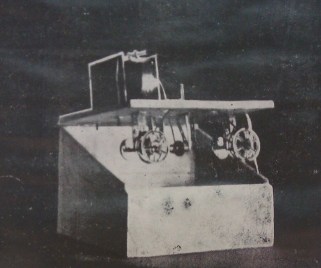
bob-brown-reading-machine
Bob Brown’s Reading Machine

That paragraph eloquently articulates, better than I could, the concerns that motivated my earlier post. I have nothing to add to what Sedivy, Jacobs, and Bogost have already said about Spritz except to mention that I’m surprised no one, to my knowledge, has alluded to Bob Brown’s Readies. In his 1930 manifesto, Brown declared, “The written word hasn’t kept up with the age,” and he developed a mechanical reading device to meet that challenge. Brown’s reading machine, which you can read about here, was envisioned as an escape from the page, not unlike Spritz. But as Abigail Thomas puts it, “It is evident that through the materiality of the page acting as the imagined machine, that the reader becomes the machine themselves.” Of course, I wouldn’t know of Brown were it not that one of my grad school profs, Craig Saper, was deeply interested in Brown’s work.

That said, I do have one more thing to add. Spritz illustrates yet another temptation posed by modern technologies. We might call it the challenge of the treadmill. When I was in my early twenties and still in my more athletic phase, I took a stress test on a treadmill. The cardiologist told me to keep pace as long as I could, but, he added, “the treadmill always wins.” Of course, being modestly competitive and not a little prideful, I took that as a challenge. I ran hard on that machine, but, no surprise, the treadmill won.

So much of our response to the quickening pace induced by modern technologies is to quicken our own stride in response or to find other technologies that will help us do things more quickly, more efficiently. But again, the treadmill always wins. Maybe the answer to the challenge of the treadmill is simply to get off the thing.

But that decision doesn’t come easily for us. We have a hard time acknowledging our limitations. In fact, so much of the rhetoric surrounding technology in the western tradition involves precisely the promise of transcending our bodily limitations. Exhibit A, of course, is the transhumanist project.

In response, however, I submit the more humane vision of the agrarian and poet Wendell Berry. In “Faustian Economics,” Berry, speaking of the “fantasy of human limitlessness” that animates so much of our political and economic life, reminds us that we are “coming under pressure to understand ourselves as limited creatures in a limited world.” But this, he adds, should not be cause for despair:

“[O]ur human and earthly limits, properly understood, are not confinements but rather inducements to formal elaboration and elegance, to fullness of relationship and meaning. Perhaps our most serious cultural loss in recent centuries is the knowledge that some things, though limited, are inexhaustible. For example, an ecosystem, even that of a working forest or farm, so long as it remains ecologically intact, is inexhaustible. A small place, as I know from my own experience, can provide opportunities of work and learning, and a fund of beauty, solace, and pleasure — in addition to its difficulties — that cannot be exhausted in a lifetime or in generations.”

I would suggest that Berry’s wisdom is just as applicable to the realm of reading and the intellectual life as it is to our economic life.

With regards to reading, the first step may be coming to the realization, once again perhaps, that we cannot read it all. According to Joseph Epstein, “Gertrude Stein said that the happiest moment of her life was that moment in which she realized that she wouldn’t be able to read all the books in the world.” May Stein be our model, although I admit the happiness on this score is sometimes hard to muster.

I’ll leave you with two questions to consider. The first is from Len Kendall: “Is your day composed of reading 10% of 100 articles or 100% of 10 articles?”

The second is a set of related questions from Adam Gurri:

“Ask yourself: what conversations matter to you? Which are relevant to your life, and which are relevant to your interests? After figuring that out, be stricter about excluding stories that fall outside of those conversations. Be selective about the publications you read regularly, and seek to go deeper rather than broader in the conversations you follow.”


Why Do We Read?

I sat down, as I usually do on Friday mornings, to catch up on the week’s online reading. Unlike most week’s, though, I had let my RSS feed get backed up until it had become an unwieldy mess, and, consequently, I was faced with the prospect of combing through hundreds of items or … deleting them all. Following my own advice from a few months back, I marked all as read. “Are you sure you would like to mark all items as read?” I was politely asked. Yes, yes I am.

There was, of course, a moment of hesitation. What might I miss? Was there a really brilliant piece that I might not otherwise see? Was there fodder for a blog post? Something that would fit nicely with my dissertation research? Perspectives that I needed to read in order to remain “informed”?

Maybe, maybe not. The better question that eventually came to mind was simpler and of greater significance: What was I reading for?

young_girl_readingThat old venerable guide, Adler and van Doren’s How to Read a Book, suggests three possible answers to that question: one may read for information, understanding, or pleasure. Heuristically speaking, that’s not a bad start. But it doesn’t work very well in digital contexts, nor, for that matter, in pre-print contexts either.

The idea of reading for information and understanding with pleasure thrown in “somewhat apologetically,” as Alan Jacobs puts it in The Pleasures of Reading in an Age of Distractionhas a certain Age of Reason feel to it. Consider, by contrast, how the monk and scholar, Hugh of St. Victor, framed the aims of reading in the twelfth century. Hugh wrote what might be the earliest guide to reading, the Didascalicon, and quite early in the life of this blog I posted a series of excerpts from Ivan Illich’s wonderful study of Hugh and twelfth century reading technology.

According to Illich, for Hugh “the reader is one who has made himself into an exile in order to concentrate his entire attention and desire on wisdom, which thus becomes the hoped-for home.” But wisdom for Hugh was not merely knowledge applied to living well. “As with Augustine,” Illich explains,

“wisdom was for Hugh not something but someone. Wisdom in the Augustinian tradition is the second person of the Trinity, Christ . . . . The wisdom Hugh seeks is Christ himself.  Learning and, specifically, reading, are both simply forms of a search for Christ the Remedy, Christ the Example and Form which fallen humanity, which has lost it, hopes to recover. The need of fallen humanity for reunion with wisdom is central to Hugh’s thought.”

Of course, it is not all that surprising to find that, historically, the act of reading has been incorporated into larger cultural frameworks of meaning and purpose. Hugh’s understanding of reading was decidedly theological. Adler and van Doren’s vision for reading we might call democratic, both in the sense that they wanted the benefits of reading to be widely distributed and in the sense that such reading was supposed to cultivate responsible, informed citizens.

It is worth noting that these cultural shifts were not independent of developments in the available technologies of reading. For instance, Illich’s In the Vineyard of the Text is concerned with understanding how twelfth century developments in the apparatus of the book and the lay out of the page were already sundering spiritual reading from scholarly reading, leading to the emergence of the university. And, of course, the printing press and, perhaps even more so, the later availability of cheap paper were pre-conditions for the age of democratic reading.

Illich, writing as the digital age was dawning, understood that “the thought of an ultimate goal of all readings is not meaningful to us.” Our motives for reading are diverse and varied, and I would hesitate to reach for a generalization that would characterize the motives of our age the way we might speak of the theological reading of the middle ages or the democratic reading of the more recent age of print. But there are a few more modest observations that we might make.

My own online reading experience is too often characterized by what Jacobs has called reading “to have read.” In the context of his discussion, Jacobs was referring to those who dutifully read through a list of “must read” books or a list of “great works” merely out of a sense of duty. In other words, they were not driven to read by the intrinsic pleasure of reading, rather they read as one does chores around the house, to be done with them. Or worse, they read in order to be the sort of people who can say that they have read certain works and cash in whatever cultural currency that may earn them.

477px-Saint_Augustine_by_Philippe_de_ChampaigneI find that the phrase “reading to have read” covers a lot of the kind of reading I end up doing online. There is some vague sense that there are things I need to keep up with, things others are talking about that I should look into, things that by the very fact of their piling up in my RSS feed are asking to be read and it is a relief to go through them just as it is to get the Inbox down to zero. So on and so forth; this is nothing new.

Additionally, we might also note a variation on the theme, “reading to be seen to have read.” This kind of reading is not a function of digital texts per se, as much as it is a function of networked reading environments. This sort of reading gets sucked in to the construction of what Rob Horning has recently called the “post-authentic viral self.” You would do well to read the whole of Horning’s essay, but the gist of it for the purposes of this post is that the viral self reads in search of what will fuel the sharing metrics by which it registers its state of being. I am retweeted, therefore I am.

“One adopts a ‘viral self,’ anchored in continual demonstrations of its reach, based on ingenious appropriation and aggregation of existing content, not,” Horning explains, “in its fidelity to a static inner truth or set of tastes. It is defined by its ability to circulate, not by the content of what it circulates.”

In a much shorter, less sophisticated, but similarly insightful post, Len Kendall, sums up the motives driving the reading the viral self undertakes: “Today we’re driven less by the words on a page (or screen) inspiring thoughts in our minds, and more by how a title or topic trigger other people to validate, praise, and fight us.”

The reading of the viral self is reading in search of what can be shared, and this need not imply actual reading. Recall the joke NPR pulled off for April Fool’s Day earlier this year. They posted an article to their Facebook page titled, “Why Doesn’t America Read Anymore?” The article generated hundreds of comments and was shared thousands of time. There was, of course, no article. Those who clicked to read the piece were immediately informed that the article was a hoax based on NPR’s sense that more than a few folks were commenting on their stories without actually taking the time to read the stories.

Of course, there is nothing particularly novel about the relationship between reading and the “self” and its presentation. There is only the question of the nature of that relationship. In the age of print, we also read, in part, so that we might be seen reading. For the bookish sorts, a bookshelf could be a kind of self-portrait; aspirational perhaps, but a self-portrait nonetheless. Even in the distant world of Hugh of St. Victor, reading and identity were intertwined.

“That which we mean today when, in ordinary conversation, we speak of the ‘self’ or the ‘individual,’ is one of the great discoveries of the twelfth century,” according to Illich.  Hugh of St. Victor, Illich continues, “wants the reader to face the page so that by the light of wisdom he shall discover his self in the mirror of the parchment.  In the page the reader will acknowledge himself not in the way others see him or by the titles or nicknames by which they call him, but by knowing himself by sight.”

All of this began with a simple straightforward question: why do I read?

My answer will not be your answer, of course. In fact, it may be that neither of us have a very good answer to that question at all, or we may find that our answer to that question evolves over time.

The point, I think, is to occasionally ask the question.