Theory and Electronic Literature

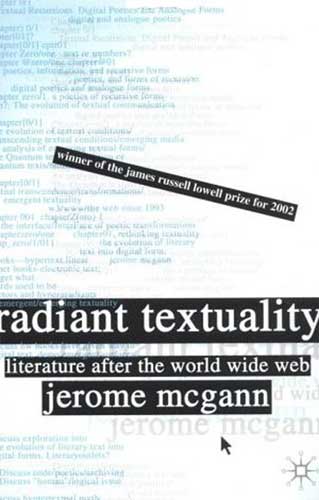
What is theory?  It is, at least in part, an effort to make explicit what is implicit and to expose what is assumed but unspoken. To paraphrase Niklas Luhmann, theory seeks to perceive the reality which one does not perceive when one perceives it.  If so, then Katherine Hayles is offering us a theory of electronic literature that renders electronic literature an embodiment of theory.  Not, however, in the sense early theorists of hypertext imagined, but in a way that is more consonant with the anti-speculative perspective advocated by Jerome McGann in Radiant Textuality: Literature after the World Wide Web.

Early hypertext theorists such as George Landow enthusiastically read electronic literature as an embodiment of poststructuralist theory.  It appeared that electronic literature manifested on the surface everything Roland Barthes painstakingly sought to reveal about traditional literature and the author.  This reading of electronic literature, however, appears now to have been stillborn because of its identification of the hyperlink as electronic literature’s “distinguishing characteristic,” a move which Hayles shows was beset by serious problems.  (Electronic Literature: New Horizons for the Literary, 31)  Likewise, McGann seems intent on moving past this mode of theorizing.  As I read him, it is not so much theory itself which McGann repudiates, but a certain way of constructing and applying theory.  As I’ve noted in response to radiant textuality, theory for Mcgann is best aligned with the kinds of knowledge that arise from performance/deformance because Mcgann envisions theory as poiesis rather than gnosis. The kind of embodied knowledge or theory that arises from acts of making or performance “makes possible the imagination of what you don’t know” because it elicits knowledge from failure and also from serendipity. (radiant textuality, 83)

McGann’s notion of imagining what you don’t know recalls Hayles’ clever appropriation of Rumsfeld’s Zen-like categorizations of knowledge.  As she puts it, “I propose that (some of) the purposes of literature are to reveal what we know but don’t know that we know, and to transform what we know we know into what we don’t yet know.”  Further resonating with McGann, she sees literature achieving this knowledge by “activating a recursive feedback loop between knowledge realized in the body through gesture, ritual, performance, posture, and enactment, and knowledge realized in the neocortex as conscious and explicit articulations” in much the same way that McGann sees theory arising through “the kinds of knowledge involved in performative operations.”  (Electronic Literature, 132; RT, 106)  In one sense I would argue that as Hayles describes the effects of electronic literature it functions in a way reminiscent of McGann’s practices of deformance.

For both Hayles and McGann, theory is bound up with the body, with the material, and with action.  For McGann, deformance is a practice which leads the reader to tap through performance the kind of embodied knowledge that helps them reckon with the materiality of the text.  For Hayles, electronic literature already requires or is intended to force the kinds of interactions that deformance is attempting to artificially elicit in the context of print.  Put otherwise, the productive disruptions code introduces into narrative awaken us, according to Hayles, to the reality of the human life-world’s integration with intelligent machines in much same way that the disruptions of deformance awaken us to the material realities of the text according to McGann.

Electronic literature as Hayles’ theorizes it draws into the open features of human existence that previously lay below the level of awareness.  At its best then electronic literature, like good theory, reveals what is not always perceived, but always present.  And this, according to Hayles, it accomplishes by “creating recursive feedback loops between explicit articulation, conscious thought, and embodied sensorimotor knowledge.”  (Electronic Literature, 135)  Or, as McGann might put it, through poiesis and not merely gnosis.
Deformance, Materiality, Theory

In radiant textuality, Mcgann introduces the practice of deformance by suggesting that it will help “break beyond conceptual analysis into the kinds of knowledge involved in performative operations.” (106)  As I understand him, Mcgann is reminding us that there is a kind of knowledge that cannot be “cast in thematic form.”  (106)  Interpretation that seeks to extract a meaning in thematic form assumes that meaning is something contained by the work of literature, let us say a poem for example, which can be sucked out and recast otherwise.  There is a place for such interpretative strategies, but they tend to ignore the knowledge embedded in the textuality/materiality of the poem that is acquired not by ratiocination but by performance.  This knowledge by its nature is difficult to articulate, but it is the kind of knowledge that deformance seeks to tap and the language of “intimacy” with a text gets at the sensuality of this knowledge.  This knowledge arises from the forming of the words with our mouths, the seeing of the words on the printed page (a seeing that is sharpened by distortion), the hearing of sounds made by the words (again sharpened by distortion), and even feeling the weight of the book in the hand.  To read the works backward or to displace or isolate elements of the text is a way of helping us see what ordinarily “escapes our scrutiny” (116) because with most interpreters we locate meaning not in the documentary features of the text but in a linguistic event. (115)  Mcgann’s dedication to John Unsworth, Deo Gratias, invites me to understand this almost as a kind of liturgical knowledge.

Referring to Dickinson’s backward reading as an example of the kind of performance that elicits this intimate knowledge, Mcgann suggests that this model is in a sense “antitheoretical: not because it is opposed to theory (i.e., speculative thought) but because it places theory in a subordinated relation to practice.”  (109)  This connects back to his earlier discussion of the “pragmatics of theory.”  (83)  There rather than equating theory with speculative thought, theory is distinguished from “hypothesis or speculation.”  Theory in this earlier case then is not what is being opposed by deformance when it is labeled antitheoretical.  Theory here is aligned with the kinds of knowledge that arise from performance/deformance because Mcgann envisions it as poiesis rather than gnosis.  This embodied knowledge that arises from making or performing “makes possible the imagination of what you don’t know” because it elicits knowledge from failure and also from serendipity.  (83)

My sense is that Mcgann sees this kind of knowledge that emerges out of the work of building something like the Rossetti Archive as a critical step toward envisioning what the digital humanities can be, but that he also is concerned that digitized texts will not be able to attain the capabilities of critical interaction with the materiality of our texts.  Or perhaps to put it differently, he is most concerned that forgetting what we have learned over centuries of interaction with material texts, we will fail to incorporate that knowledge into our emerging digital tools.

Escapes

C. S. Lewis was fond of saying that the only people opposed to escapes were jailers. In his classic essay, “On Fairy Stories,” Tolkien made the same point at greater length:

“Why should a man be scorned if, when finding himself in prison, he tries to get out and go home? Or, if when he cannot do so, he thinks and talks about other topics than jailers and prison walls? The world outside has not become less real because the prisoner cannot see it. In using Escape in this way the critics have chosen the wrong word, and, what is more, they are confusing … the Escape of the Prisoner with the flight of the Deserter.”

Why indeed?

Lewis and Tolkien, both best remembered for their works of fantasy, were each responding to the charge of writing escapist literature. But, what counts as escapism is a matter of perspective. From what is the escape? Lewis and Tolkien constructed their fantasy to offer an escape into the deepest reality. Is it possible that the structures and pace of our world chain us up in a kind of Platonic cave of ignorance, detached from what is true, good, and beautiful? If so, then escape is the very thing we should be hell-bent on achieving.

In “The Weight of Glory” Lewis evocatively describes the alluring and haunting appeal of beauty, but he is quick to remind us that beauty is not found in the moments, experiences, and objects that captivate us and fill us with wonder.

“These things—the beauty, the memory of our own past—are good images of what we really desire; but if they are mistaken for the thing itself they turn into dumb idols, breaking the hearts of their worshippers. For they are not the thing itself; they are only the scent of a flower we have not found, the echo of a tune we have not heard, news from a country we have never yet visited.”

The odd thing about beauty is that it is so often mixed with longing. Instead of leaving us satisfied, profound experiences of beauty can instead create a deep ache in our hearts. These encounters with beauty that momentarily overwhelm us are glimpses of life beyond the walls of the prison. But they are just that, glimpses. In Lewis’ view, and that of many others before him, beauty itself flows from God’s being through the created order. What we perceive then is a profound signal of God’s being beyond the created order and our taste of beauty beckons us to the source.

Lewis went on to observe that, “Almost our whole education has been directed to silencing this shy, persistent, inner voice; almost all our modem philosophies have been devised to convince us that the good of man is to be found on this earth.” And thus his efforts to remind us through the beauty of his art, that there is more; that the deep longing we feel for something we have never yet experienced is not a cruel trick played by impersonal cosmic forces, but the “truest index of our real situation.”

So perhaps art, literature, poetry, and films that offer us an escape from the ordinary and mundane are not so much pulling us out of the world, but rather helping us to see the world and our place in it more truly, more fully.