Information, A History

This is, as they say, the Information Age.  A days ago I posted a link to a graphic illustrating the exponential growth in data storage capacity, and before that I referenced the figures frequently cited to demonstrate the explosion of data and its trajectory.  But it may be fair to ask what we mean by “information” or “data” anyway.  James Gleik’s new book, The Information: A History, a Theory, a Flood, offers a historical frame of reference that helps us situate our present ideas about what exactly information is and what can be done with it.

Two recent reviews provide a helpful summary of the main themes.  Nicholas Carr’s review, “Drowning in Beeps,” is at The Daily Beast, and Freeman Dyson’s lengthier review, “How We Know,” is in The New York Review of Books.

At the NYRB blog Gleik also wrote a short, engaging post, “The Information Palace,” examining the history of Information via the entry for “information” in Oxford English Dictionary.  Here’s an excerpt:

It’s in the nineteenth century that we start to glimpse the modern sense of the word as a big category, a general thing encompassing news and facts, messages and announcements. The real turning point comes in 1948 when the Bell Labs mathematician and engineer Claude Shannon, in his landmark paper (later a book) “A Mathematical Theory of Communication,” made information, as the OED explains, “a mathematically defined quantity divorced from any concept of news or meaning …” We measure it in bits. We recognize it in words, sounds, images; we store it on the printed page and on polycarbonate discs engraved by lasers and in our genes. We are aware, more or less, that it defines our world.

Memory, Writing, Alienation

Some more reflections in interaction with Walter Ong’s work, this time an essay originally published in The Written Word: Literacy in Transition (Oxford, 1986) titled “Writing Is a Technology that Restructures Thought.”

Literacy does its work of transformation by restructuring the cultural and personal economy of memory and installing a self-alienation at the heart of literate identity.

The world of orality is fundamentally evanescent.  Spoken words themselves have begun to pass out of existence before they are fully formed by the speaker’s mouth.  The spoken word is in this way a telling image of oral society; each generation is always already fading into the unremembered past as it inhabits the present.  The accumulated knowledge and wisdom of an oral society exists only as it is remembered by individuals so that each member of the group shares in the cognitive burden of sustaining and transmitting the group’s cultural inheritance.  This work of memory preoccupies the cultural life of oral societies and configures the individual as a node within a network of cultural remembering.  Oral society is thus fundamentally conservative and collective.

Writing disrupts and rearranges this situation by offloading, to a significant degree, the cognitive burden of remembering from the living memory of each individual to the written word.  This work of cognitive offloading generates recurring debates, as we first encounter in Plato, about the proper modes of memory.  These debates reflect the (often unrecognized) force with which new mnenotechnologies impact a society.  As Ong notes, the frozen, lifeless written word is in another, paradoxical sense alive.  It achieves permanence and is “resurrected into limitless living contexts by a limitless number of living readers.”  Furthermore, the “lifeless” written word, by both resourcing and reconfiguring the economy of memory, also injects a new dynamism into literate cultures. It does so by relieving the conservative pressure of cultural remembrance thus encouraging what we might call intellectual entrepreneurship.

This new dynamism is, however, accompanied by various forms of alienation.  Crucially, writing dislodges a portion of one’s memory, a critical aspect of identity, from oneself.  To the extent that identity is constituted by memory, identity must be, to some extent, divided in literate societies.  Ong details the alienating work of writing when he lists fourteen instances of separation effected by writing:

1. Writing separates the known from the knower

2. Writing separates interpretation from data

3. Writing distances the word from sound

4. Writing distances the source of communication from the recipient

5. Writing distances the word from the context of lived experience

6. Due to 5., writing enforces verbal precision unavailable in oral cultures.  (In other words, without the context provided by face-to-face communication, words have to work harder in writing to make meaning clear.  This is why we sometimes feel compelled to use smiley faces in electronic communication — to communicate tone.)

7. Writing separates past from present.

8. Writing separates administration — civil, religious, commercial — from other types of social activities.

9. Writing makes it possible to separate logic from rhetoric.

10. Writing separates academic learning from wisdom.

11. Writing can divide society by splitting verbal communication between a “high” spoken language controlled by writing and a “low” controlled by speech.  (For example, “proper” English is really “written” English, while devalued vulgar and colloquial speech patterns are “spoken” English.)

12. Writing differentiates grapholects, dialect taken over by writing and made into a national language, from other local dialects

13. Writing divides more evidently and effectively as its form becomes more abstract, that is more removed from the world of sound to the world of sight.

14. Writing separates being from time.

By making thought (and so also the self) present to itself, literacy introduces an irreparable fissure into identity and consciousness, but one that is, in Ong’s account, ultimately “humanizing.”  Last word from Ong:

To say writing is artificial is not to condemn it but to praise it . . . By distancing thought, alienating it from its original habitat in sounded words, writing raises consciousness.  Alienation from a natural milieu can be good for us and indeed is in many ways essential for fuller human life.  To live and to understand fully, we need not only proximity but also distance.  This writing provides for, thereby accelerating the evolution of consciousness as nothing else before it does.
Handwriting, Print, and the Self

From Tamara Plakins Thornton’s Handwriting in America: A Cultural History:

To reconstruct the colonial world of handwriting, we must also attend to its setting within the world of the printing press.  Here the eighteenth century is especially critical . . . print underwent a qualitative change, now defining a medium that was characteristically abstract, impersonal, and, it was sometimes feared, duplicitous.  The quantitative growth of printing edged out the use of script in many instances, but the qualitative change in print lent new meaning to handwriting, providing script with a symbolic function even as it diminshed its practical utility.  If print entailed self-negation, then by contrast script would entail the explicit presentation of self.  The printed page might be “void of all characters,” but the handwritten one would present the self to its readers . . .

And,

Where print was defined by dissociation from the hand, script took its definition from its relationship to the hand.  Where print was impersonal, script emanated from the person in as intimate a manner as possible.  Where print was opaque, even duplicitous, script was transparent and sincere . . . . handwriting functioned as a medium of the self.

Diminished practical utility = heightened symbolic function

Might this be a useful formula for understanding what can happen when a new technology displaces an old one? Plug in e-readers and books, for example.

On another note, would there have been a “self” needing to present itself to begin with apart from print?  So another principle:  an older technology may be appropriated to address/redress conditions arising from a newer technology.

“We like lists because we don’t want to die”

It may not look like much, but that grocery list sitting on the kitchen counter is a faint visual echo of the beginnings of civilization.  At least from a certain angle of vision explicated and illustrated in Umberto Eco’s The Infinity of Lists: An Illustrated Essay (2009).  In a Der Spiegel interview from November 2009, Eco explains,

The list is the origin of culture. It’s part of the history of art and literature. What does culture want? To make infinity comprehensible. It also wants to create order — not always, but often. And how, as a human being, does one face infinity? How does one attempt to grasp the incomprehensible? Through lists, through catalogs, through collections in museums and through encyclopedias and dictionaries.

There is a point at which scholars, philosophers, intellectuals (public or otherwise), critics, etc. — one is temped to list on — reach either a certain age or a certain stature, which it is sometimes hard to tell, when they are able to make simple, direct, and yet curiously ambiguous claims and assertions which, had they been made by a lesser figure, would certainly be dismissed out of hand, but coming from the sage achieve a certain matter-of-fact status and attain the aura of profundity.  So, a list of such from Eco:

  1. “We like lists because we don’t want to die.”
  2. “The essential definition is primitive compared with the list.”
  3. “Lists can be anarchistic.”

In fact, read in context, these make a good deal of sense, or at least one sees how they may make sense.  Then one also attains a certain permission to be blunt:

If you interact with things in your life, everything is constantly changing.  And if nothing changes, you’re an idiot.

In passing Eco also manages to make some interesting claims about the Internet:

With context:

SPIEGEL: But you also said that lists can establish order. So, do both order and anarchy apply? That would make the Internet, and the lists that the search engine Google creates, prefect for you.

Eco: Yes, in the case of Google, both things do converge. Google makes a list, but the minute I look at my Google-generated list, it has already changed. These lists can be dangerous — not for old people like me, who have acquired their knowledge in another way, but for young people, for whom Google is a tragedy. Schools ought to teach the high art of how to be discriminating.

I appreciated Eco’s distinction between modes of knowledge acquisition, which can make all the difference.  Sometimes those who were trained on the older model and subsequently enter the digital world fail to appreciate how their cognitive position and sensibility are different from those who are, as they say, born digital.

One last observation from Eco,

My interests change constantly, and so does my library. By the way, if you constantly change your interests, your library will constantly be saying something different about you.

This along with Eco’s ruminations about lists as a means of holding off the specter of death and creating order from chaos echoed (pun hesitantly intended, although technically, foreshadowed) Nathan Schneider’s excellent “In Defense of The Memory Theater” from some months ago.  I’ve recommended before, and I’ll do so again as my own thinking and interests, along with the books around me, take a turn toward memory.  From Schneider:

Ever since the habit of writing first took hold of me as a teenager, I knew precisely why I did it, and why I did it so compulsively: to hedge against the terror of having a terrible memory. Though still young enough to expect no sympathy, I constantly feel the burden of this handicap. Confirmation of it, and that writing is its cure, I discover every time I pick up something I wrote years, or even months ago. Reading those things puts me in an uncanny state, like a past-life regression. Meanwhile, unrecorded impressions, sayings, old friends, and good books vanish without warning or trace. Some read and write to win eternal life; I would be happy enough just to keep a hold of this one.

Writing birthed lists and lists yielded annals and annals, history — personal and cultural.

Ong’s Orality and Literacy Visualized

I’ve mentioned Walter Ong more than a few times in previous posts.  He’s best known for a little book titled Orality and Literacy in which he argues that transitions from oral to literate to secondary oral cultures (marked respectively by the development of alphabetic technology and electronic communication) have effected transformations in human consciousness. It is something of a testament to Ong’s enduring influence, he passed away in 2003, that I’ve been assigned his work in three separate graduate courses.
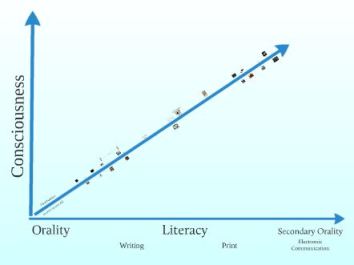
In the event that it may be of interest to someone out there, here is a visualization I put together using Prezi of Ong’s argument (supplemented by some additional information).  Once you’ve clicked over to the site, click the forward arrow to move through the presentation.