The View from 1907: Begging for an Update

Leo Marx, a distinguished historian of technology with no relation to Karl or the brothers as far as I know, writes the following in a 2010 article* exploring the history “technology” as a concept:

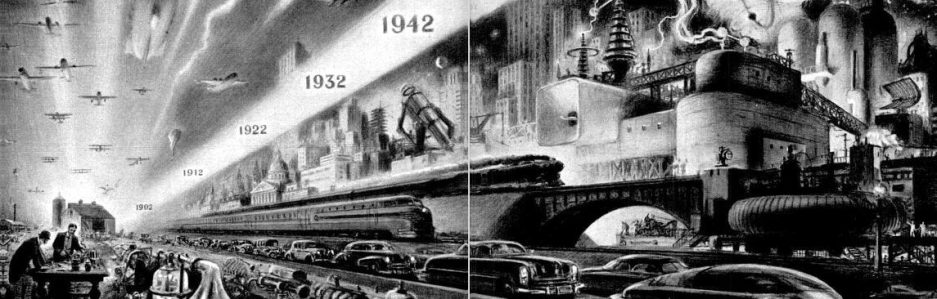
Henry Adams gives a particularly vivid, telling account of this sudden, unprecedented acceleration of the rate of change—and its consequences—in The Education of Henry Adams (which he first published privately in 1907). Here he announces the appearance of what he takes to be a uniquely empowered human being, an American “born since 1900”:

the child of incalculable coal-power, chemical power, electric power, and radiating energy, as well as new forces yet undetermined—[and who] must be a sort of God compared with any other former creation of nature. At the rate of progress since 1800, every American who lived to the year 2000 would know how to control unlimited power. He would think in complexities unimaginable to an earlier mind.

This begs to be evaluated in light of how the 20th century played out, and it also invites us to imagine an updated version for the American “born since 2000.”

Any takers?

_________________________________________________________________

*I can email a PDF of the article if anyone is interested.

Resisting Disposable Reality, II: The Pen

Consumerism, together with the technology it drives, generates disposable reality. That was my conclusion in a post a few months back that synthesized some insights drawn from William Cavanaugh and Albert Borgmann. In that same post I suggested that the book was an instance of resistance to disposable reality as it is very often purchased and kept, sometimes for a lifetime. This is one important way in which e-books differ from traditional print books.

Since then I’ve had the lingering idea of documenting similar instances of resistance to disposable reality, and this past Sunday morning one such instance presented itself on CBS’s morning show. A short four and a half minute segment profiled Richard Binder, a former computer programmer who devoted himself to the care and repair of pens. Not the disposable kind, of course, and that is the point. These are mostly fountain pens and have in some instances been handed down from one generation to the next. It may come as a surprise to learn that Binder has a four month back-log of work.

Naturally, it is about more than a pen, it is about what we might call the culture of the pen that includes the care of the pen, the memories it carries, and the practice of writing it supports. To borrow Borgmann’s terminology, these are the focal practices that gather around the commanding presence of the pen as a focal thing (read the original post for a translation). Taken together they suggest a posture toward lived experience that is radically at odds with the culture of disposable reality. And resistance to disposable reality may yet help us calibrate the pace of our lives to a more humane rhythm.

Enjoy the clip below and feel free to send my way any instances of resistance to disposable reality that cross your path.

[Update: Clip has since been taken down.]

Midnight in Paris: Learning to Live With the Past

The past may be a foreign country where they do things differently as the L. P. Hartley line has it, but it is one to which many would readily immigrate given the opportunity. If you are among them, Woody Allen’s Midnight in Paris will likely enchant and delight you. (Warning: some spoilers ahead.) Gil, the main character played charmingly by Owen Wilson, and his fiancée tag along with her parents who have come to Paris on a business trip. She and her parents are crassly materialistic, he is a romantic — a romantic in love with the city, particularly its Jazz Age past. Having been a successful, but disenchanted Hollywood film writer he is determined to write real literature, even if it means surrendering the upscale lifestyle his fiancée craves. While they shop for chairs that cost as much as a moderately priced four-door sedan, he frequents outdoor shops that sell vintage vinyl records and works on his novel about a man who owns a nostalgia shop. The theme of his would-be novel tracks closely with Gil’s own sensibilities. He obsesses over the past and its artifacts, and his obsession is an index of his dissatisfaction with the present.

Without even a gesture toward explantation, and all the better for it, a vintage Peugeot filled with revelers stops to pick up Gil just after a clock has struck midnight. Gil, with some hesitation, joins the merry crowd and finds himself transported back to the 1920’s and the Paris of his dreams. Endearingly awestruck throughout the experience, he meets the Fitzgeralds, Hemingway, Gertrude Stein, T. S. Eliot, Picasso, Dali, Cole Porter, and a host of other luminaries just entering into the fullness of their legend. Each night he rides into the past, and each morning he finds himself again in the present, a progressively unfulfilling present.

When he is in the past, Gil comes alive. The characters are inspired: Adrien Brody plays a delightfully quirky Salvador Dali and Corey Stoll is almost absurdly intense as Hemingway. Kathy Bates’ Gertrude Stein provides Gil with straightforward counsel regarding life and writing. Gil, as he becomes increasingly at ease in the past, offers Luis Buñuel a suggestion for a film in which guests find themselves unable to leave a room. Buñuel, perplexed, wonders why they cannot simply walk out.  He also finds in Picasso’s lover Adriana, a woman who stirs his heart and a kindred spirit. Simply put, the past rekindles Gil’s passion.

Yet, Allen finally wants to critique nostalgia and reaffirm the present. The film builds up to an overly didactic moment when Gil, realizing that he cannot remain in the past indefinitely, launches into a not quite moving appreciation of the present. Allen foreshadows the moment throughout the film. While delivering one of his impromptu lectures, Paul, a pedantic intellectual and friend of Gil’s fiancee, pontificates about the “Golden Age Fallacy,” the unsubstantiated belief that the greatness  of some prior historical era eclipses the present, a chronological version of the grass is always greener. The character of Adriana is herself unimpressed with the ’20s and nostalgic for 1890s Paris, La Belle Époque. When Gil and Adriana, Inception-like, delve even further into the past via horse-drawn carriage they meet up with Degas, Gauguin, and Toulouse-Lautrec just as La Belle Époque commences.  But we find those  artists similarly dismissive of their own age believing it pales in comparison with the Renaissance. And it is then that Gil realizes the futility of inordinately longing for another age.

He returns to the present, reorders his life, and walks off happily ever after in the Paris rain. And we, likewise, leave the theater, returning to our own present, cured of our nostalgic longings, and determined to seize the moment. Yet, the film lingers in our minds and as we revisit it, we find ourselves charmed. It works its magic as we turn it over in our memory. Wasn’t the “Golden Age Fallacy” introduced by the most unlikeable, pompous character in the film? Wasn’t the past portrayed in delightful, vivacious, enchanting fashion? Wasn’t Gil, in fact, nourished and invigorated by his dalliances with the past? While Gil chose to return to his present, did not Adriana choose to stay in La Belle Époque? Finally, wasn’t Gil’s other climatic epiphany (that I will not spoil) revealed in the past?

Certainly, the past is shown to be complex and disordered in its own way. In one of the few more sober scenes, Gil and Adriana, on a moonlit stroll through the city, come upon Zelda Fitzgerald very near to taking her own life. Yet, even here there is ambiguity. Gil offers Zelda Valium which we learn he has been taking to cope with the anxieties of an impending wedding. Are we to conclude that while the past bequeaths great art and literature to the present, the best the present can offer the past is Valium? Not quite I suppose, I do recall penicillin also being mentioned at some point.

Midnight in Paris takes nostalgia as its theme, but the difficulty with any exploration of nostalgia is that in common usage the word indiscriminately names too many sensibilities, unfortunately dismissing appropriate and enriching ways of being with the past. Altogether, the film helpfully suggests that there is more than one way to have a disordered relationship to the past. We may succumb to the “Golden Age” fallacy and refuse the present, or we might also reject the past altogether uprooting ourselves from that which gives depth of field to lived experience. While Gil chooses the present, it is clear that the past nourished and educated him. While he has chosen not to live in the past, he has not abandoned it either. He will not live in it, but he will live with it.

It was Buñuel who wrote in his autobiography,

You have to begin to lose your memory, if only in bits and pieces, to realize that memory is what makes our lives.  Life without memory is no life at all …  Our memory is our coherence, our reason, our feeling, even our action.  Without it, we are nothing.

Thus we may turn the commonplace on its head and suggest that the past is the only place we can live.
Neil Postman, Technopoly, and Technological Theology

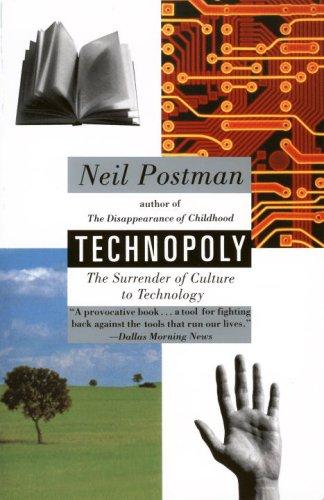
Early in his book Technopoly, Neil Postman presents a helpful summary of the variety of schema or classifications offered by historians for the history of the relationship of technology to culture:

We think at once of the best-known classification:  the Stone Age, the Bronze Age, the Iron Age, the Steel Age.  We speak easily of the Industrial Revolution, a term popularized by Arnold Toynbee, and, more recently, of the Post-Industrial Revolution, so named by Daniel bell.  Oswald Spengler wrote of the Age of Machine Technics, and C. S. Peirce called the nineteenth century the Railway Age.  Lewis Mumford, looking at matters from a longer perspective, gave us the Eotechnic, the Paleotechnic, and Neotechnic Ages.  With equally telescopic perspective, Jose Ortega y Gasset wrote of three stages in the development of technology:  the age of technology of chance, the age of technology of the artisan, the age of technology of the technician.  Walter Ong has written about Oral cultures, Chirographic cultures, Typographic cultures, and Electronic cultures.  McLuhan himself introduced the phrase “the Age of Gutenberg” (which, he believed, is now replaced by the Age of Electronic Communication).

A lot is packed into that paragraph, and if we were to go on and read each of these scholars in order to understand their classifications we would end up with an impressive grasp on the relationship of technology to culture. To these Postman adds his own schema.  He divides cultures into three types:  tool-using cultures, technocracies, and technopolies. Here is a quick overview for your consideration:

In a tool-using culture according to Postman, tools were “largely invented to do two things”:  “solve specific and urgent problems of physical life” and “serve the symbolic world of art, politics, myth, ritual, and religion …” Additionally, “in a tool-using culture technology is not seen as autonomous, and is subject to the jurisdiction of some binding social or religious system.”

In a technocracy, society is “only loosely controlled by social custom and religious tradition” and it is “driven by the impulse to invent.” A technocracy, however, “does not have as its aim a grand reductionism in which human life must find its meaning in machinery and technique.  Technopoly does.”

Technopoly, in Postman’s most succinct formulation, features “the submission of all forms of cultural life to the sovereignty of technique and technology.”  Postman took the assumptions informing Frederick Taylor’s The Principles of Scientific Management to be more less the assumptions of the “thought-world of Technopoly.” These included the following beliefs:

  • “the primary, if not the only, goal of human labor and thought is efficiency”
  • “technical calculation is in all respects superior to human judgment”
  • “human judgment cannot be trusted because it is plagued by laxity, ambiguity, and unnecessary complexity”
  • “subjectivity is an obstacle to clear thinking”
  • “what cannot be measured either does not exist or is of no value”
  • “the affairs of citizens are best guided and conducted by experts.”

Ironically, in Postman’s view, these assumptions amount to a “technological theology.”  In other words, while traditional theologies which governed tool-using cultures are displaced in a technocracy, in a  Technolopy a governing ideology in the mode of theology is reintroduced to order society. The function of theology has not been eradicated, it has just been reconfigured, which rather reminds me of a Dylan tune:

But you’re gonna have to serve somebody, yes indeed
You’re gonna have to serve somebody
Well, it may be the devil or it may be the Lord
But you’re gonna have to serve somebody.

I’ll leave the applications to you.

McLuhan: 100

The medium is the message … five words, plump and alliterative though they may be, are wildly inadequate … he was born in Edmonton, Alberta on July 21, 1911 … He speaks in canned riddles … Speech as organized stutter is based on time. What does speech do to space? … “Clear prose indicates the absence of thought” … Watching McLuhan, you can’t quite decide whether he was a genius or just had a screw loose … he gave us language that made “media” into a thing …

It feels wistful to imagine a time when people didn’t go about their daily routine with the assumption that at any moment another massive media technology will be dumped on us by some geek in California … “I’m going to be a computer when I grow up” …

“What if he is right”? … “Instead of the book as a fixed package of repeatable and uniform character suited to the market with pricing, the book is increasingly taking on the character of a service … and the book as an information service is tailor-made and custom-built” … First of all – and I’m sorry to have to repeat this disclaimer – I’m not advocating anything … “The next medium, whatever it is – it may be the extension of consciousness – will include television as its content, not as its environment” …

an alchemical mix of his vast historical and literary knowledge, his bombastic personality and a range of behaviors we might now place on the very mild end of the autistic spectrum … McLuhan’s mind was probably situated at the mild end of the autism spectrum. He also suffered from a couple of major cerebral traumas …

First, that McLuhan never made arguments, only assertions … a fixture of culture both nerd and pop, which are increasingly the same thing. He is the patron saint of Wired … what mattered was merely the fact that you were watching TV. The act of analysing the content of TV – or of other mediums – is either sentimental or it’s beside the point … Annie Hallthe fastest brain of anyone I have ever met, and I never knew whether what he was saying was profound or garbage… He wanted his words to knock readers out of their intellectual comfort zones, to get them to entertain the possibility that their accepted patterns of perception might need reordering ..McLuhan was an information canary …

“He writes by paradox — that makes him hard to read (or hard on the reader),” wrote McLuhan … he loved Chesterton’s rhetorical flourishes, imbibed his playfulness, turned his impulse to try out new combinations of ideas into the hallmark of the McLuhan method … He became a daily Mass-goer …

There is absolutely no inevitability … what will be the psychic fallout of these technologies on our inner lives? … Like Marx and Freud, he was an intellectual agitator, a conceptual mind expander, the yeast in the dough …  James Joyce and Ezra Pound especially … The web. The web, with its feeds and flows and rivers and streams … That kaleidoscopic, almost psychedelic style … In that Playboy interview … a celebrity-seeking charlatan …

lost all hope “that the world might become a better place with new technology” …  people who classify McLuhan as a techno-utopian aren’t simply making stuff up … Resenting a new technology will not halt its progress … Many people seem to think that if you talk about something recent, you’re in favor of it … And so eschatological hope appears as nothing more than an early manifestation of cyber-utopianism … Look at what these media are doing to our souls … “Once we have surrendered our senses and nervous systems to the private manipulation of those who would try to benefit by taking a lease on our eyes and ears and nerves, we don’t really have any rights left” …

Your question reflects the usual panic of people confronted with unexplored technologies. I’m not saying such panic isn’t justified … merely that such reactions are useless and distracting … “Man the food-gatherer reappears incongruously as information-gatherer” … But an understanding of media’s effects constitutes a civil defense against media fallout … someone who didn’t just have strong ideas but who invented a whole new way of talking … all a teacher can ever do is get people to think …

outlived his fame … he died in a state of wordlessness …

That’s what McLuhan did.

_______________________________________________________________________

In case it is not apparent, only a very few of these words are mine.  Sources:

Webs and whirligigs:  Marshall McLuhan in his time and ours by Megan Garber
Why McLuhan’s chilling vision still matters today by Douglas Coupland
McLuhan at 100 and McLuhan on the Cloud by Nicholas Carr
Why Bother With Marshall McLuhan by Alan Jacobs
Divine Inspiration by Jeet Heer
Marshall McLuhan:  Escape into Understanding by W. Terrence Gordon
McLuhan, Chesterton, and the Pursuit of Joy
McLuhan as Teacher by Walter Ong