More Work For Teacher: The Ironies of Educational Technology

In 1983, Ruth Schwartz Cowan published a seminal work in the social history of technology, More Work for Mother: The Ironies of Household Technology from the Open Hearth to the Microwave, in which she dismantled the seemingly commonsensical notion that the introduction of modern household technologies radically unburdened the average housewife.

Cowan’s book tackles three related but distinct phenomena: the history of household technologies (and to a lesser extent the systems that support them), the social factors that shaped their development and adoption, and the evolution of gender roles. To borrow an analogy, the household is not unlike a complex ecosystem. The introduction of a new factor, such as a new technology, is bound to have multiple consequences, some paradoxical and some unintended, and its absorption into the ecosystem will be shaped by existing conditions. New household technologies entered an ecosystem in which existing gender-based divisions of labor, for example, meant that initially men were relieved of more (household) work than women. The household ecosystem is also shaped by socially constructed expectations such as those disseminated by popular magazines and, later, television programming. As some tasks were made more efficient and less arduous by certain technologies, popular media tended to create expectations which undermined those gains.

In the following paragraph, Cowan gives as concise an overview of her argument as one could hope for:

“Some of the work that was eliminated by modernization was work that men and children — not women — had previously done: carrying coal, carrying water, chopping wood, removing ashes, stoking furnaces, cleaning lamps, beating rugs. Some of the work was made easier, but its volume increased: sheets and underwear were changed more frequently, so there was more laundry to be done; diets became more varied, so cooking was more complex; houses grew larger, so there were more surfaces to be cleaned. Additionally, some of the work that, when done by hand had been done by servants, came to be done by the housewife herself when done by machine …. Finally, some of the work that had previously been allocated to commercial agencies actually returned to the domain of the housewife — laundry, rug cleaning, drapery cleaning, floor polishing — as new appliances were invented to make the work feasible for the average housewife …”

More Work for Mother remains a classic in the field and deservedly so. It reminds us of how much can be obscured by our collective historical memory. It also suggested to me what might be the title for a companion volume: More Work for Teacher.

The assumption that new technologies make things easier certainly applies to more than just housework. In the case of education, technology may not so explicitly present itself as labor saving, but it does typically present itself as an unalloyed enhancement of the classroom while the question of labor remains surprisingly muted. In my own experience, the introduction of the new technologies almost always leads to more labor for the teacher that is hardly ever acknowledged, much less compensated.

Just to be clear — because I certainly don’t want to come off as a coddled, whiny teacher that is simply resistant to change and hard work — this is not intended as a critique of educational technology in general, nor is my point that teachers are overworked and underpaid, true as that may often be. My point is simply to make an observation and to draw attention to what seems to me to be an insufficiently commented upon dimension of educational technology.

Consider the introduction of online educational platforms used by schools to post homework, grades, and other class related materials. These platforms, on the whole, increase the teacher’s workload by requiring the teacher not only to announce homework and post it in the classroom, but now also to post it online. This may seem like a small thing, but consider a high school teacher who teaches six sections a day and must go through the several steps necessary to enter in homework for all six classes each day. Depending on the software, this is often a less than user-friendly or streamlined experience.

These platforms also tend to generate what may gently be termed heightened grade awareness on the part of a small number of parents and students. Again, don’t misunderstand me,  we do want students and parents to care about learning. But, for one thing, caring about grades is not always synonymous with caring about learning, and there does come a point when one more email interrogation regarding the reason for an A- rather than A gets a bit old.

Teachers in the past were asked to tabulate their grades at the middle and end of the quarter, now they are expected to keep grades up to date to the day, in some cases to the hour. But, you may ask, raising a skeptical eyebrow, don’t these platforms typically tabulate the grades for you? Yes, but teachers have to record them and this again amounts to added time because, in my experience anyway, a teacher is asked to keep both a hard copy and online grade book. Again, not a huge amount of time considered independently, but we’re concerned with the aggregated total.

The matter of emails alluded to earlier is also worth mentioning. Teachers are now asked to field emails from parents, students, and administrators and as anyone who receives a heavy volume of emails knows, this is not necessarily arduous work, but it is, once again, time-consuming. Ironically, these email sometimes involve questions regarding assignments that had been explained in class and also described online.

If in class lessons are expected to take advantage of available technologies, projectors or smart boards for example, then more time is added to the planning of each lesson. Again, this is not a commentary on the effectiveness or desirability of technologically augmented lessons; it is only to point out the added time requirements.

Some teachers I know are also expected to post summaries of lessons online or create and post podcasts of each class. Wonderful perhaps, we’ll let the efficacy of all of this go for the purpose of this post, but again time consuming. All the while remember that the work of grading, preparing lessons, tutoring, staying after school to help students, myriad administrative duties, extra-curricular responsibilities, committee and faculty meetings, keeping up with the field — all of the typical work that teachers are expected to do, and much of which more often then not gets taken home and worked on over the weekends — none of this goes away, more work just gets added to it.

Most of these observations have been made with the high school teacher in mind. The college instructor may face similar circumstances with the additional possibility of being expected to teach online classes. These classes, much like household technologies, may appear to be more convenient. The teacher doesn’t have to go to a physical class two or three times a day, all of the work can be done from the office or even the home. But the amount of work that goes into setting up an online class, or at least setting it up well, is not at all insubstantial. And the maintenance of a class throughout the semester, again if it is done well, takes considerable more time than showing up to class two or three times a week. In large measure this is due to what must be done online to compensate for the absence of face to face time. Usually this amounts to online “discussion” and this means faculty members read and perhaps comment on student posts throughout the week. In a class of thirty, say, in which students are expected to post and respond to other students twice a week, this quickly adds up to over a hundred posts a week, and often much more.

Cowan wrote More Work for Mother to scrutinize the assumption that new technologies made life easy, simple, and unambiguously better for housewives. Her scrutiny revealed that such was simply not the case. I’ve written this post because teachers are encouraged or pressured from several directions to incorporate more and more technology into the classroom. The most important question to ask is whether or not the particular technologies actually enhance learning. Not far behind, however, is the question of time and labor. What sorts of demands have new technologies placed on teachers who already are expected to do a good deal of off the clock work? And because time is ultimately a finite resource during a school week, what is being crowded out by the aggregated  time demands of educational technologies?

If you’re a teacher, I’d love to hear your thoughts. Does this ring true, or is there more to the story? On balance, how would you evaluate the demands of technology on your time in and out of the classroom?

And to wrap it up on a positive note, here’s a little inspiration via Taylor Mali:
Leo Marx and Jacques Ellul on Technological Determinism

My post earlier today alluded to a long standing debate regarding the personal and social consequences of technology. It is usually described as a debate about technological determinism, a phrase that’s been thrown around in these pages often enough, usually to indicate that I don’t espouse the theory it names while I, at the same time, find its polar opposite likewise inadequate. While the poles of this spectrum — and it is a spectrum of opinion, not a binary opposition — may be clear enough, I thought it might be useful to take a brief look at a two individuals who have articulated these poles rather clearly and forcefully — American historian Leo Marx and the late French sociologist Jacques Ellul.

“Technology,” Leo Marx warned in a recent essay in Technology and Culture, is a hazardous concept. In his 2010 essay, Marx explored the history of “technology” as a concept arguing that it arose to fill a linguistic void created by the emergence, in the 19th century, of sociotechnical systems that could no longer be adequately described by the existing repertoire of terms that included “machinery,” “the mechanical arts,” “the useful arts,” “improvement,” and “invention.” Already, by the mid-19th century, such constructions seemed inadequate and even quaint. Marx consequently concludes that “technology” is one of those keywords, such as “culture” in Raymond Williams analysis, that reflexively index the historical situation in which they rose to prominence. It is not until the close of Marx’s essay, however, that we learn wherein the hazard lies.

In his view, the generality of the term “technology” which made it particularly serviceable in characterizing the emerging components of what Thomas P. Hughes has aptly called the human-built world, also rendered the term “peculiarly susceptible to reification.” The problem with reified phenomenon, Marx warns citing George Lukacs, is that it acquires “a ‘phantom-objectivity,’ an autonomy that seems so strictly rational and all-embracing as to conceal every trace of its fundamental nature: the relation between people.” This false aura of autonomy leads in turn to “hackneyed vignettes of technologically activated social change—pithy accounts of ‘the direction technology is taking us’ or ‘changing our lives.'” According to Marx, such accounts are not only misleading, they are also irresponsible. By investing “technology” with causal power, they distract us from “the human (especially socioeconomic and political) relations responsible for precipitating this social upheaval.” It is these relations, after all, that “largely determine who uses [technologies] and for what purposes.” And, it is the human use of technology that makes all the difference, because, as Marx puts it, “Technology, as such, makes nothing happen.”

It is finally a moral and political concern that Marx seeks to register. Speaking of “technology,” he writes:

“We have made it an all-purpose agent of change. As compared with other means of reaching our social goals, the technological has come to seem the most feasible, practical, and economically viable. It relieves the citizenry of onerous decision-making obligations and intensifies their gathering sense of political impotence. The popular belief in technology as a—if not the—primary force shaping the future is matched by our increasing reliance on instrumental standards of judgment, and a corresponding neglect of moral and political standards, in making judgments about the direction of society. To expose the hazards embodied in this pivotal concept is a vital responsibility of historians of technology.”

Altogether, Marx presents the reader with a compelling critique of technological determinism wrapped within an essay that is mostly engaged in the task of semantic archeology. One would be hard pressed to find a more strongly worded defense of human agency in relation to technology, and this is why it is useful to begin with Marx. In the debate between technological determinism and technological voluntarism, Marx compellingly and articulately represents the latter.

To find an equally provocative and rhetorically charged defense of the autonomy of technology we’ll turn to the writing of the late Jacques Ellul. In The Technological System, Ellul insisted on the autonomy of technology which he took to mean that

“… technology ultimately depends only on itself, it maps its own route, it is a prime and not a secondary factor, it must be regarded as an “organism” tending toward closure and self-determination: technology is an end in itself.”

When Marx laments “our increasing reliance on instrumental standards of judgment, and a corresponding neglect of moral and political standards, in making judgments about the direction of society,” we can safely imagine Ellul retorting that this is precisely the work of technology bending society to its own logic.

Ellul, like Marx, was also concerned with the moral and political consequences of his position, and it was at this point that he most vigorously pressed the case for the autonomy of technology. No doubt the state makes decisions about technology, but who, Ellul invites us to ask, are the ones making these decisions? Technicians in the thrall of the technological system. Moreover, Ellul believes that the technological system “does not endure any moral judgement.” Rather, “a moral proposition will not be deemed valid for our time if it cannot enter the technological system and be consistent with it.” Furthermore, according to Ellul, the technological system disrupts traditional morality only then to establish its own governing principles as a new ethic.

Ellul and Marx express two opposing views regarding the relationship between technology and human agency. Their positions stand in conveniently for the opposite poles of a spectrum of opinion. Despite his concerns with the rise of rhetoric which tends to attribute agency to “technology,” popular opinion may very well be on Marx’s side. An NRA style, “guns don’t kill people, people kill people” approach seems to hold sway. A “technology made me do it” defense of action would likely garner little sympathy. There is, after all, something powerfully intuitive about the claim that ultimately it is individuals who make choices regarding the use of technology, and that such choices are not coerced. Yet, the rhetoric that attaches agency to technology cannot be wholly dismissed either. That it is so readily employed suggests that at some level it too attains a certain plausibility. It is not unusual to feel as if, against Thoreau’s advice, we are becoming tools of our tools.

And so it was in an effort to explore mediating possibilities that I wrote my earlier post, certainly not as a definitive resolution, but as one way of thinking about technology that seeks to escape the poles of the spectrum.

Weekend Reading, 10/22/11

Happy Saturday morning! For your reading pleasure: studies on the effects of video games and television; quantum stuff; a little history; and reflections on computing, ethics, and the future.

These first two links will warm the old curmudgeon’s heart. Some studies had suggested that video games bore certain cognitive benefits (although even those seemed to me less than significant), but our first report is of a study that claims those earlier studies were deeply flawed. The second report is perhaps of a more serious nature and it points to the potentially negative side-effects of early exposure to television. The jury is still out on the iPad and similar devices, but caution seems to be in order.

“Video Game Studies Have Serious Flaws” by Mo Costandi in Nature News.

“It’s Official: To Protect Baby’s Brains, Turn Off TV” by Brandon Keim at Wired.

The next two pieces delve into the quantum world. I don’t pretend to understand it, but both these links provided some interesting stuff to think about … or just be impressed by, make sure to check out the video.

“Quantum Levitation” from scholars at Tel Aviv University on YouTube: Very cool. Not at all sure what the applications may finally be, but suggestively it was funded in part by Israel’s ministry of Infrastructure.

“Quantum Life: The Weirdness Inside Us” by Michael Brooks at New Scientist: While we’re on the quantum theme, here is an article that discusses some recent attempts to explore quantum biological effects. 

From quantum mechanics to a more philosophical exchange on the meaning of computing:

“Information Is Cheap, Meaning is Expensive,” George Dyson interviewed at The European: Dyson offers his take on the evolution of computing, ethics in a technological age, and how best to face future. “Information is cheap, but meaning is expensive. Where is the meaning? Only human beings can tell you where it is.”

And finally two pieces going back in the history of technology to a famous rivalry and the building  of an American technological marvel.

“Edison v. Westinghouse: A Shocking Rivalry” by Gilbert King at Smithsonian.com: Short piece retelling the story of Edison and Westinghouse, the competition over electric current (AC/DC), and the (intentional) electrocution of dogs, animals, and men.

“Construction of the Hoover Dam” photographs at The Denver Post: Fascinating photographs documenting the construction of the Hoover Dam, one of America’s technologically sublime marvels.

The Art Inspired by the Religion of Technology

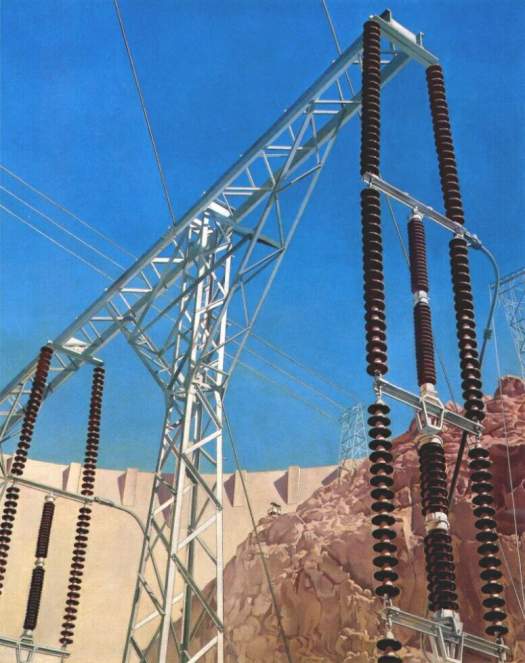
The American painter Charles Sheeler was contracted by Fortune magazine to create a series of paintings that captured the power and majesty of American technology. Nye describes Sheeler’s paintings as follows:

Like many artists of his generation, Charles Sheeler explored the apparent omnipotence of industrialization. In six paintings commissioned by Fortune he depicted the central objects of the technological sublime: the water wheel, the railroad, electrification, and flight. Martin Friedman has observed of the series: ‘Sheeler always depicted power at absolute stasis. In his hermetic visualizations, power is not treated in terms of crashing strength but as an intellectualized concept with its mechanisms always in mint condition.’ The immobility of these paintings creates a tension between the static forms and the reader’s knowledge that all these objects move at great speed. Published together in a single issue of Fortune, Sheeler’s images were presented like a photographic essay. The accompanying text asserted: ‘The heavenly serenity of Sheeler’s style brings out the significance of the instruments of power he portrays here … He shows them for what they truly are: not strange, inhuman masses of material, but exquisite manifestations of human reason.'”

“Heavenly serenity” was not the only religiously inflected language to appear in the text. Here is another portion of the text, cited by Nye, that accompanied Sheeler’s paintings:

“What is this incredible, elusive power that man has taken so magnificently from the waters and the hills? What unguessed secrets of the universe are hinted by its transmission unchanged through unchanging strands of copper or aluminum? In what way have men’s minds, grappling with the raw phenomena of lightning and magnetism, managed to contrive so swift and carefully guarded a channel for a force that no one can fully apprehend? … It is not surprising that the modern scientist, confronted with such questions and with their partial answers, which open up still further questions, should often be a man of deep religious feeling. And it is not surprising either that the modern artist, depicting such a scientist’s handiwork, should put a devout intensity into the painting. This is as truly a religious work of art as any altarpiece, or stained-glass window, or vaulted choir.”

This further points to the entanglement of religion and technology explored by historian David Noble among others. It also suggests to me that while some have referred to the 1930s as America’s most irreligious decade, coming on the heals of the Scopes Trial debacle and fed by H. L. Menken’s acerbic wit, this may be a mischaracterization. It may be better to suggest that in the 1930s the religious impulse was more thoroughly displaced onto technology and its possibilities. Although as Nye’s study of the American technological sublime makes clear, this was a displacement that had long been in the making.

Below is one of the Sheeler’s paintings that appeared in Fortune. Another is included in the preceding post. You can see the whole spread by following the link in the first paragraph.

Conversation -- Sky and Earth

American Technological Sublime: Our Civil Religion

David Nye, the author of Electrifying America which I cited a handful of times in the past month or so, is also the author American Technological Sublime (1995), a classic work in the history of technology. Except that it is not a work of history in the strict disciplinary sense. Nye draws promiscuously from other fields — citing for example Burke, Kant, Durkheim, Barthes and Baudrillard among others — to present a wide ranging and insightful study into the American character.

The concept of the technological sublime was not original to Nye. It had first been developed by Perry Miller, a prominent mid-twenieth century scholar of early American history, in his study The Life of the Mind in America. There Miller noted in passing the almost religious veneration that sometimes attended the experience of new technologies in the early republic.

Miller found that in the early nineteenth century “technological majesty” had found a place alonside the “starry heavens above and the moral law within to form a peculiarly American trinity of the Sublime.” Taking the steamboat as an illustration, Miller suggests that technology’s cultural ascendancy was abetted by a decidedly non-utilitarian aspect of awe and wonder bordering on religious reverence. “From the beginning, down to the great scenes of Mark Twain,” Miller explains, “the steamboat was chiefly a subject of ecstasy for its sheer majesty and might, especially for its stately progress at night, blazing with light through the swamps and forests of Nature.”

Leo Marx, who I’ve also mentioned here of late, also employed the technological sublime, but again in passing. It fell to David Nye, a student of Marx’s, to develop a book length treatment of the concept. Nye looks to Edmund Burke and Immanuel Kant in order fill out the concept of the sublime, but it is apparent from the start that Nye is less interested in the philosopher’s solitary experience of the sublime in the presence of natural wonders than he is in the popular and often collective experience of the sublime in the presence of technological marvels.

Nye, with a historian’s eye for interesting and compelling sources, weaves together a series of case studies that demonstrate the wonder, awe, and not a little trepidation that attended the appearance of the railroads, the Brooklyn bridge, the Hoover Dam, the factory, skyscrapers, the electrified cityscape, the atomic bomb, and the moon landing. Through these case studies Nye demonstrates how Americans have responded to certain technologies, either because of their scale or their dynamism, in a manner that can best be described by the category of the sublime. And perhaps more importantly, he argues that this experience of the technological sublime laced throughout American history has acted as a thread stitching together the otherwise diverse and divided elements of American society.

If the philosophers provided Nye with the terminology to name the phenomenon, he takes his interpretative framework from the sociologists of religion. Nye’s project is finally indebted more to Emile Durkheim than to either Burke or Kant. Nye notes early on that “because of its highly emotional nature, the popular sublime was intimately connected to religious feeling.” Later he observes that the American sublime was “fused with religion, nationalism, and technology” and ceased to be a “philosophical idea” instead it “became submerged in practice.”

This emphasis on practice is especially important to Nye’s overall thesis and it is on the practices surrounding the technological sublime that he concentrates his attention. For example, with each new sublime technology he discusses, Nye explores the public ceremonies that attended its public reception. The 1939 World’s Fair, to take another example, appears almost liturgical in Nye’s exposition with its carefully choreographed exhibitions featuring religiously intoned narration and a singular vision for a utopian future.

This attention to practices and ceremonies was signaled at the outset when Nye cited David Kertzer’s “Neo-Durkheimian view” that “ritual can produce bonds of solidarity without requiring uniformity of belief.” This functionalist view of religious ritual informs Nye’s analysis of the technological sublime throughout. In Nye’s story, the particular technologies are almost irrelevant. They are significant only to the degree that they gather around themselves a set of practices. And these practices are important to the degree that they serve to unify the body politic in the absence of shared blood lines or religion.

All told, Nye has written a book about a secular civil religion focused on sublime technologies and he has presented a convincing case. Absent the traditional elements that bind a society together, the technological sublime provided Americans a set of shared experiences and categories around which a national character could coalesce.

Nye has woven a rich, impressive narrative that draws technology and religion together to help explain the American national character. There’s a great deal I’ve left out that Nye develops. For example: the evolving relationship of reason to nature and technology as mediated through the sublime or the diminishing active role of citizens, and especially laborers, in the public experience of the technological sublime. But these, in my view, are minor threads.

The take-away insight is that Americans blended, almost seamlessly, their religious affections with their veneration for technology until finally the experience of technology took on the unifying role of religion in traditional societies. Historically American’s have been divided by region, ethnicity, race, religion, and class. American share no blood lines and they have no ancient history in their land. What they have possessed, however, is a remarkable faith in technological progress that his been periodically rekindled by one sublime technology after another all the way to the space shuttle program and its final mission.

The question I’m left with is this: What happens when the technological sublime runs dry? As Nye points out, it is, unlike the natural sublime, a non-renewable sublime. In other words, the sublime response wears off and must find another object to draw it out. If Nye is right — and I do think it is possible to overreach so I want to be careful — there is not much else that serves as well as the technological sublime to bind American society together. Perhaps then, part of our recent sense of unraveling, our heightened sense of disunity, the so called culture wars — perhaps these are accentuated by the withdrawal of the technological sublime. Perhaps, but that would take another book to explore.

“Suspended Power”