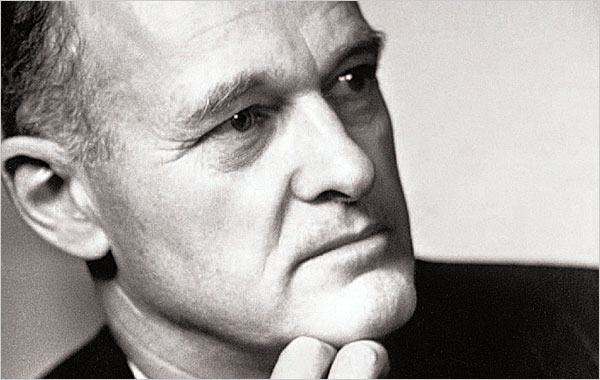
Remembering George Kennan

Early on in the life of this blog I wrote a couple of posts referencing George Kennan, the American diplomat and scholar who played a seminal role in the evolution of American foreign policy in the years following the close of the Second World War. Kennan’s “Long Telegram,” for example, is generally considered to be the ur-text of containment, even if Kennan later disavowed its application. Kennan’s influence later permeated the State Department under George C. Marshall. After the Truman administration, Kennan would serve from time to time in an advisory capacity but largely as an outsider — a status he keenly felt.

In the second of those posts last summer I noted the following observation from a review of Peter Beinhart’s The Icarus Syndrome: A History of American Hubris:

Kennan once set out to write a biography of Chekhov; as Beinart dryly observes, “Bush sent a man to run Iraq, L. Paul Bremer, who had never before been posted to the Arab world. To grasp the intellectual chasm between American foreign policy toward the U.S.S.R. in 1946 and American foreign policy toward Iraq in 2003, one need only try to envision Bremer writing a biography of an Iraqi writer, or, for that matter, being able to name one.”

Perhaps I may be forgiven for a certain nostalgic and perhaps romanticized longing for a foreign policy team that featured George C. Marshall and Dean Acheson along with George Kennan. Acheson, Kennan, and four other contemporaries feature in Walter Isaacson and Evan Thomas’ The Wise Men: Six Friends and the World They Made. And Kennan is the subject of a new biography by John Lewis Gaddis, dean of Cold War studies, titled George F. Kennan: An American Life.

It’s doubtful that I’ll get a chance to read Gaddis’ book any time soon, so I am glad for two long reviews that have appeared to give a taste of the whole: Louis Menand’s review in the New Yorker and Henry Kissinger’s in the NY Times. Here is the conclusion of Menand’s review:

“Still, buried within Kennan’s realism there is a moral view: that in relations of power, which is what he thought international relations ultimately are, people can’t be trusted to do the right thing. They will do what the scorpion does to the frog—not because they choose to but because it’s their nature. They can’t help it. This is an easy doctrine to apply to other nations, as it is to apply to other people, since we can always see how professions of benevolence might be masks for self-interest. It’s a harder doctrine to apply to ourselves. And that was, all his life, Kennan’s great, overriding point. We need to be realists because we cannot trust ourselves to be moralists.

This was the danger that the United States faced after Europe had destroyed itself in the Second World War. We had power over other nations to a degree unprecedented in our history, possibly in the world’s history, and it was natural for us to conclude that we deserved it. “Power always thinks it has a great soul,” as another Adams, John, once said. Containment was intended as a continual reminder that we do not know what is best for others. It is a lesson to be ignored only with humility.”

And this from Kissinger’s:

“In a turbulent era, Kennan’s consistent themes were balance and restraint. Unlike most of his contemporaries, he applied these convictions to his side of the debate as well. He testified before the Senate Foreign Relations Committee against the Vietnam War but on the limited ground that there was no strategic need for it. He emphasized that the threat posed by Hanoi was exaggerated and that the alleged unity of the Communist world was a myth. But he also warned elsewhere against ‘violent objection to what exists, unaccompanied by any constructive concept of what, ideally ought to exist in its place.’ He questioned the policy makers’ judgment but not their intent; he understood their dilemmas even as he both criticized and sought to join them.”

It is too easy to idealize historical figures after the more jagged edges of their performance on history’s stage have been smoothed over by the passage of time. But I cannot help but think that Kennan — and Acheson and Marshall — represented a seriousness that at times seems to be wholly absent from the present political scene.

Kennan had his contradictions and, being human, he was not without flaws and blind spots. And yet, we might safely conclude that he was no fool, and that, regrettably, seems to be more than we can say as we survey the population of our present political landscape. We are in the thrall of great frivolity and there is a disheartening lack of seriousness to our political discourse. And little wonder, we seem long ago to have lost the patience for intellectual rigor and nuance. That a diplomat would undertake the biography of a foreign literary figure is likely to strike us as a waste of resources.

The realities of lived, concrete experience demand a certain provisionality and openness, anchored by deep learning, that issues in practical wisdom. This wisdom coupled with moral courage is what the times demand. And, if I may be pardoned a moment of unseemly cynicism, it is precisely this package of virtues that our political discourse seems to forbid by the logic of the media ecosystem in which it plays out. In this environment our political options have calcified into grotesque parodies of themselves and it is at times hard to be hopeful.

In his 1994 memoir, Kennan wrote,

“… let us, acting on the principle that peoples tend, over the long run, to get the kind of government they deserve, leave the peoples of these ‘nondemocratic’ countries to be governed or misgoverned as habit and tradition may dictate …”

The principle that “peoples tend, over the long run, to get the kind of government they deserve” may not always be a fair historical assessment, but if there is even a grain of truth to it, as I suspect there is, then this does not bode well for us.
Cell Phones and Longbows: Watershed Moments In History And The Technologies That Facilitate Them

In a recent NY Times editorial, historian Paul Kennedy drew our attention away from developments in consumer technology and toward what he called “the hard worlds of economics and politics.” Kennedy believes that we may be passing through a watershed moment in human history largely unawares because we are distracted by less important facets of present circumstances.

Rather than obsess about the latest gadgets that come on the market, we should be paying attention to at least four developments that are, according to Kennedy, of momentous import. They are, in his words:

a. “the waning of the dollar’s heft”

b. “the unwinding of European dreams” of political union

c. “the arms race in Asia”

d. “the paralysis of the U.N. Security Council”

These are indeed significant developments and one should hope that they are not being ignored, by either the voting public, or those voted into office to steer the ship of state through these turbulent waters (although on the latter see the last post.) But it is unfortunate that Kennedy opposes attention to these economic and political developments and attention given to technological developments.

It is unfortunate, and also curious given some of what Kennedy himself alludes to in his essay.

Describing two previous watershed moments in the history of the West he writes,

“No one alive in 1480 would recognize the world of 1530 — a world of new nation-states, Christendom splintered, European expansion into Asia and the Americas, the Gutenberg communications revolution. Perhaps this was the greatest historical watershed of all time, at least in the West.

There are other examples, of course. Someone living in England in 1750, before the widespread use of the steam engine, would have been staggered at its application 50 years later: The Industrial Revolution had arrived!”

Well, as I think about these moments of great historical change, it seems to me that technology was inextricably implicated in each. Technology, or better, technologies were not the sole factor driving historical change in these instances, but it would be hard to imagine the change taking place without the technologies.

Notably, Kennedy later refers to the critical role of the printing press in a rather odd paragraph:

“So what about today? Many newspaper correspondents and technology pundits point excitedly to our ongoing communications revolution (cell phone, iPad and other gadgetry), and to its impact upon states and peoples, upon traditional authorities and new liberation movements. The evidence for this view is clear across the entire Middle East, and even in the very tame “Occupy Wall Street” movement, although one wonders if any of the high-tech prophets proclaiming that a new era in world affairs has arrived have ever bothered to study the impact of the Gutenberg printing press, or of F.D.R.’s radio chats to tens of millions of Americans in the 1930s and early 1940s.”

This is an odd paragraph because the events it cites seem to undermine the gist of his argument, and because of the closing line. I’m not sure which “hight-tech prophets” Kennedy has in mind, but, in fact, the printing press is often enough cited as a precedent of note when exploring the social transformations wrought by technological change. While I doubt her work informs much of the popular level discourse, Elizabeth Eisenstein’s magisterial two-volume, The Printing Press as an Agent of Change certainly explores the consequences of the printing press in fine-grain detail.

I suspect that Kennedy may be mostly distraught by the attention given to something like the release of the latest iPhone and the ensuing consumerist frenzy/orgy. Fair enough. But when we consider the larger “communications revolution,” to use Kennedy’s own formulation, of which the latest iPhone is but a bit part, then the focus on technology is not at all misplaced.

In fact, I wonder whether technology could not be implicated in the four developments that Kennedy himself lists from the hard world of economics and politics. I suspect so. For example, I would think it impossible to discuss the current monetary situation and fluctuations in currency values from the interconnected world of electronic, computerized buying, selling, and trading.

Finally, it was Kennedy’s conclusion that led to the train of thought developed in this post. Kennedy wrapped with the following:

“It is as if one were back in 1500, emerging from the Middle Ages to the early-modern world. The crowds at that time were marveling at a new and more powerful longbow. Surely we can take our world a bit more seriously than that?”

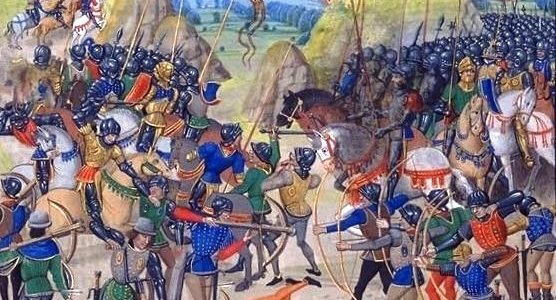
The irony here is that if you consider Lynn White’s work on medieval society, then you might conclude the attention to the longbow was not at all misplaced. White’s thesis taken by itself is probably reductionistic, but it does point to important factors. He argued that the feudal system and the consequent social order was premised on the invention of the stirrup which led to the appearance of mounted, armored soldiers and the rise of wealthy, landed aristocrats  who could afford to maintain mounted knights in their service. This social order was itself challenged by the invention of the longbow which, given its long range and armor piercing capability, drastically undermined the combat effectiveness of mounted knights. Historian Theodore Rabb, in The Last Days of the Renaissance, has likewise argued for the analogous role played by gunpowder in the evolution of the modern nation state.

Looking only at technology, especially if by that we mean consumer electronics in suburban context, is certainly too narrow a frame by which to understand our times. But the reverse is also true: trying to understand political and economic realities while ignoring the underlying technologies that shape those realities is likewise ill advised.

Technology, politics, and economics — not to mention all of the other complex social realities we too neatly compartmentalize by the very act of naming them — these are all recursively interrelated and entangled in fascinating ways and we do well resist the temptation to take refuge in explanations and understandings that refuse the complexity by unduly privileging one dimension of social reality over all others.

Froissart’s “Battle of Crecy”

“Harry Truman” … the Song

Before they started belting out ’80s power ballads, the band Chicago put out more, how shall we say … politically interesting music.  Having recently heard David McCullough, Harry Truman had been on my mind, and today I remembered that Chicago released a song titled “Harry Truman” back in 1975.

In the wake of the Watergate scandal it’s easy to see why the song did so well on the charts, peaking at #13. Today it might race to #1.

“Harry Truman”

by Robert Lamm

America needs you
Harry Truman
Harry could you please come home
Things are looking bad
I know you would be mad
To see what kind of men
Prevail upon the land you love

America’s wondering
How we got here
Harry all we get is lies
We’re gettin’ safer cars
Rocket ships to mars
From men who’d sell us out
To get themselves a piece of power

We’d love to hear you speak your mind
In plain and simple ways
Call a spade a spade
Like you did back in the day
You would play piano
Each morning walk a mile
Speak of what was going down
With honesty and style

America’s calling
Harry Truman
Harry you know what to do
The world is turnin’ round and losin’ lots of ground
Oh Harry is there something we can do to save the land we love


The Not So Dark Ages

Actually, it depends what period you label as the Dark Ages, but here is an excerpt from a longish interview Douglas Rushkoff gave at HiLobrow that gives us a counterintuitive perspective:

PN: They didn’t get money from Rome to fund their cathedrals?

DR: They did not. The Vatican and central Rome did not build the cathedrals. The funds came from local currency, which was very different than money as we use it now. It was based on grain, which lost value over time. The grain would slowly rot or get eaten by rats or cost money to store, so the money needed to be spent as quickly as possible before it became devalued. And when people spend and spend and spend a lot of money, you end up with an economy that grows very quickly.

Now unlike a capitalist economy where money is hoarded, with local currency, money is moving. The same dollar can end up being the salary for three people rather than just one. There was so much money circulating that they had to figure out what to do with it, how to reinvest it. Saving money was not an option, you couldn’t just stick it in the bank and have it grow because it would not grow there, it would shrink. So they paid the workers really well and they shortened the work week to four and in some cases three days per week. And they invested in the future by way of infrastructure — they started to build cathedrals. They couldn’t build them all at once, but they took the long view — with three generations of investment they could build an entire cathedral, and their great-grandchildren could live in a rich town! That’s how the great cathedrals were built, like Chartres. Some historians actually term the late Middle Ages “The Age of Cathedrals.”

Here’s the really interesting part:

They were the best-fed people in the history of Europe; women in England were taller than they are today, and men were taller than they have been at any point in time until the 1970s or 80s (with the recent growth spurt largely the result of hormones in the food supply). Life expectancy of course was still lower; they lacked modern medicine, but people were actually healthier and stronger and better back then, in ways that we don’t admit.

That was right before the corporation and the original chartered monopolies were created, before central currency was created and local currencies were outlawed. When everything gets moved into the center, things began to change.

PN: It seems like the Dark Ages were not perhaps so “dark.”

DR: Yes, I think that’s disinformation. I’m not usually a conspiracy theorist about these things, but I think the reason why we celebrate the Renaissance as a high point of western culture is really a marketing campaign. It was a way for Renaissance monarchs and nation-states, and the industrial age powers that followed, to recast the end of one of the most vibrant human civilizations we’ve had, as a dark, plague-ridden, horrible time.

Read the whole thing, it is a very engaging reflection on the history of corporations and currency. Depending on your interests, that may sound as appealing as watching paint dry on a muggy day, but really, it’s quite good and comes complete with imbedded video including scenes from Monty Python and Rudolph the Red Nose Reindeer.

Oh, and I almost forgot to add: No, I don’t want to be a medieval peasant.

Weekend Reading, 11/5/11

Alright so here’s our reading for the weekend. We start with four pieces on brain science and philosophy:

“Telling the Story of the Brain’s Cacophony of Competing Voices” by Benedict Carey at the NY Times: Discussion of the life and work of neuroscientist and professor of psychology Michael Gazzaniga on the brain, freedom, responsibility, and law.

“A Brief Guide to Embodied Cognition: Why You Are Not Your Brain” by Samuel McNerney at Scientific American: As the title implies. Focusing on the work of George Lakoff and Mark Johnson.

“Raymond Tallis Takes Out the Neurotrash” by Marc Parry in the The Chronicle of Higher Education: Profile of Raymond Tallis whose made a reputation for himself challenging reductive theories of the brain that, for example, reduce things like love to neural impulses. If you click through on this one make sure to listen to the audio of the exchange between Parry and his editor on Tallis. In fact, listen to that rather than read the article if you have to choose. You can also read a longish essay by Tallis on the subject here: “What Neuroscience Cannot Tell Us About Ourselves.”

“Your Brain Knows A Lot More Than You Realize” by David Eagleman at Discover Magazine: Excerpt from Eagleman’s new book, Incognito, on how much our brain does without our conscious awareness. Interesting case studies, good read.

We’re following that up with a couple of pieces on advertising, and the segue is legitimate if not entirely obvious:

“Thinking Vs. Feeling: The Psychology of Advertising” by Derek Thompson at The Atlantic: Light blog post, true to the title.

“Advertising is a poison that demeans even love – and we’re hooked on it” by George Monbiot at The Guardian: Hmm, well, that title pretty much says it all no? It’s a rant, enjoy.

And finally, to wrap up with a lighter piece:

“Dialing Up Twenty Years of Gadget Reviews” by Walter S. Mossberg in the Wall Street Journal: Nice retrospective jaunt through twenty years of consumer tech history beginning with those brick phones.