“He has perpetually occasion to rely on ideas which he has not had leisure to search to the bottom; for he is much more frequently aided by the opportunity of an idea than by its strict accuracy; and, in the long run, he risks less in making use of some false principles, than in spending his time in establishing all his principles on the basis of truth. The world is not led by long or learned demonstrations; a rapid glance at particular incidents, the daily study of the fleeting passions of the multitude, the accidents of the time, and the art of turning them to account, decide all its affairs.”
Conservative diatribe against the tenor of political discourse?
Traditionalist invective against new media and the decline of journalism?
Reactionary complaint against the culture of blogs and social media?
Curmudgeonly rant against all things digital?
Not exactly.
This was from the pen of Alexis de Tocqueville writing in the early nineteenth century about the habits of mind induced by America’s democratic society.
Apparently ours was a temperament waiting for a medium to match.
Alexis de Tocqueville arrived in America on May 10, 1831. He departed on February 20, 1832. He spent 271 days in the United States; 15 others were spent in Canada. Then, over the next several years, he wrote one of the most perceptive interpretations of American life ever written, Democracy in America.
Tocqueville touched on almost every conceivable facet of American life with a view to understanding the character of American democracy which was still something of a novelty, and certainly not guaranteed to endure. He necessarily generalized from his limited experience, but he did so brilliantly. Reading Democracy in America today, one is left with the impression that he saw through to the soul of the young republic and many of his observations remain compelling.
The tenth chapter of the second volume (Democracy in America was a hefty work) is titled “Why The Americans Are More Addicted To Practical Than To Theoretical Science.” You may recall from the essays of Leo Marx on the emergence of the concept of technology, that in Tocqueville’s day technology had not yet taken on the multifaceted sematic role it serves today. Other words and phrases, such as practical science, were invoked to discuss the various realities that we would group under technology. In this chapter, then, we find Tocqueville turning his attention to the American fascination and facility with technology.
As with all of the particularities of American society that Tocqueville discusses, he is mostly concerned to understand the consequences of the democratic political culture on the topic under consideration. At the outset of this chapter, for example, he notes that, “Equality begets in man the desire of judging of everything for himself: it gives him, in all things, a taste for the tangible and the real, a contempt for tradition and for forms.” And so it is with the culture of American science and technology.
To begin with, Tocqueville believes that the work of science may be divided into three types of endeavor:
“The first comprises the most theoretical principles, and those more abstract notions whose application is either unknown or very remote. The second is composed of those general truths which still belong to pure theory, but lead, nevertheless, by a straight and short road to practical results. Methods of application and means of execution make up the third.”
He concludes that Americans are quite good at the third, do a passable job at the second, and are least adept, but not altogether incompetent in the first. As best as I can judge, assuming the validity of his categories, this was not far off the mark. Tocqueville connects this with the absence of a leisured class:
“Nothing is more necessary to the culture of the higher sciences, or of the more elevated departments of science, than meditation; and nothing is less suited to meditation than the structure of democratic society. We do not find there, as amongst an aristocratic people, one class which clings to a state of repose because it is well off; and another which does not venture to stir because it despairs of improving its condition.”
Instead Americans are promiscuously active and, according to Tocqueville, “In the ages in which active life is the condition of almost everyone, men are therefore generally led to attach an excessive value to the rapid bursts and superficial conceptions of the intellect; and, on the other hand, to depreciate below their true standard its slower and deeper labors.”
Moreover, Tocqueville adds, “A desire to utilize knowledge is one thing; the pure desire to know is another.” Americans are decidedly in the former camp. Put otherwise, all of this means that America is much more likely to produce a Thomas Edison than an Albert Einstein. As a generalization, this seems about right still. I’m hard pressed to name theoreticians that Americans presently hold in high regard. Perhaps Stephen Hawking, but then again, he is not American. We venerate the likes of Steve Jobs and Bill Gates instead. The inventor-entrepreneur is still the preferred American icon.
Further on, Tocqueville once again leads with his familiar rough-and-ready brand of sociological analysis:
“The greater part of the men who constitute these nations are extremely eager in the pursuit of actual and physical gratification. As they are always dissatisfied with the position which they occupy, and are always free to leave it, they think of nothing but the means of changing their fortune, or of increasing it.”
From this premise, Tocqueville then launches into the following observations which strike me as more true than not:
“To minds thus predisposed, every new method which leads by a shorter road to wealth, every machine which spares labor, every instrument which diminishes the cost of production, every discovery which facilitates pleasures or augments them, seems to be the grandest effort of the human intellect. It is chiefly from these motives that a democratic people addicts itself to scientific pursuits-that it understands, and that it respects them. In aristocratic ages, science is more particularly called upon to furnish gratification to the mind; in democracies, to the body. You may be sure that the more a nation is democratic, enlightened, and free, the greater will be the number of these interested promoters of scientific genius, and the more will discoveries immediately applicable to productive industry confer gain, fame, and even power on their authors.”
And that is why Tocqueville is still in print — his analysis still resonates even if we may quibble with the details. This is as succinct a diagnosis as one could hope for of the distinct blend of technology and economics that we might label America’s techno-start-up culture.
Tocqueville, incidentally, was not being wholly critical in his observations. He notes, for instance, that, “These very Americans, who have not discovered one of the general laws of mechanics, have introduced into navigation an engine which changes the aspect of the world.”
What Tocqueville could not quite anticipate is the degree to which technology would eventually drive theoretical science. In this regard, his analysis falls short. But his insight into the American temperament and its stance toward technology has proved remarkably durable.
One final note, given recent posts, Tocqueville’s analysis is also an argument against a hard technological determinism. The history of technology in America takes its unique shape, at least in part, due to America’s political economy. But, mindful of the reciprocal nature of technology’s relationships to society, it would be only fair to note that technology has since rather significantly reshaped America’s political economy.
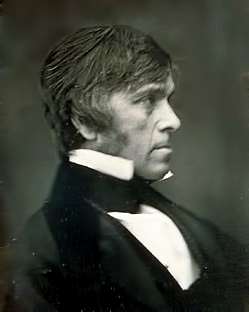
Alexis de Tocqueville by Théodore Chassériau, 1850
As counterintuitive as it may now seem, there are links between the ethos and the history of technology and magic. A few weeks ago, I posted some observations by Lewis Mumford and C. S. Lewis to that effect (although Lewis speaks more generally of science rather than technology). In The Technological Society, Jacques Ellul makes a series of similar observations regarding magic and technique. Technique, for Ellul, encompasses not only material technology, but also the extension of machine logic into social and personal spheres. “Technique,” Ellul explains, “integrates the machine into society.” It amounts to the conditioning of man for a world of machines. More generally, it is a mentality that privileges efficiency and rationalization.
According to Ellul, “technique has evolved along two distinct paths.” The “concrete technique of homo faber [man the maker]” and “the technique, of a more or less spiritual order, which we call magic.”
Citing the work of sociologist Marcel Mauss, Ellul describes the affinities between magic and technique:
“Magic developed along with other techniques as an expression of man’s will to obtain certain results of a spiritual order. To attain them, man made use of an aggregate of rites, formulas, and procedures which, once established, do not vary. Strict adherence to form is one of he characteristics of magic: forms and rituals, masks whichever vary, the same kind of prayer wheels, the same ingredients for mystical drugs, for formulae for divination, and so on.”
And a little later on he writes,
“Every magical means, in the eyes of the person who uses it, is the most efficient one. In the spiritual realm, magic displays all the characteristics of a technique. It is a mediator between man and ‘the higher powers,’ just as other techniques mediate between man and matter. It leads to efficacy because it subordinates the power of the gods to men, and it secures a predetermined result. It affirms human power in that it seeks to subordinate the gods to men, just as technique serves to cause nature to obey.”
This latter observation also recalls Walter Benjamin’s observation that “technology is not the mastery of nature but of the relations between nature and man.”
Regarding magic’s relationship to technology, Mumford explained that “magic was the bridge that united fantasy with technology: the dream of power with the engines of fulfillment.”
What technology and magic, then, have in common is the effort to manipulate relationships through techniques that are an extension and empowerment of the human will. Manipulate tends to have rather pejorative connotations, but I use it nonetheless because of its suggestive etymology which is linked to a method for mining iron ore, a pharmacist’s measure, and, of course, the hand. This etymology felicitously evokes both technology and the body. The pejorative connotations, however, are not entirely misplaced.
Historians of science have linked the rise of modern science in the West with theological and philosophical developments in the late medieval period. During this time, Aristotelianism was displaced by a voluntarist account of God’s action. The voluntarists so emphasized God’s power and freedom, they concluded there was nothing at all necessary, and thus subject to rational deduction, about the world as it exists. It could have been otherwise in every detail. It would not do, then, to merely reason about the way the world must necessarily be assuming certain rational propositions, rather the world must be investigated in order to arrive at an accurate understanding of its nature.
Magic, science, and technology all initially flourished in this cultural climate oriented toward the will, and this orientation became a part of their DNA as it were. The freedom of the divine will imagined by the voluntarists appears eventually to have become the freedom of the human will. Unfettered from the constraints of either Aristotelian form or telos, and later from notions of a normative moral and natural order, the human will is liberated to manipulate reality as it sees fit.
Technology, in Western contexts, was anchored in this emphasis on the unfettered will and the activist vision of Francis Bacon, who did more than any other individual to shape Western attitudes toward technology in the early modern period. It is little wonder then that we are generally unwilling to abide non-technological constraints on technology. We are generally unwilling to abide such constraints on our own will and we have long since understood technology, as we once did magic, as an accouterment of the will.
It is sometimes suggested that human beings may be characterized as tool-using animals. Some, for example Katherine Hayles, have alternatively ventured to define human beings as meaning-making animals:
“… the primary purpose of narrative is to search for meaning, making narrative an essential technology for human beings, who can arguably be defined as meaning-seeking animals …”
To put this point another way, we might say that human beings are story-telling animals.
Interestingly, Hayles suggests a link between technology and narrative by defining narrative as a kind of technology. In Technology Matters, historian David E. Nye also links narrative and technology in a slightly different, but likewise intriguing manner:
“Consider the similarity between what is involved in creating and using a tool and the sequence of a narrative …. Composing a narrative and using a tool are not identical processes, but they have affinities. Each requires the imagination of altered circumstances, and in each case beings must see themselves to be living in time. Making a tool immediately implies a succession of events in which one exercises some control over outcomes. Either to tell a story or to make a tool is to adopt an imaginary position outside immediate sensory experience. In each case, one imagines how present circumstances might be made different.”
A little later on Nye adds, “To improvise with tools or to tell stories requires the ability to imagine not just one outcome but several. To link technology and narrative does not yoke two disparate subjects; rather, it recalls an ancient relationship.”
And further on still, “A tool always implies at least one small story. There is a situation; something needs doing.”
All told, Nye is arguing that tools and narratives emerged symbiotically, seemingly as byproducts of a capacity to imagine that was not temporally encased in the present, and that human culture depended on their emergence. Nye is hesitant to enter into debates about the chronological priority or primacy of either tools or narrative and this strikes me as a rather sensible position to take.
It is interesting, however, to entertain the problem if just momentarily. In one respect, seeking to discern the primary partner in the relationship is a variation of the debate over technological determinism. Let us agree that we have, for all intents and purposes, always told stories and always made tools. But what frames what? This may be the critical question. Do our stories define our tools or do our tools shape our stories? (Of course, I admit at the outset that this is most likely a misleading question in that the best response is of a both/and rather than either/or nature.)
Narrative is essentially geared toward the production of meaning. We tell stories to make sense out of experience. To understand our relationship to technology, then, it is worth asking what stories we tell about our tools.
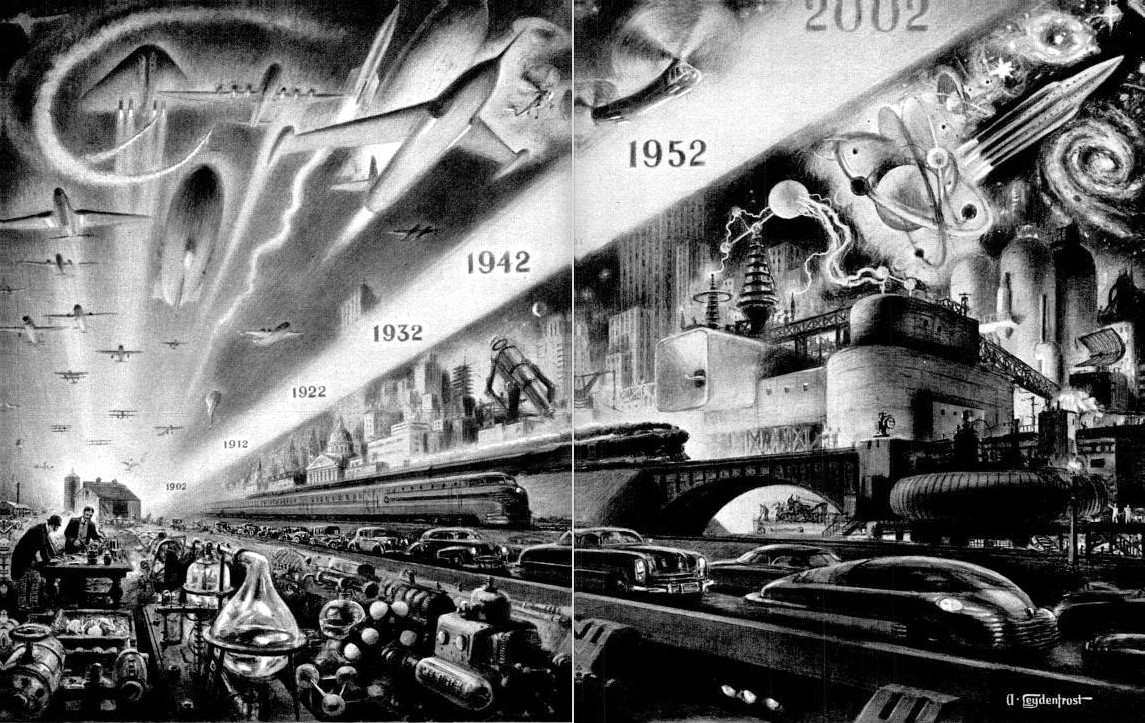
Immediately, I am reminded of the grand narratives of progress told by Western societies — and perhaps American society most enthusiastically — in which technology has been a central character, if not indeed, the central character. These stories have framed the place of technology within society; they have given a certain meaning to the presence and evolution of technology. As Leo Marx, among others, has noted, as the grand narrative of progress mutated over the course of the nineteenth century, technology assumed a dominant role, eventually making the story of progress coterminous with the story of technology. This was a powerful story and it influenced the nature of technology’s relationship to society as long as the story was widely affirmed.
The conventional wisdom is that postmodernity has fatally undermined all such grand (or, meta-) narratives. I’m not so sure. I think there is certainly something to the claim, no doubt. Certain kinds of totalizing grand narratives seem intuitively implausible, or what amount to the same thing, unpalatable. Yet, even though varieties of technological pessimism seem more widespread, the myth of the machine, to borrow Mumford’s phrasing, seems alive and well. The transhumanist project and its quite grand narrative is just one example. On a less grandiose scale we may perceive a survival of the grand narrative of progress in the popular insistence (or hope) that the answer to the problems introduced by technology is simply more technology. And, of course, the myth of the machine/progress still infuses a good bit of advertising.
Moreover, if we are indeed meaning-making, story-telling animals, then it is unlikely that the lure of grand narratives will ever permanently fade away. Certain types of grand narratives will undoubtedly pass from the scene, and all grand narratives may for a time leave a bad taste in our mouth, particularly if we have binged on one of them, but in time, I suspect, our taste for them will return and we’ll go looking once again to make sense of it all.
Returning specifically to the narrative of technological progress, it was undoubtedly challenged more recently by the dystopian stories of the twentieth century, particularly postwar science fiction, which framed technology within darker, more ambiguous narratives. These stories, many of which are quite popular, elicit a more reserved and chastened posture toward technology. But, more to the point, they are narratives and as narratives they frame technology in a meaningful way.
Along with these macro-narratives that order a society’s relationship to technology, we should also note the micro-narratives we weave around our own personal tools and devices. These micro-narratives may tell the story of how we came to possess the technology, they may instruct others in using the technology, they may explicitly tell of the technology’s significance to us; in all of these ways and more, they constitute our meaning making activity with regards to technology in our lives. These micro-narratives, in conversation with the macro-narratives, go a long way toward ordering our own personal relationship with technology, or at least they are symptoms of that ordering (or dis-ordering as the case may be).
Additionally, at a level between the micro- and the macro-, we might also consider the stories of particular technologies and the way these stories intersect with larger grand narratives and more personal accounts. One might take the story of the car, for example. The story of the automobile has a privileged place in narratives about the character of American society in the twentieth century. It is intimately woven into local histories such as that of Detroit, and it may even feature prominently in our personal histories. Who, after all, doesn’t remember their first car? The story of the automobile also attracts other prominent thematic elements that comprise the larger stories we tell about our culture including freedom, motion, autonomy, and restlessness. At this level we might also include the role accorded the printing press in the larger story of the Protestant Reformation or that accorded the cotton gin the story of the American Civil War. These stories may not always be entirely truthful, but they are believed and so secure their influence.
Altogether, we may distinguish at least the following kinds of technologically related stories:
a. Narratives about a particular technology
b. Small vignettes about our personal experience with technology
c. Large scale narratives in which technology figures prominently
d. Grand narratives that frames cultural attitudes toward technology
Technologies, we might then conclude, elicit a multiplicity of narratives. They invite meaning and encourage its construction.
Finally, I’m inclined to add that while it is true that narrative preceded literacy, literacy reshaped narrative. We have always told stories, but the shape and form of those stories have shifted in response to the appearance of new communication technologies, be it the stylus, the printing press, the radio, or the motion picture, to name but a few. And so again we are left with a reciprocal relationship. Narratives shape the way we use our tools and our tools shape the way we construct our narratives.
In last week’s post on Leo Marx and the sources of technological pessimism, I noted that Marx alludes to an 1829 essay by Thomas Carlyle, “Sign of the Times,” in which Carlyle describes his era as an “Age of Machinery.” Here is the fuller context of that phrasing:
“Were we required to characterize this age of ours by any single epithet, we should be tempted to call it, not an Historical, Devotional, Philosophical, or Moral Age, but above all others, the Mechanical Age. it is the Age of Machinery, in every outward and inward sense of that word: the age which, with its whole undivided might, forwards, teaches and practices the great art of adapting means to ends.”
More from Carlyle:
“Not the external and physical alone is now managed by machinery, but the internal and spiritual also …. The same habit regulates not our modes of action alone, but our modes of thought and feeling. Men are grown mechanical in head and heart, as well as in hand. They have lost faith in individual endeavors, and in natural force, of any kind. Not for internal perfection but for external combinations and arrangements for institutions, constitutions, for Mechanism of one sort or another, do they hope and struggle.”
In Christian Worship and Technological Change, Susan J. White, pairs Carlyle’s sentiment with the following passage from Darwin’s “Recollections of the Development of My Mind and Character”:
“I have said that in one respect my mind has changed in the last twenty or thirty years. Up to the age of thirty, poetry of many kinds … gave me great pleasure, and even as a schoolboy I took intense delight in Shakespeare. But now for many years I cannot read a line of poetry; I have tried lately to read Shakespeare, and found it so intolerably dull that it nauseated me. I have also almost lost my taste for pictures or music …. My mind seems to have become a kind of machine for grinding general laws out of a large collection of facts.”
First of all, this latter self-diagnosis is terribly sad. One hopes that Darwin’s experience is not suggestive of a general tendency, even as one suspects that it may very well be.
Secondly, Carlyle and Darwin, in their own way, intuited what later scholars including Mumford and McLuhan would formalize into theory: our habits of mind and patterns of thought have a way of adapting themselves to our technological environment.
Ours, however, is no longer an Age of Machinery in the same way. How might we update Carlyle’s and Darwin’s observations to better fit our own time? How might we label our age? How has our technological environment worked its way into our heads and hearts?

 L.M. Sacasas