Ritual Fairs: Liminality and the World’s Fairs

In 1983, cultural historian Warren Susman wrote a brief but remarkably suggestive essay in the journal Chicago History. The essay, “Ritual Fairs,” evoked the categories of ritual studies and the sociology of religion to understand the significance of World’s Fairs to American culture.

Susman begins by discussing the World’s Fairs as instances of tourism, as the first modern media events, and as the paradigmatic generator of souvenirs. Susman then pivots to draw a comparison between the World’s Fairs of the 19th and 20th centuries and the fairs of medieval society.  According to Susman, “in our era pilgrimage becomes tourism, … souvenirs are a more modern form of relic, and … the iconographic function of some fair’s buildings can be related to the iconographic significance of Gothic cathedrals.”

Like the medieval fairs, World’s Fairs were “idealized towns, utopias, or as H. Bruce Franklin shrewdly suggests about New York’s 1939 fair, works of science fiction.” Consequently, Susman recommends that we understand the fairs in light of the liminal stage that Victory Turner assigned to pilgrimages. The fairs separated the “pilgrim” from their ordinary world and immersed them in another world “somewhere between past, present, and future.” From this vantage point fair goers were led to “an acceptance and participation in a new social order that is emerging technologically, socially, culturally, politically”.

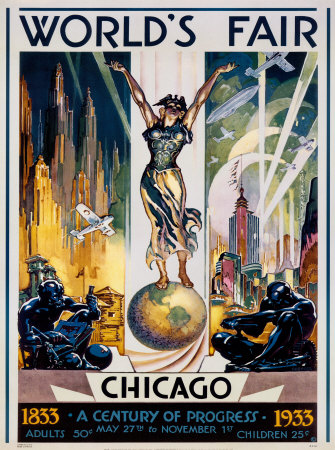
Consider the poster below, from the 1933 Century of Progress Fair in Chicago, a graphic representation of this idea of liminality. The fair’s icon stands posed between the world as it has been and the imagined world of the future.

Borrowing from Emile Durkheim’s notion that religion involves the worship of society, Susman also believes that the fair goers “went to worship or at least stayed to worship a vision of that society or social order.” Susman doesn’t use this language, but it is an eschatological vision that the fairs communicated and invited attendees to worship and participate in. It was not a vision of society as it was or had been, but as it could be. In this respect, the fairs traded in the cultivation of hope; thus their frequent appearance at times of economic or social upheaval.

The golden age of World’s Fairs in America, roughly the period between the 1870s and 1960s, witnessed the nation’s passage from an economy of scarcity and production to one of abundance and consumption. In Susman’s view, the World’s Fairs played an indispensable role in guiding American society through this transition: “… world’s fairs were rites of passage for American society which made possible the full acceptance of a new way of life, new values, and a new social organization.”

To wrap up with a question, is there anything comparable today? Do we have anything that serves a similar function in what is evidently our ongoing transition from one form of society to another?

Ideologies at a Crossroad … Literally

Here’s a moment in time from which one could build a book.

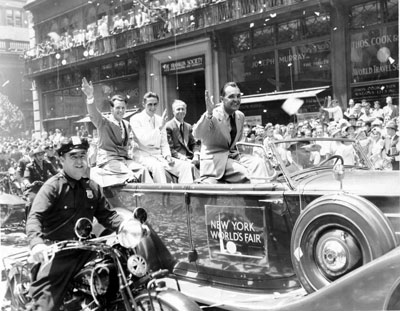
In 1938, a preview parade for the New York World’s Fair with its corporate modernist ethos wound its way through the city. The parade was ten miles long and it included cars from every state in the union.

At the intersection of Thirteenth Street and Seventh Avenue it was cut off by a 50,000-100,000 strong parade celebrating May Day.

One couldn’t script a better symbolic scene.

No disturbances or altercations were reported.

______________________________________________________________

Sources: Robert Rydell mentions the incident in World of Fairs: The Century of Progress Expositions. He cites a 1938 NY TImes article, “Divided Leftists in Quiet May Day,” and “Red Light for May Day March” in World-Telegram.

Flânerie and the Dérive, Online and Off

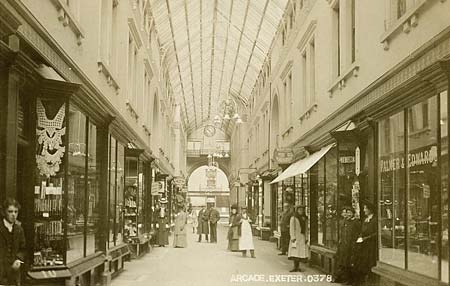
Had I been really ambitious with yesterday’s post, I would have attempted to draw in a little controversy over the practice of flânerie earlier this week. You may be wondering what flânerie is, or if you know what it is, you may be wondering why on earth it would spark controversy.

Short answers today. First, flânerie is the practice of being a flâneur. The flâneur is a figure from the city streets of nineteenth century Paris who made his way through the crowded avenues and arcades watching and observing, engaging in what we could call peripatetic social criticism. He was popularized in the work of the poet Charles Baudelaire and the literary critic Walter Benjamin.

The recent mini-controversy revolved around the practice of cyber-flânerie, playing the part of the flâneur online. The debate was kicked off by Evgeny Morozov’s “The Death of the Cyberflâneur” in the NY Times. Morozov drew a spirited response from Dana Goldstein in a blog post, “Flânerie Lives! On Facebook, Sex, and the Cybercity”.

Morozov is a champion of the open, chaotic web of the early Internet. He is a fierce critic of the neat, closed web of Google, Facebook, and apps. Here is the gist of his argument (although, as always, I encourage you to read the whole piece):

“It’s easy to see, then, why cyberflânerie seemed such an appealing notion in the early days of the Web. The idea of exploring cyberspace as virgin territory, not yet colonized by governments and corporations, was romantic; that romanticism was even reflected in the names of early browsers (“Internet Explorer,” “Netscape Navigator”).

Online communities like GeoCities and Tripod were the true digital arcades of that period, trading in the most obscure and the most peculiar, without any sort of hierarchy ranking them by popularity or commercial value. Back then eBay was weirder than most flea markets; strolling through its virtual stands was far more pleasurable than buying any of the items. For a brief moment in the mid-1990s, it did seem that the Internet might trigger an unexpected renaissance of flânerie.

….

Something similar has happened to the Internet. Transcending its original playful identity, it’s no longer a place for strolling — it’s a place for getting things done. Hardly anyone “surfs” the Web anymore. The popularity of the “app paradigm,” whereby dedicated mobile and tablet applications help us accomplish what we want without ever opening the browser or visiting the rest of the Internet, has made cyberflânerie less likely. That so much of today’s online activity revolves around shopping — for virtual presents, for virtual pets, for virtual presents for virtual pets — hasn’t helped either. Strolling through Groupon isn’t as much fun as strolling through an arcade, online or off.”

Further on, Morozov lays much of the blame on Facebook and the quest for frictionless sharing. All told it seems to me that his critique centers on the loss of anonymity and the lack of serendipity that characterize the Facebook model web experience.

For her part, Goldstien, who has done graduate work on nineteenth century flânerie, questioned whether anonymity was essential to the practice. Morozov cited Zygmunt Bauman’s line, “The art that the flâneur masters is that of seeing without being caught looking.” Goldstein on the other hand writes, “The historian Della Pollock, contra Morozov and Bauman, describes flânerie as ‘observing well and…being well worth observing’ in turn.”

Yet, even if we did grant Bauman’s characterization of flânerie, Goldstein still believes that much of what we do online qualifies as such:

“Seeing without being caught looking. Is there any better description for so much of what we do online? Admit it: You’re well acquainted with your significant other’s ex’s Facebook page. You’ve dived deep into the search results for the name of the person you’re dating, the job applicant you’re interviewing, the prospective tenant or roommate. On the dating site OkCupid, you can even pay for the privilege of “enhanced anonymous browsing,” in which you can see who checks out your profile, but no one can see which profiles you’ve looked at yourself. On Facebook, one of the most common spam bots promises to reveal who’s been looking at your profile. It’s so tempting! People click and the spam spreads, but it’s a trick: Facebook conceals users’ browsing histories from one another.”

I should say that I have no particular expertise in the study of the flâneur beyond a little reading of Benjamnin here and there. My hunch, however, is that the tradition of flânerie is wide enough to accommodate the readings of both Morozov and Goldstein. Moreover, I suspect that perhaps a metaphor has been unhelpfully reified. After all, cyber-space (who knew we would be using “cyber” again) and physical space are only metaphorically analogous. That metaphor is suggestive and has generated insightful analysis, but it is a metaphor that can be pushed too far. Cyberflânerie and, what shall we call it, brick-and-mortar flânerie — these two are also only metaphorically analogous. Again, it is a rich and suggestive metaphor, but it will have its limits. Phenomenologically, clicking on a link is not quite the same thing as turning a corner. The way each presents itself to us and acts on us is quite different.

Additionally, to complicate matters, it might also be interesting to draw into the conversation related practices such the dérive popularized by Guy Debord and the Situationists. That, however, will remain only a passing observation, except to note that intention is of great consequence. Why are we engaging in this practice or that? That seems to me to be the question. Stalking, flânerie, and the dérive may have structural similarities (particularly to the outside observer, the one watching the watcher as it were, but not knowing why the watcher watches), but they are distinguished decisively by their intent. Likewise, online analogs should be distinguished according to their intent.

Although, having just written that, it occurs to me that the dérive analogy does have an interesting dimension to offer. Regardless of our intentions, when we go online we do often find ourselves very far afield from whatever our initial reason for going online might have been. This is something the dérive assumes as an integral part of the practice. Also, while varieties of flânerie involve acting to see and to be seen in debatable portions, the dérive, in analogy with psychotherapy, is less focused on the seeing and being seen altogether. Here is Debord on the dérive:

“One of the basic situationist practices is the dérive, a technique of rapid passage through varied ambiences. Dérives involve playful-constructive behavior and awareness of psychogeographical effects, and are thus quite different from the classic notions of journey or stroll.

“In a dérive one or more persons during a certain period drop their relations, their work and leisure activities, and all their other usual motives for movement and action, and let themselves be drawn by the attractions of the terrain and the encounters they find there. Chance is a less important factor in this activity than one might think: from a dérive point of view cities have psychogeographical contours, with constant currents, fixed points and vortexes that strongly discourage entry into or exit from certain zones.”

This practice seems to better fit (metaphorically still) the online experience of either the early web or its more recent iteration. The difference, it would seem, lies in the object of study. Flânerie oscillates between social criticism and performance. The dérive takes one’s own psychic state as the object of study insofar as it is revealed by the manner in which we negotiate space, online and off.
Outsourcing the Future

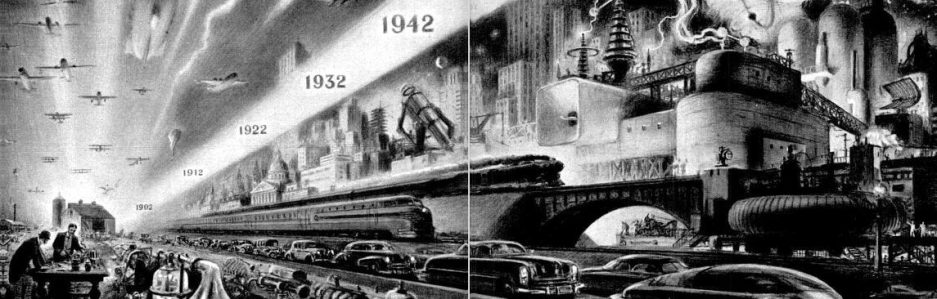
I suspect that when you think about World’s Fairs, if ever you do, you think about those that have already receded into the modestly distant past. Arguably, the last notable fair held in the US — with apologies to Knoxville and New Orleans — was the unsanctioned New York Fair of 1964-65.

Unsanctioned because that fair did not receive the approval of the Bureau International des Expositions (International Bureau of Expositions, although I suspect the translation was rather self-evident). The fair, of course, proceeded in any case under the leadership of Robert Moses who was not one to take “no” for an answer. For the record, the US ended its membership in the Bureau International des Expositions in June 2001.

World’s fairs and expositions, however, are still held around the globe. Since we tend to get rather little news about international happenings unless they are tragic or otherwise immediately relevant to American affairs, the fairs tend to get little notice. Case in point: I was blissfully unaware until fairly recently that an ambitious and impressive fair was held in Shanghai in 2010, Expo Shanghai. (If you follow the link, you’l be taken to an interactive map from which you can virtually experience the many exhibits at the Expo). And in the tradition of the 1939 New York Fair, the Shanghai Expo featured a sizable “Pavilion of the Future.”

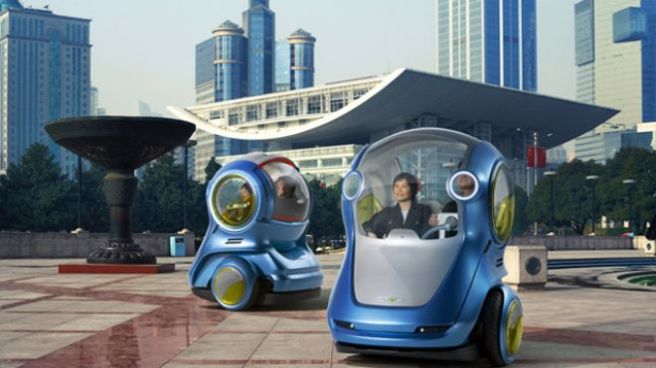
General Motors, the corporation that sponsored the original Futurama in 1939 and its sequel in 1964, is apparently not altogether out of the business of shaping the vision of transportation for the world of tomorrow. At the Shanghai Expo, GM debuted its EN-V concept car pictured below. The EN-V is equipped with a sophisticated navigation system that is intended to render it virtually accident proof. In this it shares in a vision already articulated in the 1939 Futurama which predicted the appearance of cars which would be kept at safe distances from each other by radio control while careening down as yet unbuilt interstate highways.

What’s more, the car, if we can call it that (and I don’t mean that disparagingly), is set to play an important role in a working “city of the future,” the Tianjin Eco-City, a joint effort by the governments of China and Singapore. If you click the image below, you’ll be taken to a slide show of Eco-City concept drawings.  The story linked just above gives this brief description:

“Located on the outskirts of one of China’s largest existing metropolises, the Tianjin Eco-City was conceived as a large-scale prototype for sustainable, high-density communities. A reliance on renewable energy sources and mass transit are key elements in its environmentally-friendly design.

But even though its creators are planning for 90 percent of its eventual population of 350,000 to get around town using a light rail system, there will still be a need for individual point to point transportation, and that’s where GM comes in.”

It’s a long way from realization, but I’ve got to say, it’s an impressive project.

It would seem that we have out-sourced the future.

At least we’re working on productivity.

Oral Social Literacy, Past and Present

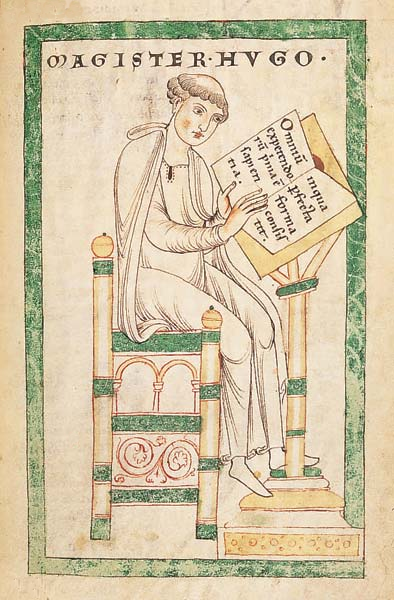
Ivan Illich’s In the Vineyard of the Text is an exploration of the evolution of reading and the book in Western Europe during the 13th century. It is focused on Hugh of St. Victor and a well-known work of his titled the Didascalicon, essentially the first guide to the art of reading.

Illich notes, “Before Hugh’s generation, the book is a record of the author’s speech or dictation. After Hugh, increasingly it becomes a repertory of the author’s thought, a screen onto which one projects still unvoiced intentions.”

Illich early on acknowledges his debt to Walter Ong who synthesized a great deal of research on the cultural consequences of the shift from orality to literacy (and later to what Ong called the secondary orality of electronic media).

What is sometimes lost in this schema is the persistence of orality after the emergence of literacy. And not only in the sense that oral cultures existed alongside literate ones, but also in the persistence of orality within literate societies.

A full 1500 years after literacy was effectively internalized into Western society (which is not the same thing as saying that all of those living in Western society were literate), reading remained a fundamentally oral activity. The quotation from Illich above is drawn from a chapter titled, “Recorded Speech to Record of Thought.” That title nicely captures the degree to which writing was understood as a record of oral communication rather than its own distinct medium prior to the period Illich examined.

Here is Illich again on the orality (and corporeality) of literacy through the late medieval period:

“In a tradition of one and a half millennia, the sounding pages are echoed by the resonance  of the moving lips and tongue.  The reader’s ears pay attention, and strain to catch what the reader’s mouth gives forth.  In this manner the sequence of letters translates directly into body movements and patterns nerve impulses.  The lines are a sound track picked up by the mouth and voiced by the reader for his own ear.  By reading, the page is literally embodied, incorporated.”

And here again on the oral and social nature of reading:

“The monastic reader — chanter or mumbler — picks the words from the lines and creates a public social auditory ambience. All those who, with the reader, are immersed in this hearing milieu are equals before the sound … Fifty years after Hugh, typically, this was no longer true. The technical activity of deciphering no longer creates an auditory and, therefore, a social space. The reader then flips through pages. His eyes mirror the two-dimensional page. Soon he will conceive of his own mind in analogy with a manuscript. Reading will become an individualistic activity, intercourse between a self and a page.”

As I read these passages again today, I was reminded of an essay that appeared not too long ago in the Wall Street Journal. In “Is This the Future of Punctuation?”, Henry Hitchings, the author of The Language Wars: A History of Proper English, makes the following observation about new proposed punctuations marks such as the  interrobang:

“Such marks are symptoms of an increasing tendency to punctuate for rhetorical rather than grammatical effect. Instead of presenting syntactical and logical relationships, punctuation reproduces the patterns of speech.”

The emergence of telephony, radio, and television marked the re-emergence of orality following the era of print literacy’s dominance. Ong called this secondary orality. Having appeared after literacy, it was not identical to primary orality, but it nonetheless represented a reemergence of orality and its habits which would now compete with literacy on the cultural stage.

Within the last twenty years, however, a funny thing has happened on the way to the world of secondary orality. Writing or text has reasserted itself. Text messaging, emails, online reading, e-reading, etc. — all of these together mean that most of us are deciphering of a lot of text each day. Even our television screens, depending on what we are watching, may be chock full of text, scrolling or otherwise.

But this reemergence of text is marked by orality, as the observation by Hitchings suggests. Can we call this secondary literacy? Is it still useful to speak in terms of literacy and orality?

It has always seemed to me that the orality/literacy distinction got at important historical developments in communication and consciousness. The bare dichotomy glossed over a good deal and it was always in need of qualification, but it was serviceable nonetheless. Secondary orality also pointed to important developments. But now what we appear to have, text having reasserted itself, is a thoroughly blended media environment.

It’s chief characteristic is neither its orality nor its literacy. Rather, it is the preponderance of both together — overlapping, interpenetrating, jostling, complementing, conflating.

Interestingly, there has also been, of course, a reemergence of social literacy, but it is not tied to the oral as it was in the circumstances described by Illich above. Rather than an orally constituted literate social anchored to physical presence, we have a diffused literacy based, image-inflected social often untethered from physical presence.

A social space was, then, constituted by an oral performance of the written text and gathered presences. We have, today, spaces constituted as social by silent reading and the presence of absences.

File all of this under “thinking aloud.” (Except, of course, that it wasn’t!)