Revisiting “The Religion of Technology”

Several months ago I wrote a short post on David Noble’s The Religion of Technology. Having recently revisited the book I thought it would be worthwhile to post about Noble’s work once again, this time with a little more detail.

Noble’s thesis offers an intriguing perspective on the relationship between religion and technology. By tracing their historical entwinement, Noble claimed to expose more than “a merely metaphorical” relationship between the two. Noble intended the designation, religion of technology, “literally and historically, to indicate that modern technology and religion have evolved together and that, as a result, the technological enterprise has been and remains suffused with religious belief.”

Noble is making an important distinction here. It is not uncommon to hear people talk metaphorically about technology in religiously inflected language or to draw analogies between religious practices and technology. As an example consider the poster below for “Login: The Conference of Future Insight” by the New! ad agency (h/t @troy_s). This poster analogically relates religion to technology by taking as its theme, “What will we worship next?” The question implies that we “worship” technology analogously to the worship of the religious believer, or that technology functions analogously to a deity in the life of the believer. This is a perfectly valid and suggestive angle of inquiry. However, it is not exactly what Noble has in mind. He unearths a concrete historical interrelationship between the Western technological project and the Christian tradition. A relationship, incidentally, which Noble hoped could be severed for the benefit of all involved.
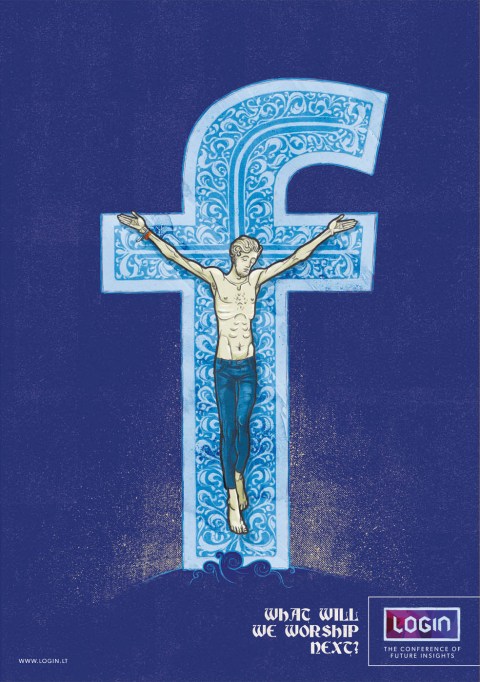
By the New! ad agency

According to Noble, the religion of technology constitutes “an enduring ideological tradition that has defined the dynamic Western technological enterprise since its inception.” Consequently, it’s influence is evident not only upon “professed believers and those who employ explicitly religious language,” but also on many for “whom the religious compulsion is largely unconscious, obscured by a secularized vocabulary.” This influence manifests itself in the utopian hopes attached to the technological enterprise and can be traced back to the late Middle Ages. These utopian hopes include the expectation that technology would bring about the perfection of the individual and of society and serve as a vehicle of transcendence.

Statue of Roger Bacon in the Oxford University Museum of Natural History

The religion of technology emerges out of a worldview that posits an original state of perfection that, once lost, must be retrieved. Noble’s narrative traces the manner in which technology came to occupy a central place in this effort to regain the lost paradise. The medieval Christian worldview posited the requisite fallen condition: humanity had, by Adam’s sin, fallen from a state of spiritual and material perfection, and technology’s entanglement with the project of restoring the fallen order begins in an unlikely setting. Within the Benedictine monastic tradition, according to Noble’s interpretation*, work and its tools came to be seen as a means of grace enabling the recovery of mankind’s original perfection. At the dawning of the second millennium, this redemptive view of work and its tools was then joined to an eschatological fervor that anticipated the soon return of Christ and the renewal of the created order. In Noble’s narrative, this fusion was best exemplified by Roger Bacon:

“Having inherited the new medieval view of technology as a means of recovering mankind’s original perfection, Bacon now placed it in the context of millenarian prophecy, prediction, and promise. If Bacon, following Erigena and Hugh of St. Victor, perceived the advance of the arts as a means of restoring humanity’s lost divinity, he now saw it at the same time, following Joachim of Fiore, as a means of anticipating and preparing for the kingdom to come, and as a sure sign in and of itself that that kingdom was at hand.”

Noble goes on to describe the manner in which Christianity’s evangelical and missionary impulse “encouraged exploration, and thereby advanced the arts upon which such exploration depended, including geography, astronomy, and navigation, as well as shipbuilding, metallurgy, and, of course, weaponry.” Francis Bacon – who, Noble notes, “is typically revered as the greatest prophet of modern science” – is the next key figure in the evolution of the religion of technology. Noble, agrees with Lewis Mumford’s insistence that what Bacon advanced was “science as technology.” Bacon had little patience for science that did not issue in application and he suffused his advocacy of science as technology with a very specific theological aim: “the relief of man’s estate” understood as the amelioration of the material consequences of humanity’s fall. While the advent of Protestantism addressed the spiritual consequences of the fall, the scientific revolution underway in Europe was destined to address its material consequences. Both together would result in the re-establishment of the unfallen created order.

At the end of the nineteenth century, the religion of technology was alive and well in America, and it was best exemplified, according to Noble, by the techno-utopianism of Edward Bellamy whose writings “resound with the familiar refrains of redemption, of the divinely destined recovery of mankind’s lost perfection.” The historian Howard P. Segal, cited by Noble, summarizes Bellamy’s depiction of life in the year 2000 as follows:

The United States of the year 2000 is very much a technological utopia: an allegedly ideal society not simply dependent upon tools and machines, or even worshipful of them, but outright modeled after them. … The purposeful, positive use of technology – from improved factories and offices to new highways and electric lighting systems to innovative pneumatic tubes, electronic broadcasts, and credit cards – is, in fact, critical to the predicted transformation of the United States from living hell into a heaven on earth.

Following his survey of the historical origins of the religion of technology, Noble demonstrates its continuing vitality throughout the twentieth century in chapters exploring atomic weaponry, the space program, artificial intelligence, and genetic engineering. In each of these fields, Noble illustrates the enduring allure of the religiously inspired techno-utopian quest for perfection and transcendence.  In the end, Noble concludes that the religion of technology ultimately hinges on a hope of salvation that technology cannot finally provide.

_________________________________________________

*Noble’s interpretation of the Benedictine tradition should be qualified by George Ovitt’s work on the same.

Sex Sells the Future

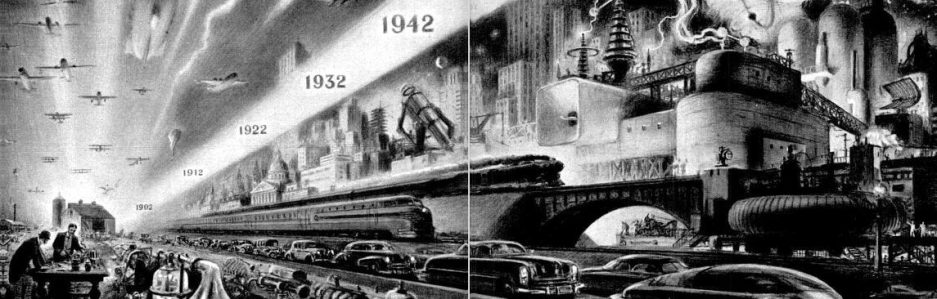
The late nineteenth and early twentieth century world’s fairs were instrumental in transitioning America from an economy of production to one of consumption. Their role in bringing about this shift is fascinating. Here is but one of the more interesting dimensions of this role described by Robert Rydell in World of Fairs: The Century of Progress Expositions:

“Fundamental to this effort was an assault on remaining vestiges of values that were associated with what some historians have called a ‘culture of production.’ To hasten the dissolution of this older emphasis on restraint and inhibition, already under siege by world’s fairs at the beginning of the century and by the steady barrage of advertising that saturated the country during the 1920s, world’s fair builders injected their fantasies of progress with equally heavy doses of technological utopianism and erotic stimulation.”

We’re more familiar with the technological utopianism of the world’s fairs; the manner in which this technological utopianism was alloyed to erotic representations is less commonly noted. For example, Norman Bel Geddes, who famously designed Futurama, the fair’s most popular exhibit, also designed “Crystal Lassies,” “A Peep Show of Tomorrow.” Rydell continues:

“As if to liberate these fantasies from their Victorian moorings, exposition promoters gave increasing prominence to female striptease performances on exposition midways that, by the end of the decade, gave way to fully nude female performers in shows replete with world-of-tomorrow themes.”

Of course, this makes a great deal of sense. Chastity is to sexual desire what thrift is to economic desire. Rydell goes on:

“By suffusing the world of tomorrow with highly charged male sexual fantasies, the century-of-progress expositions not only reconfirmed the status of women as objects of desire, but represented their bodies as showcases that perfectly complemented displays of futuristic consumer durables everywhere on exhibit at the fairs.”

We know sex sells. This is a commonplace in our society. But we often think it operates by association. Pair the model with the car and somehow the attraction to the model will infuse the car. Perhaps. But some marketers appear to have understood the relationship somewhat differently. Eliminate restraint in one domain and you will eliminate it in the other as well.

E Simms Campbell in Esquire, 1939

“Sacred Industry” and Technology

From David Nye’s American Technological Sublime:

“Writing of the Philadelphia Exposition of 1876, Walt Whitman proclaimed:

Mightier than Egypt’s tombs,
Fairer than Grecia’s, Roma’s temples.
Prouder than Milan’s statued, spired cathedral,
More picturesque than Rhenish castle-keeps,
We plan even not to raise, beyond them all,
The great cathedral sacred industry, no tomb,
A keep for life of practical invention*.

‘Sacred industry’ rivaled the religious architecture of antiquity; in America technological achievements became measures of cultural value.”

______________________________________

* “Practical invention” was one of several phrases then commonly used to designate what we would today call “technology.”

The Centennial Tower, Philadelphia 1876

Looking Forward

Edward Bellamy in Equality, 1897 (cited by David Noble in The Religion of Technology):

“This craze for more and more and ever greater and wider inventions for economic purposes, coupled with apparent complete indifference as to whether mankind derived any ultimate benefit from them or not can only be understood by regarding it as one of those strange epidemics of insane excitement which have been known to affect whole populations at certain periods, especially of the middle ages. Rational explanation it has none.”

The Technological Sublime, Alive and Well

Natural wonders, lightning storms, tornadoes, sunsets — we sometimes describe the experience of these sorts of natural phenomenon as experiences of the sublime. They leave us in awe and render us speechless if only for a moment. There is a long tradition of reflection about the nature of the sublime experience going back at least to the eighteenth century. Kant and Burke in particular are often taken as starting points for the discussion. The sublime in Burke’s view was tinged with a certain terror, and for Kant the ability of human reason to take in and domesticate the sublime was a testament to its power.

More recently historian David Nye has argued that it is not only nature that inspires sublime experiences, our modern technologies also have the ability to elicit similar reactions of wonder, awe, and not a little trepidation. In American Technological Sublime, Nye argued that these experiences of the technological sublime have been especially characteristic of American society and have amounted to a kind of civil religion. They have at least been an integral part of the American civil religion. These experiences were more than moments of profound personal experience. They were moments that forged the collective national character. They were rituals of solidarity.

The first railroads, the first massive industrial factories, the electrified cityscapes, the Hoover Dam, the atomic bomb — all of these and more have inspired sublime experiences in those who first witnessed their appearance. One is reminded as well of Henry Adams’ famous account of the massive Corliss engine that powered the Philadelphia Centennial Exposition in 1876 and led Adams to compare the place of the dynamo in modern society to the place of the Virgin Mary in medieval society.

In more recent history the space program has supplied most instances of the technological sublime. Nye describes rocket launches at Cape Caneveral as quasi-religious events: “the event is less a matter of spectatorship than a pilgrimage to a shrine where a technological miracle is confidently expected.” In his account of the launch of Apollo 11, Nye describes Norman Mailer’s experience of the event. Mailer came as a skeptic, bent on resisting the allure of the event. He was determined not to be caught up in the fervor and devotion of the crowd of pilgrims. And yet … When the rocket launched and the earth began to rumble and the sound caught up with the sight, Mailer found himself saying over and over again, “Oh, my God! oh my God! oh, my God! oh my God!” That is the power of the technological sublime.

I write all of this today because yesterday Americans in Florida and the Washington D. C. area got an experience of the technological sublime. The space shuttle Discovery whose launches had been occasion for numerous pilgrimages to the Cape, especially as the shuttle program wound down, took her final voyage mounted on a specially fitted 747. If you were able to catch a glimpse of the spectacle, perhaps you know experientially what Nye theorized. If you were not able to see the sight in person, you have only to read the new stories, personal accounts, and, yes, tweets to conclude that the technological sublime is alive and well, if perhaps increasingly rare.

The technological marvel, the national pride, the sense of solidarity, the awe, the pride, the wave of emotion, the patriotic fervor abetted by the military jet accompanying the shuttle on its final voyage — you can read all of it on the faces of the spectators and in the nature of the pictures that made their way around the news outlets and blogs.

In the midst of it all, however, there was a sense of nostalgia as well. Of course, part of that nostalgia arises from the fact that this was a final voyage, and as such it recalled to mind all of the previous voyages, including those that ended in tragedy. But perhaps the nostalgia also arose from a tacit realization (if such a thing is possible) of the absence of such experiences from our more common and ordinary encounters with technology. In his final chapter, Nye describes the transition to what he calls the “consumer’s sublime” typified by Las Vegas and Disneyland. “The epiphany,” Nye writes, “has been reduced to a rush of simulations, in an escape from the very work, rationality, and domination that once were embodied in the American technological sublime.”

Put that way, one wonders whether it is not on the whole better that the American technological sublime is waning. And yet when one experiences its “melancholy, long withdrawing roar,” perhaps it is only natural to feel a tinge of sadness.

_________________________________________________________________________

My thanks to Christopher Friend for the excellent images posted below.

You can see additional photo-documentation of the technological sublime here, here, and here.

Image courtesy of Chris Friend
Image courtesy of Chris Friend.