Why We’re Anxious About Technological Stagnation, And Why We Shouldn’t Be

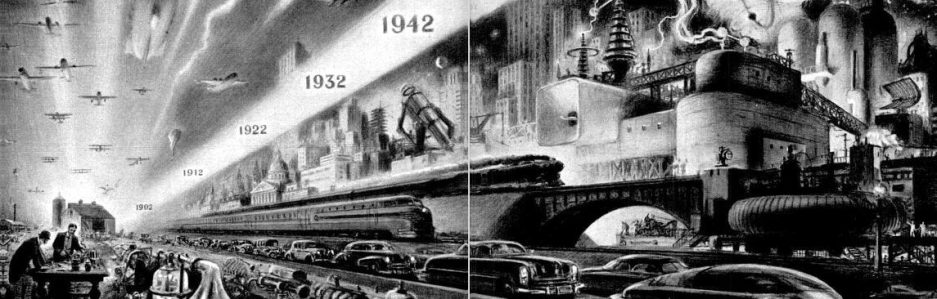
William Robinson Leigh - '"Visionary City," 1908
William Robinson Leigh – ‘”Visionary City,” 1908

Virginia Postrel thinks that Peter Thiel is wrong about the future. I think she is about half right, roughly.

If I read her correctly, Postrel’s thesis runs something like this: our lack of optimism about the future is not the consequence of fewer “moonshot” technological innovations, rather it stems from a failure to tell positive stories about the incremental improvements that have made the present better than the past.

In what follows, I want to take a close look at Postrel’s argument and some of its underlying assumptions because I think the piece reflects some interesting tensions in our thinking about technology and innovation.

Let’s start where Postrel does, with her examples of what I’m going to start calling Tech Stagnation Angst (TSA–sure there’s another TSA out there, but maybe the overlap is instructive).

Her points of departure are the science-fiction author Neal Stephenson and, big surprise, our would-be Francis Bacon, the tech-entrepreneur cum philosopher of innovation, Peter Thiel.

I’ve written enough about Thiel (e.g., here and here) to let mention of him go without further comment. Bottom line: yes, he’s is poster-boy for TSA. Now here’s Postrel quoting Stephenson on the worries that spurred him to write a series of positive stories about the future:

“’I worry that our inability to match the achievements of the 1960s space program might be symptomatic of a general failure of our society to get big things done,’ writes Stephenson in the preface to ‘Hieroglyph,’ a science-fiction anthology hoping ‘to rekindle grand technological ambitions through the power of storytelling.’”

Here’s the first point I want to register: stories alone will not shape our outlook about the future, especially not if they’re consciously designed to do so.

I’ve also recently written about pleas for more hopeful science-fiction writing, pleas which seem to be a symptom of TSA. Needless to say, Stephenson is not the only one who thinks that dystopian science-fiction is poisoning our imagination for the future. Witness, for instance, Kevin Kelly’s recent offer of cash for the best happy 100-word story about the next 100 years.

About these, Postrel is mostly right–writing happy stories will not change the spirit of the age. Stories are powerful, and they can shape our imagination. But compelling fiction tends to tap into some existing aspect of the zeitgeist rather than consciously setting out to change it. The artificiality of the latter enterprise dooms it. It’s that whole thing about how you can’t tell someone how to sublimate.

Postrel adds the following public comments by Stephenson:

“’There’s an automatic perception … that everything’s dangerous,’ Stephenson mused at a recent event in Los Angeles, citing the Stonehenge example, ‘and that there’s some cosmic balance at work–that if there’s an advance somewhere it must have a terrible cost. That’s a hard thing to fix, but I think that if we had some more interesting Apollo-like projects or big successes we could point to it might lift that burden that is on people’s minds.’”

Postrel comments: “He’s identified a real problem, but his remedy — ‘more interesting Apollo-like projects’ — won’t work.” Again, I think Postrel is right, but only to an extent.

She is, on the one hand, right to challenge the simplistic fix that Stephenson lays out. But there are at least two additional points that need to be made.

First, while I agree that “more moonshots”–which just now, in my own mental wunderkammer, echoed “more cowbell” is not the right prescription for our time, I think Postrel ignores the degree to which “moonshots” fueled the public imagination for a very long time.

These “moonshots” we keep hearing about longingly might just be shorthand for the phenomena that David Nye labeled the American Technological Sublime. You can click that link to read more about it, but here is the short version: Nye documented responses to new technologies throughout the 19th and early to mid-20th century that verged on religious awe. These experiences were elicited by technologies of tremendous and hitherto unseen scale or dynamism (railroads, the Hoover Dam, skyscrapers, the electrified cityscape, atomic weapons, the Saturn V, etc.), and they were channeled into what amounted to a civil religion, public celebrations of national character and unity.

I would argue that Tech Stagnation Angst is, in fact, a response, wrong-headed perhaps, to the eclipse of the American Technological Sublime, which, as Nye himself explained, by the late 20th century had morphed into what he called the consumer sublime, a tacky simulated (!) version of the genuine experience.

Even if their response is misguided, Stephenson, Thiel, and all of those suffering from TSA are reacting to a real absence. While attitudes toward new technologies were often mixed, as Postrel points out, the popular response to new technologies of a grand scale in America has been overwhelmingly positive (with the exception of the atomic bomb). In fact, the response has been tinged with reverential awe, which functioned to sustain a powerful narrative about American exceptionalism grounded in our technological achievement.

It is only reasonable to expect that the eclipse of such a powerful cultural phenomena would yield a profoundly felt absence and not a little bit of anxiety. Again, I’m not endorsing the idea that we need only fabricate some more sublime experiences with moonshot-style projects and everything will be fine. On that score, I think Postrel is right. But in insisting that past optimism was chiefly grounded in relatively mundane accounts of how the present was incrementally better than the past, I think she misses other powerful forces at work in the complex way Americans came to think about technology in relation to the future.

In sum, technological projects of impressive scale and power have fueled America’s optimism about technology, thus their absence may very well account for tech stagnation angst. 

Postrel seems to waver with respect to the power of stories to shape the future, and she does so in a way that reinforces my point about the collapse of the sublime. “Stephenson and Thiel are making a big mistake,” Postrel writes, “when they propose a vision of the good future that dismisses the everyday pleasures of ordinary people — that, in short, leaves out consumers.” She then adds that, “storytelling does have the potential to rekindle an ideal of progress.”

As I’ve argued elsewhere, and as Nye suggested, it is precisely the triumph of consumerism that, in part at least, accounts for the eclipse of the American Technological Sublime. To be clear, this is not a judgment call about the relative merits of consumer technology vs. moonshot/sublime technologies. It is simply a recognition of a historical feedback loop.

Innovation in a democratic, free-market society is driven by public sentiment; public sentiment is informed by our imaginative estimation of the good technology can achieve. In the American context at least, that imaginative estimation was shaped by the experience of the technological sublime. Once public sentiment became more narrowly consumeristic in the post-war period, technological innovation followed suit and, as a result, experience of the sublime faded. Fewer experiences of the sublime assured the ongoing collapse of innovation into consumer technology, narrowly conceived.

My second quibble with Postrel arises from her bristling at any criticisms of tech. Toward the end of her essay she calls for stories that do not “confuse pessimism with sophistication or, conversely, to demand that optimism be naive.” But she seemingly has very little patience with criticism of the sort that might temper naive optimism. In this respect, she is not unlike some of the tech-boosters she criticizes. It’s just that she would have us be happy with the technologies the industry has given us rather than pine for more grandiose varieties. Whatever we do, it seems we shouldn’t complain. Don’t complain about what you haven’t gotten, and don’t complain about what you have. Basically, just happily embrace whatever the tech industry feeds you.

She complains, for example, that it is “depressing to see just about any positive development — a dramatic decline in the need for blood transfusions, for instance — greeted with gloom.” Click on that story and you will find fairly even-keeled and reasonable reporting on the consequences of the decreased demand for blood, consequences having to do both with jobs and future preparedness. It’s hardly depressing or gloomy. Elsewhere, with respect to Stephenson’s complaints about the relative triviality of Internet-based technologies, she tells us there’s already plenty of negative press out there, no need for Stephenson to pile on.

Then she goes on to tell us, “The reason mid-20th-century Americans were optimistic about the future wasn’t that science-fiction writers told cool stories about space travel.” Rather, she explains, “People believed the future would be better than the present because they believed the present was better than the past. They constantly heard stories — not speculative, futuristic stories but news stories, fashion stories, real-estate stories, medical stories — that reinforced this belief.” In other words, stories did matter, but only certain kinds of stories–real-life stories about how life was getting better.

Unfortunately, these stories began to change. Postrel goes on to give a litany of reasons “good and bad” explaining the change in the character of stories. Read the grouping of reasons for yourself, but they seem to amount to a recognition of the costs that came along with the advent of certain technologies and innovations. And to give these reasonable concerns and legitimate observations the pallor of unhinged lunacy, she caps the litany off with reference to the unfortunate growing resistance to vaccinations. See what she did there?

Postrel is right to stress that how we feel about the future has something to do with how we understand the present in light of the past (even though that’s not the whole story), and she is right to ask for something other than fashionable pessimism and naive optimism. But on the whole she seems to miss this balance herself. As I read her, she is calling for a balanced presentation of the relative merits and costs of technology, so long as we keep quiet about those costs.

Clearly, I have some reservations about the manner in which Postrel has made her case. On the one hand, with respect to what shapes our view of the future, I think she’s missed some important elements. Of course, one can’t be expected to say everything in a short piece. More importantly, I find her bristling at the critics of technology disingenuous. How else are we to temper our utopian expectations and the misguided longing for “moonshot” technologies if we are to forego searching criticism?

I want to wrap up, though, by commending Postrel’s urging that we seek to move forward with a clear-eyed vision for the future that eschews both unbridled optimism and thoughtless pessimism, one that seeks to meet our real needs and enrich our lives in a responsible and ethical manner.

Simply saying so, of course, will not make it happen. But if we’ve lost our taste for escapist fantasies of transcendence about the future, perhaps we might then be better prepared to pursue a more humane vision for our future technologies.

Simulated Futures

There’s a lot of innovation talk going on right now, or maybe it is just that I’ve been more attuned to it of late. Either way, I keep coming across pieces that tackle the topic of technological innovation from a variety of angles.

While not narrowly focused on technological innovation, this wonderfully discursive post by Alan Jacobs raises a number of relevant considerations. Jacobs ranges far and wide, so I won’t try to summarize his thoughts here. You should read the whole piece, but here is the point I want to highlight. Taking a 2012 essay by David Graeber as his point of departure, Jacobs asks us to consider the following:

“How were we taught not even to dream of flying cars and jetpacks? — or, or for that matter, an end to world hunger, something that C. P. Snow, in his famous lecture on ‘the two cultures’ of the sciences and humanities, saw as clearly within our grasp more than half-a-century ago? To see ‘sophisticated simulations’ of the things we used to hope we’d really achieve as good enough?”

Here’s the relevant passage in Graeber’s essay. After watching one of the more recent Star Wars films, he wonders how impressed with the special effects audiences of the older, fifties-era sci-fi films would be. His answer upon reflection: not very. Why? Because “they thought we’d be doing this kind of thing by now. Not just figuring out more sophisticated ways to simulate it.” Graeber goes on to add,

“That last word—simulate—is key. The technologies that have advanced since the seventies are mainly either medical technologies or information technologies—largely, technologies of simulation. They are technologies of what Jean Baudrillard and Umberto Eco called the ‘hyper-real,’ the ability to make imitations that are more realistic than originals. The postmodern sensibility, the feeling that we had somehow broken into an unprecedented new historical period in which we understood that there is nothing new; that grand historical narratives of progress and liberation were meaningless; that everything now was simulation, ironic repetition, fragmentation, and pastiche—all this makes sense in a technological environment in which the only breakthroughs were those that made it easier to create, transfer, and rearrange virtual projections of things that either already existed, or, we came to realize, never would.”

Here again is the theme of technological stagnation, of the death of genuine innovation. You can read the rest of Graeber’s piece for his own theories about the causes of this stagnation. What interested me was the suggestion that we’ve swapped genuine innovation for simulations. Of course, this interested me chiefly because it seems to reinforce and expand a point I made in yesterday’s post, that our fascination with virtual worlds may stem from the failure of our non-virtual world to yield the kind of possibilities for meaningful action that human beings crave.

As our hopes for the future seem to recede, our simulations of that future become ever more compelling.

Elsewhere, Lee Billings reports on his experience at the 2007 Singularity Summit:

“Over vegetarian hors d’oeuvres and red wine at a Bay Area villa, I had chatted with the billionaire venture capitalist Peter Thiel, who planned to adopt an ‘aggressive’ strategy for investing in a ‘positive’ Singularity, which would be ‘the biggest boom ever,’ if it doesn’t first ‘blow up the whole world.’ I had talked with the autodidactic artificial-intelligence researcher Eliezer Yudkowsky about his fears that artificial minds might, once created, rapidly destroy the planet. At one point, the inventor-turned-proselytizer
 Ray Kurzweil teleconferenced in to discuss,
among other things, his plans for becoming transhuman, transcending his own biology to 
achieve some sort of
 eternal life. Kurzweil
 believes this is possible, 
even probable, provided he can just live to see
 The Singularity’s dawn, 
which he has pegged at 
sometime in the middle of the 21st century. To this end, he reportedly consumes some 150 vitamin supplements a day.”

Billings also noted that many of his conversations at the conference “carried a cynical sheen of eschatological hucksterism: Climb aboard, don’t delay, invest right now, and you, too, may be among the chosen who rise to power from the ashes of the former world!”

Eschatological hucksterism … well put, indeed. That’s a phrase I’ll be tucking away for future use.

And that leads me to the concluding chapter of David Noble’s The Religion of Technology: The Divinity of Man and the Spirit of Invention. After surveying the religiously infused motives and rhetoric animating technological projects as diverse as the pursuit of AI, space exploration, and genetic engineering, Noble wrote

“As we have seen, those given to such imaginings are in the vanguard of technological development, amply endowed and in every way encouraged to realize their escapist fantasies. Often displaying a pathological dissatisfaction with, and deprecation of, the human condition, they are taking flight from the world, pointing us away from the earth, the flesh, the familiar–‘offering salvation by technical fix,’ in Mary Midgley’s apt description–all the while making the world over to conform to their vision of perfection.”

A little further on he concluded,

“Can we any longer afford to abide this system of blind belief? Ironically, the technological enterprise upon which we now ever more depend for the preservation and enlargement of our lives betrays a disdainful disregard for, indeed an impatience with, life itself. If dreams of technological escape from the burdens of mortality once translated into some relief of the human estate, the pursuit of technological transcendence has now perhaps outdistanced such earthly ends. If the religion of technology once fostered visions of social renovation, it also fueled fantasies of escaping society altogether. Today these bolder imaginings have gained sway, according to which as on philosopher of technology recently observed, ‘everything which exists at present … is deemed disposable.’ The religion of technology, in the end, ‘rests on extravagant hopes which are only meaningful in the context of transcendent belief in a religious God, hopes for a total salvation which technology cannot fulfill …. By striving for the impossible, [we] run the risk of destroying the good life that is possible.’ Put simply, the technological pursuit of salvation has become a threat to our survival.”

I’ll leave you with that.

Building Worlds In Which We Matter

Sometimes, when you start writing, you end up somewhere very different from where you thought you were going at the outset. That’s what happened with my last post which ended up framing Peter Thiel as a would-be, latter-day Francis Bacon. What I set out to write about, however, was the closing line of this paragraph:

“Indefinite longevity—as opposed to the literal immortality promised by the Singularity—might be considered to be in the spirit of the great founder Machiavelli. At the end of ‘You Are Not a Lottery Ticket,’ however, Thiel calls for a ‘cultural revolution’ that allows us to plan to make our futures as definite as possible. That means no more taking orders from John Rawls or Malcolm Gladwell; they are too accepting of the place of luck (or fortuna, to use Machiavelli’s word) in human affairs. It also means ‘rejecting the unjust tyranny of Chance’ by seeing that ‘You can have agency not just over your own life, but over a small and important part of the world.’”

That’s from Peter Lawler’s discussion Thiel’s understanding of the role of luck in a start-up’s success, or lack thereof. In short, Thiel thinks we are in danger of making too much of luck. In fact, he hopes to mitigate the role of chance as much as possible. He would have us maximize our control and mastery over the chaotic flow of time. This was in part what elicited the comparison to Francis Bacon.

What first caught my attention, however, was that line from Thiel quoted at the end of the paragraph: “You can have agency not just over your own life, but over a small and important part of the world.”

More specifically, it was the last clause that piqued my interest. I read this desire to have agency “over a small and important part of the world” in light of Hannah Arendt’s theory of action. Action, in her view, is the most important shape our “doing” takes in this world. In her three-fold account of our doing, there is labor, which seeks to meet our basic bodily needs; there is also work, through which we build up an enduring life-world of artifice and culture; and then there is action.

Here is how Arendt describes action in an oft-cited passage from The Human Condition:

“Action, the only activity that goes on directly between men without the intermediary of things or matter, corresponds to the human condition of plurality … this plurality is specifically the condition — not only the conditio sine qua non, but the conditio per quam — of all political life ”

Action is a political category, it is possible only in the context of plurality when men and women are present to each other. Plurality is one condition of action; the other is freedom. This is not freedom understood merely as a lack of constraint, but rather as the ability to initiate, to begin something, to create (the power Arendt called natality). It is through this action that men and women disclose their true selves and ground their identity. Action discloses not only “what” we are, but “who” we are.

There’s much more that could be said, the category of action is central to Arendt’s political theory, but that should be enough to ground what follows. Arendt worried about the loss of public spaces in which human beings might engage in action. She distinguished between the private, the social, and the public. Roughly put, the private is the sphere of the family and the household. The public is the sphere in which we may act in a self-disclosing manner as described above, where we might express the fullness of our humanity. The social is the realm of bureaucracy and the faceless crowd; rather than self-disclosure, it is the realm of anonymity that forecloses the possibility of action.

I find Arendt’s conception of action and identity compelling. If Aristotle is right and we are political animals, then to some degree we seek to appear in a meaningful fashion among our peers, to act and to be acknowledged. And this is how I read the unspoken subtext of Thiel’s desire to exert agency over a small and important part of the world.

But what if, as Arendt worried in the mid-twentieth century, the world we have built is not amenable to action and self-disclosure? What if we have gradually eliminated the public spaces in which action was possible. Remember, public here does not simply refer to any physical space that someone might freely enter like a park. Rather it is a space constituted by the gathering of people and in which individuals can act in a meaningful and consequential manner.

If our world is one in which we find it increasingly difficult to appear before others in a meaningful fashion, then we have perhaps two options left to us. One might be to force our appearance upon the world by actions of such dramatic scale that they are able to register in the social world, even if just fleetingly. This sort of action, which is not truly action in Arendt’s sense, tends to be rare and frequently destructive.

The other option, of course, is to find or create a world in which action matters. I immediately thought of the immensely popular online game Minecraft. To be clear, I have never played Minecraft; these are the observations of an outsider. I’ve only seen it played and read about it. In fact, Robin Sloan’s recent piece about the game explains why it is kicking around in my mind just now.

Minecraft_city_hallAccording to Sloan, the secret of Minecraft is that “it does not merely allow […] co-creation but requires it.” In other words, in Minecraft is a virtual world in which you work in the midst of others and create with them. Behold: freedom and plurality (of sorts), and thus action. And, of course, it is not only Minecraft. Consider as well the tremendous popularity of multiplayer online role-playing games like World of Warcraft. In these cases, players inhabit virtual worlds in which they may appear before others and act with consequence to win a victory or secure a goal.

I understand, of course, that, at best, I am using the words appear, act, and consequence in a manner that is merely analogical to what Arendt meant by these same words. But the analogical relationship may tell us something about the appeal of these virtual worlds. Conversely, their popularity may also tell us something about our (non-virtual) world.

This brings me, finally, to the point I first set out to make–really, it is a question I’d like to pose (at the expense of egregious digital dualism): Are we building and participating in virtual worlds where our actions matter because in the real world, they don’t?

Let me expand on that question with a hypothetical scenario. I read recently about one man’s vision for ameliorating dire living conditions in a potential future when urban housing is reduced to 100 square-foot windowless apartments. The solution: “‘Mixed Reality Living Spaces,’ where technology is used to create immersive environments that give the inhabitant an illusion of living in a much larger, well-lit space.” I came across that article on Twitter via Christopher Mims. Frank Pasquale likened the scenario to a variation of the living arrangements in Forster’s “The Machine Stops.” I kicked in a comparison to the multimedia walls that Ray Bradbury imagined in Fahrenheit 451, the well-to-do could afford four screen-walls for total immersion.

Imagine, if you will, a future in which people have retreated into immersive media environments, private worlds masquerading as faux-public spheres, where they find it possible to engage in something that approximates meaningful action in the (virtual) presence of others.

In imagining such a scenario it would be far too easy to complain about the hapless masses that so easily retreat into their own personal holodecks, abandoning the world in favor of their escapist fantasies. It would be far too easy because it would avoid the more important consideration. How did we arrive at a society in which virtual worlds afforded the only possibility for meaningful, self-disclosing action that most people would ever encounter?

That scenario, of course, extrapolates in exaggerated fashion from a few present realities. Nonetheless, it gets at questions worth considering. If Arendt is right about the role and significance of what she calls action, then it is right and appropriate that individuals seek it. Where might individuals find these public spaces today? How can we ensure the possibility for meaningful action in the world? How can we avoid a world in which people are drawn into virtual worlds because it is only there that they feel they matter?

Our Very Own Francis Bacon

Francis BaconFew individuals have done as much to chart the course of science and technology in the modern world as the the Elizabethan statesmen and intellectual, Francis Bacon. But Bacon’s defining achievement was not, strictly speaking, scientific or technological. Rather, Bacon’s achievement lay in the realm of human affairs we would today refer to as “public relations.” Bacon’s genius was Draper-esque: he wove together a compelling story about the place of techno-science in human affairs from the loose threads of post-Reformation religious and political culture and the scientific breakthroughs we loosely group together as the Scientific Revolution.

In story he told, knowledge mattered only insofar as it yielded power (the well-known formulation, “knowledge is power,” is Bacon’s), and that power mattered only insofar as it was directed toward “the relief of man’s estate.” To put that less archaically, we might say “the improvement of our quality of life.” But putting it that way obscures the theological overtones of Bacon’s formulation and its allusion to the curse under which humanity labored as a consequence of the Fall in the Christian understanding of the human condition. Our problem was both spiritual and material, and Bacon believed that in his day both facets of that problem were being solved. The improvement of humanity’s physical condition went hand in hand with the restoration of true religion occasioned by the English Reformation, and together they would lead straight to the full restoration of creation.

Bacon’s significance, then, lay in merging science and technology into one techno-scientific project and synthesizing this emerging project with the dominant world picture, thus charting it’s course and securing its prestige. It is just this sort of expansive vision driving technological development that I’ve had in mind in my recent posts (here and here) regarding culture, technology, and innovation.

My recent posts have also mentioned the entrepreneur Peter Thiel, who is increasingly assuming the role of Silicon Valley’s leading public intellectual–the Sage of Silicon Valley, if you will. This morning, I was re-affirmed in that evaluation of Thiel’s position by a pair of posts by political philosopher, Peter Lawler. In the first of these posts, Lawler comments on Thiel’s seeming ubiquity in certain circles, and he rehearses some of the by-now familiar aspects of Thiel’s intellectual affinities, notably for the sociologist cum philosopher Rene Girard and the political theorist Leo Strauss. Chiefly, Lawler discusses Thiel’s flirtations with transhumanism, particularly in his recently released Zero to One: Notes on Startups, or How to Build the Future, a distilled version of Thiel’s 2012 lecture course on start-ups at Stanford University.

(The book was prepared with Blake Masters, who had previously made available detailed notes on Thiel’s course. I’ll mention in passing that that tag line on Masters’ website runs as follows: “Your mind is software. Program it. Your body is a shell. Change it. Death is a disease. Cure it. Extinction is approaching. Fight it.”)

As it turns out, Francis Bacon makes a notable appearance in Thiel’s work. Here is Lawler summarizing that portion of the book:

“In the chapter entitled ‘You Are Not a Lottery Ticket,’ Thiel writes of Francis Bacon’s modern project, which places “prolongation of life” as the noblest branch of medicine, as well the main point of the techno-development of science. That prolongation is at the core of the definite optimism that should drive ‘the intelligent design’ at the foundation of technological development. We (especially we founders) should do everything we can “to prioritize design over chance.” We should do everything we can to remove contingency from existence, especially, of course, each of our personal existences.”

The “intelligent deign” in view has nothing to do, so far as I can tell, with the theory of human origins that is the most common referent for that phrase. Rather, it is Thiel’s way of labeling the forces of consciously deployed thought and work striving to bring order out of the chaos of contingency. Intelligent design is how human beings assert control and achieve mastery over their world and their lives, and that is an explicitly Baconian chord to strike.

Thiel, worried by the technological stagnation he believes has set in over the last forty or so years, is seeking to reanimate the technological project by once again infusing it with an expansive, dare we say mythic, vision of its place in human affairs. It may not be too much of a stretch to say that he is seeking to play the role of Francis Bacon for our age.

Like Bacon, Thiel is attempting to fuse the disparate strands of emerging technologies together into a coherent narrative of grandiose scale. And his story, like Bacon’s, features distinctly theological undertones. The chief difference may be this: whereas the defining institution of the early modern period was the nation-state, itself a powerful innovation of the period, the defining institution in Thiel’s vision is the start-up. As Lawler puts it, “the startup has replaced the country as the object of the highest human ambition. And that’s the foundation of the future that comes from being ruled by the intelligent designers who are Silicon Valley founders.”

Lawler is right to conclude that “Peter Thiel has emerged as the most resolute and most imaginative defender of the distinctively modern part of Western civilization.” Bacon was, after all, one of the intellectual founders of modernity, on par, I would say, with the likes of Descartes and Locke. But, Lawler adds,

“that doesn’t mean that, when it comes to the libertarian displacement of the nation by the startup and the abolition of all contingency from particular personal lives, his imagination and his self-importance don’t trump his astuteness. They do. His theology of liberation is that we, made in the image of God, can do for ourselves what the Biblical Creator promised—free ourselves from the misery of being self-conscious mortals dependent on forces beyond our control.”

And that is, as Lawler notes in his follow-up post, a rather ancient aspiration. Indeed, Thiel, who professes an admittedly heterodox variety of Christianity, may do well to remember that to say we are made in the image of God is one way of saying we are not, the Whole Earth Catalog notwithstanding, gods ourselves. This, it would seem, is a hard lesson to learn.

_______________________________

Update: On Twitter, I was made aware of a talk by Thiel at SXSW in 2013 on the topic of the chapter discussed above. Here it is (via @carlamomo).

Technology Will Not Save Us

A day after writing about technology, culture, and innovation, I’ve come across two related pieces.

At Walter Mead’s blog, the novel use of optics to create a cloaking effect provided a springboard into a brief discussion of technological innovation. Here’s the gist of it:

“Today, Big Science is moving ahead faster than ever, and the opportunities for creative tinkerers and home inventors are greater than ever. but the technology we’ve got today is more dynamic than what people had in the 19th and early 20th centuries. IT makes it possible to invent new services and not just new gadgets, though smarter gadgets are also part of the picture.

Unleashing the creativity of a new generation of inventors may be the single most important educational and policy task before us today.”

And …

“Technology in today’s world has run way ahead of our ability to exploit its riches to enhance our daily lives. That’s OK, and there’s nothing wrong with more technological progress. But in the meantime, we need to think much harder about how we can cultivate and reward the kind of innovative engineering that can harness the vast potential of the tech riches around us to lift our society and ultimately the world to the next stage of human social development.”

Then in this weekend’s WSJ, Walter Isaacson has a feature essay titled, “Where Innovation Comes From.” The essay is in part a consideration of the life of Alan Turing and his approach to AI. Isaacson’s point, briefly stated, is that, in the future, innovation will not come from so-called intelligent machines. Rather, in Isaacson’s view, innovation will come from the coupling of human intelligence and machine intelligence, each of them possessed of unique powers. Here is a representative paragraph:

“Perhaps the latest round of reports about neural-network breakthroughs does in fact mean that, in 20 years, there will be machines that think like humans. But there is another possibility, the one that Ada Lovelace envisioned: that the combined talents of humans and computers, when working together in partnership and symbiosis, will indefinitely be more creative than any computer working alone.”

I offer these two you for your consideration. As I read them, I thought again about what I had posted yesterday. Since the post was more or less stream of consciousness, thinking by writing as it were, I realized that an important qualification remained implicit. I am not qualified to speak about technological innovation from the perspective of the technologist or the entrepreneur. Quite frankly, I’m not sure I’m qualified to speak about technological innovation from any vantage point. Perhaps it is simply better to say that my interests in technological innovation are historical, sociological, and ethical.

For what it is worth, then, what I was after in my previous post was something like the cultural sources of technological innovation. Assuming that technological innovation does not unfold in a value-neutral vacuum, then what cultural forces shape technological innovation? Many, of course, but perhaps we might first say that while technological innovation is certainly driven by cultural forces, these cultural forces are not the only relevant factor. Those older philosophers of technology who focused on what we might, following Aristotle, call the formal and material causes of technological development were not altogether misguided. The material nature of technology imposes certain limits upon the shape of innovation. From this angle, perhaps it is the case that if innovation has stalled, as Peter Thiel among others worry, it is because all of the low-hanging fruit has been plucked.

When we consider the efficient and final causes of technological innovation, however, we enter the complex and messy realm human desires and cultural dynamics. It is in this realm that the meaning of technology and the direction of its unfolding is shaped. (As an aside, we might usefully frame the perennial debate between the technological determinists and the social constructivists as a failure to hold together and integrate Aristotle’s four causes into our understanding of technology.) It is this cultural matrix of technological innovation that most interests me, and it was at this murky target that my previous post was aimed.

Picking up on the parenthetical comment above, one other way of framing the problem of technological determinism is by understanding it as type of self-fulfilling prophecy. Or, perhaps it is better to put it this way: What we call technological determinism, the view that technology drives history, is not itself a necessary characteristic of technology. Rather, technological determinism is the product of cultural capitulation. It is a symptom of social fragmentation.

Allow me to borrow from what I’ve written in another context to expand on this point via a discussion of the work of Jacques Ellul.

Ellul defined technique (la technique) as “the totality of methods rationally arrived at and having absolute efficiency (for a given stage of development) in every field of human activity.” This is an expansive definition that threatens, as Langdon Winner puts it, to make everything technology and technology everything. But Winner is willing to defend Ellul’s usage against its critics. In Winner’s view, Ellul’s expansive definition of technology rightly points to a “vast, diverse, ubiquitous totality that stands at the center of modern culture.”

Although Winner acknowledges the weaknesses of Ellul’s sprawling work, he is, on the whole, sympathetic to Ellul’s critique of technological society. Ellul believed that technology was autonomous in the sense that it dictated its own rules and was resistant to critique. “Technique has become autonomous,” Ellul concluded, “it has fashioned an omnivorous world which obeys its own laws and which has renounced all tradition.”

Additionally, Ellul claimed that technique “tolerates no judgment from without and accepts no limitation.” Moreover, “The power and autonomy of technique are so well secured that it, in its turn, has become the judge of what is moral, the creator of a new morality.” Ellul’s critics have noted that in statements such as these, he has effectively personified technology/technique. Winner thinks that this is exactly the case, but in his view this is not an unintended flaw in Ellul’s argument, it is his argument: “Technique is entirely anthropomorphic because human beings have become thoroughly technomorphic. Man has invested his life in a mass of methods, techniques, machines, rational-productive organizations, and networks. They are his vitality. He is theirs.”

And here is the relevant point for the purposes of this post: Elllul claims that he is not a technological determinist.

By this he means that technology did not always hold society hostage, and society’s relationship to technology did not have to play out the way that it did. He is merely diagnosing what is now the case. He points to ancient Greece and medieval Europe as two societies that kept technology in its place as it were, as means circumscribed and directed by independent ends. Now as he sees it, the situation is reversed. Technology dictates the ends for which it alone can be the means. Among the factors contributing to this new state of affairs, Ellul points to the rise of individualism in Western societies. The collapse of mediating institutions fractured society, leaving individuals exposed and isolated. Under these conditions, society was “perfectly malleable and remarkably flexible from both the intellectual and material points of view,” consequently “the technical phenomenon had its most favorable environment since the beginning of history.”

This last consideration is often forgotten by critics of Ellul’s work. In any case, it is in my view, a point that is tremendously relevant to our contemporary discussions of technological innovation. As I put it yesterday, our focus on technological innovation as the key to the future is a symptom of a society in thrall to technique. Our creative and imaginative powers are thus constrained and caught in a loop of diminishing returns.

I hasten to add that this is surely not the whole picture, but it is, I think, an important aspect of it.

One final point related to my comments about our Enlightenment heritage. It is part of that heritage that we transformed technology into an idol of the god we named Progress. It was a tangible manifestation of a concept we deified, took on faith, and in which we invested our hope. If there is a palpable anxiety and reactionary defensiveness in our discussions about the possible stalling of technological innovation, it is because, like the prophets of Baal, we grow ever more frantic and feverish as it becomes apparent that the god we worshipped was false and our hopes are crushed. And it is no small things to have your hopes crushed. But idols always break the hearts of their worshippers, as C.S. Lewis has put it.

Technology will not save us. Paradoxically, the sooner we realize that, the sooner we might actually begin to put it to good use.