Weekend Reading, 12/10/11

Short and to the point this week.

“Solitude and Political Friendship” by Anthony Esolen in Public Discourse: On the difference between solitude and isolation. Wise reflections.

“Out of Body Experience: Master of Illusion” by Ed Yong in Nature: On experiments exploring body image, perception, sense of self, etc.

“Beardless in Barnesville” by Joshua Glenn in HiLobrow: Lovely essay, first published in 1996, on the Second Luddite Congress.

“Dear Amazon: You Really, Really Suck” at Advent Book Blog: Very short post on a disconcerting Amazon sales tactic and what to do instead.

“You Say You Want a Devolution” by Kurt Anderson in Vanity Fair: “Or maybe, I worry some days, this is the way that Western civilization declines, not with a bang but with a long, nostalgic whimper.” Not as dramatic as all that, but an interesting look at the stagnation culture over the last twenty years.

“Hugo Addendum: The Film in Context” by Adam Batty at Hope Lies at 24 Frames per Second: Excellent post on the film history that forms the context of Hugo. H/T Mr. Gladding.

The Frictionless Life and Its Discontents: You Heard It Here First

Nick Carr links to a post by Michael Loukides, “The End of the Social,” which takes aim at the automated sharing of music via the Spotify/Facebook alliance. Loukides observes:

“It is meaningful if I tell you that I really like the avant-garde music by Olivier Messiaen. It’s also meaningful to confess that I sometimes relax by listening to Pink Floyd. But if this kind of communication is replaced by a constant pipeline of what’s queued up in Spotify, it all becomes meaningless. There’s no “sharing” at all. Frictionless sharing isn’t better sharing; it’s the absence of sharing. There’s something about the friction, the need to work, the one-on-one contact, that makes the sharing real, not just some cyber phenomenon. If you want to tell me what you listen to, I care. But if it’s just a feed in some social application that’s constantly updated without your volition, why do I care?”

Loukides in turn links to a post by Andrés Monroy-Hernández, “In Defense of Friction,” in which the author takes aim at systems of automated trust in online environments. He also challenges the ideal of frictionless social interactions:

“In many scenarios, automation is quite useful, but with social interactions, removing friction can have a harmful effect on the social bonds established through friction itself. In other cases, as Shauna points out, ‘social networking sites are good for relationships so tenuous they couldn’t really bear any friction at all.’

I am not sure if sharing has indeed been ruined by Facebook, but perhaps this opens new opportunities for new online services that allow people to have ‘friction-full’ interactions.”

Following the potential rabbit hole one link further, Monroy-Hernández links to a post by Molly Wood on the pitfalls of frictionless sharing:

Frictionless sharing via Open Graph recasts Facebook’s basic purpose, making it more about recommending and archiving than about sharing and communicating. That’s a potentially dangerous strategy–not just because oversharing diminishes our interest in sharing but also because it’s tweaking the formula that made the site a winner in the first place.

All of this to remind you that you heard it here first: A Frictionless Life is Also a Life Without Traction.

Traction implies resistance and sometimes trouble, but it also presents us with the opportunity to navigate meaningfully.  A frictionless life may promise ease and a certain security, but it also leaves us adrift, chasing one superficial pleasure after another; never satisfied, because we never experience the struggle against resistance that is essential to a sense of accomplishment.  The trajectory of our desire toward a frictionless life, then, may paradoxically leave us unable to find meaningful satisfaction or a sense of fulfillment.

Read the rest if you missed it the first time back in May.

Glad the notion is catching on!

The Machinery of Poetry?

John Stuart Mill in the Westminster Review from 1831:

“It would be a pity that poetry should be an exception to the Great Law of progress that attains in human affairs: and it is not. The machinery of a poem is not less susceptible of improvement than the machinery of a cotton mill; nor is there any better reason why the one should retrograde from the days of Milton than the other from those of Arkwright.”

My only question is this: how does a thinker as subtle as Mill (perhaps I’m giving him too much credit) make such an evidently egregious category mistake? Is it the power of the myth of the machine or is it the power of metaphor? Both I suspect.

“Mechanical in Head and Heart”: Carlyle and Darwin on the Mind as Machine

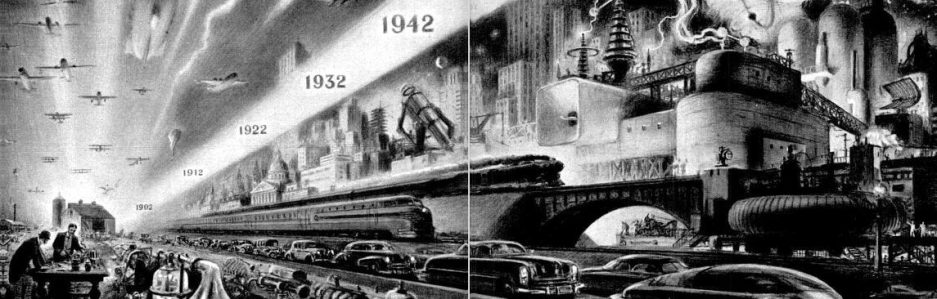
In last week’s post on Leo Marx and the sources of technological pessimism, I noted that Marx alludes to an 1829 essay by Thomas Carlyle, “Sign of the Times,” in which Carlyle describes his era as an “Age of Machinery.” Here is the fuller context of that phrasing:

“Were we required to characterize this age of ours by any single epithet, we should be tempted to call it, not an Historical, Devotional, Philosophical, or Moral Age, but above all others, the Mechanical Age. it is the Age of Machinery, in every outward and inward sense of that word: the age which, with its whole undivided might, forwards, teaches and practices the great art of adapting means to ends.”

More from Carlyle:

“Not the external and physical alone is now managed by machinery, but the internal and spiritual also …. The same habit regulates not our modes of action alone, but our modes of thought and feeling. Men are grown mechanical in head and heart, as well as in hand. They have lost faith in individual endeavors, and in natural force, of any kind. Not for internal perfection but for external combinations and arrangements for institutions, constitutions, for Mechanism of one sort or another, do they hope and struggle.”

In Christian Worship and Technological Change, Susan J. White, pairs Carlyle’s sentiment with the following passage from Darwin’s “Recollections of the Development of My Mind and Character”:

“I have said that in one respect my mind has changed in the last twenty or thirty years. Up to the age of thirty, poetry of many kinds … gave me great pleasure, and even as a schoolboy I took intense delight in Shakespeare. But now for many years I cannot read a line of poetry; I have tried lately to read Shakespeare, and found it so intolerably dull that it nauseated me. I have also almost lost my taste for pictures or music …. My mind seems to have become a kind of machine for grinding general laws out of a large collection of facts.”

First of all, this latter self-diagnosis is terribly sad. One hopes that Darwin’s experience is not suggestive of a general tendency, even as one suspects that it may very well be.

Secondly, Carlyle and Darwin, in their own way, intuited what later scholars including Mumford and McLuhan would formalize into theory: our habits of mind and patterns of thought have a way of adapting themselves to our technological environment.

Ours, however, is no longer an Age of Machinery in the same way. How might we update Carlyle’s and Darwin’s observations to better fit our own time? How might we label our age? How has our technological environment worked its way into our heads and hearts?
Embodied Art

Annie Dillard on the embodied nature of art:

“The body of literature, with its limits and edges, exists outside some people and inside others. Only after the writer lets literature shape her can she perhaps shape literature. In working-class France, when an apprentice got hurt, or when he got tired, the experienced workers said, ‘It is only the trade entering his body.’ The art must enter the body, too. A painter cannot use paint like glue or screws to fasten down the world. The tubes of paint are like fingers; they work only if, inside the painter, the neural pathways are wide and clear to the brain. Cell by cell, molecule by molecule, atom by atom, part of the brain changes physical shape to accommodate and fit paint.

You adapt yourself, Paul Klee said, to the contents of a paintbox. Adapting yourself to the contents of the paintbox, he said, is more important than nature and its study. The painter, in other words, does not fit the paints to the world. He most certainly does not fit the world to himself. He fits himself to the paint.”

“It is only the trade entering his body.” Love that.

From The Writing Life.