More than a year and half ago, I published two posts, in what was to be a series of three, framing social networking sites, Facebook in particular, within the arts of memory tradition. The third post, for a variety of now forgotten reasons, never appeared. Recent discussion regarding Facebook and memory prompted me to complete what had been left unfinished. Below you will find the complete essay including the text of those two earlier posts, lightly edited, along with the concluding section.
Early in The Art of Memory, Frances Yates pauses to envision a “forgotten social habit” of antiquity. She invites us to wonder,“Who is that man moving slowly in the lonely building, stopping at intervals with an intent face?” That man, Yates tells us, is a “rhetoric student forming a set of memory loci.” The rhetoric student would have been creating the architecture of a mental space into which they would then place vivid images imaginatively designed to recollect the themes or words of a prepared oration. While delivering the oration, the rhetor would navigate the mental space coming upon each carefully placed image which triggered their memory accordingly. This work of designing mental space and populating the space with striking images followed the prescriptions of the techniques of artificial memory widely practiced in classical antiquity.
What if, however, we updated Yates’ scene by setting it in the present? The scene would be instantly recognizable as long as we equipped our imagined person with a cell phone. The stopping at intervals and the intent face would correspond to any of the multiple uses to which an Internet-enabled smart phone may be put: reading or sending a text message, downloading songs, taking or sending pictures and video, updating social media profiles, or finding directions with GPS, to name but a few. What is striking is how often these activities would, like that of the ancient rhetor, involve the work of memory. Much of what cell phones are used for has very little to do with making a phone call, after all. Cell phones are more likely to be used to access the Internet, send a text message, take a picture, or film a video. Given these capabilities cell phones have become prosthetic memory devices; to lose a cell phone would be to induce a state of partial amnesia. Or, it may be better to say it might induce a fear of future amnesia since our ability to approach the present as a field of potential memories would be undermined.
Social networking sites (SNS) are of special interest because of how they explicitly trade in memory. This leads Joanne Garde-Hansen to ask in “MyMemories?: Personal Digital Archive Fever and Facebook,” “If memory and identity can be seen as coterminous and SNSs involve literally digitising ones’ self into being then what is at stake when memories and identities are practiced on Facebook?”
She goes on to add,
“It goes without saying that the allure of the site is in its drawing together in one place memory practices: creating photograph albums, sharing photographs, messaging, joining groups and alumni memberships, making ‘friends’ and staying in touch with family.”
It would be fair to acknowledge that SNS such as Facebook traffic in more than the allure of memory practices. Nonetheless, the production, maintenance, and retrieval of memory is integral to the practices deployed on social networks.
Following Jacques Derrida, Garde-Hansen considers Facebook as an instance of the archiving archive. Thus, she points out, the architecture of a SNS such as Facebook is not neutral with respect to the memories it archives. As Derrida observed,
“… the technical structure of the archiving archive also determines the structure of the archivable content even in its very coming into existence and in its relationship to the future. The archivization produces as much as it records the event.”
Garde-Hansen also draws SNS into the tension between database and narrative addressed by Manovich in The Language of New Media. In her view, the most significant aspect of Manovich’s analysis of new media for SNS is the comparison he draws between the visual organization of digital media interfaces and spatial montage. “Manovich’s emphasis upon spatial narrative is,” according to Garde-Hansen, “extremely pertinent to thinking through the emergence of SNSs and how these sites remediate personal and collective memory.” Framed in this way, memory as spatial montage challenges “the rise and dominance of history,” the “power of the written word” to order the past temporally, and the “twentieth century’s emphasis upon the single, unadulterated image (think cinema).”
Derrida’s insight suggests that the sorts of memories we are able to archive with social media may already be directing our interactions in the present. (For an insightful discussion of this point anchored on an analysis of faux-vintage photography see Nathan Jurgenson’s, “The Faux-Vintage Photo.”) Drawing in Manovich’s database/narrative opposition further suggests that the visual/spatial mode of ordering memories on SNS potentially shifts how meaning is derived from memory and, consequently, how we understand the self.
Returning to the scene suggested by Yates we may also consider SNS such as Facebook as instances of new artificial memory spaces constructed to supplement and augment the natural memory. In the artificial memory tradition we already see memory rendered spatially and visually in a manner that anticipates the representation and organization of memory on SNS. Situating SNS within the long history of spatial and visual memory also affords us the opportunity to consider such sites in the context of a complex and rich tradition of philosophical reflection on the nature of memory.
What emerges is a history of memory practices that alternate between a Platonic focus on memory as the presence of an absence and an Aristotelian emphasis on memory as the record of the past. There are several thematic threads that weave this story together including the opposition of internal memory to memory supported by inscription, the connection between memory and imagination, memory as the index of desire, the related tensions between space and time and databases and narratives, and the relationship of memory to identity. Yet for all the complexity those themes introduce, we will begin with a story.
The Origin of the Arts of Memory
Spatiality, images, and death have long been woven together in the complex history of remembering. Each appears prominently in the founding myth of what Yates called the “art of memory” as it is recounted by Cicero in his De oratore. According to the story, the poet Simonides of Ceos was contracted by Scopas, a Thessalian nobleman, to compose a poem in his honor. To the nobleman’s chagrin, Simonides devoted half of his oration to the praise of the gods Castor and Pollux. Feeling himself cheated out of half of the honor, Scopas brusquely paid Simonides only half the agreed upon fee and told him to seek the rest from the twin gods. Not long afterward that same evening, Simonides was summoned from the banqueting table by news that two young men were calling for him at the door. Simonides sought the two callers, but found no one. While he was out of the house, however, the roof caved in killing all of those gathered around the table including Scopas. As Yates puts it, “The invisible callers, Castor and Pollux, had handsomely paid for their share in the panegyric by drawing Simonides away from the banquet just before the crash.”
The bodies of the victims were so disfigured by the manner of death that they were rendered unidentifiable even by family and friends. Simonides, however, found that he was able to recall where each person was seated around the table and in this way he identified each body. This led Simonides to the realization that place and image were the keys to memory, and in this case, also a means of preserving identity through the calamity of death. In Cicero’s words,
“[Simonides] inferred that persons desiring to train [their memory] must select places and form mental images of the things they wish to remember and store those images in the places, so that the order of the places will preserve the order of the things, and the images of the things will denote the things themselves, and we shall employ the places and images respectively as a wax writing-tablet and the letters written on it.”
Cicero is one of three classical sources on the principles of artificial memory that evolved in the ancient world as a component of rhetorical training. The other two sources are Quintilian’s Institutio oratoria and the anonymous Ad Herennium. It is through the Ad Herennium, mistakenly attributed to Cicero, that the art of memory migrates into medieval culture where it is eventually assimilated into the field of ethics. Cicero’s allusion to the wax-writing table, however, reminds us that discussion of memory in the ancient world was not limited to the rhetorical schools. Memory as a block of wax upon which we make impressions is a metaphor attributed to Socrates in Plato’s Theaetetus where it appears as a gift of Mnemosyne, the mother of the muses:
“Imagine, then, for the sake of argument, that our minds contain a block of wax, which in this or that individual may be larger or smaller, and composed of wax that is comparatively pure or muddy, and harder in some, softer in others, and sometimes of just the right consistency.
Let us call it the gift of the Muses’ mother, Memory, and say that whenever we wish to remember something we see or hear or conceive in our own minds, we hold this wax under the perceptions or ideas and imprint them on it as we might stamp the impressions of a seal ring. Whatever is so imprinted we remember and know so long as the image remains; whatever is rubbed out or has not succeeded in leaving an impression we have forgotten and do not know.”

The Platonic understanding of memory was grounded in an epistemology which located the ability to apprehend truth in an act of recollection. Plato believed that the highest forms of knowledge were not derived from sense experience, but were first apprehended by the soul in a pre-existent state and remain imprinted deep in a person’s memory. Truth consists in matching the sensible experience of physical reality to the imprint of eternal Forms or Ideas whose images or imprints reside in memory. Consequently, the chief aim of education, and the highest calling of memory, is the remembering of these Ideas and this aim is principally attained through “dialectical enquiry,” a process, modeled by Plato’s dialogs, by which a student may arrive at a remembering of the Ideas.
At this point, we should notice that the anteriority, or “pastness,” of the knowledge in question is, strictly speaking, incidental. What is important is the presence of the absent Idea or Form to be contemplated. It is to evoke the presence of this absence that memory is deployed. It is the presence of eternal Ideas that secures the apprehension of truth, goodness, or beauty in the present. Locating the memory within the span of time past does not bear upon its value which rests in its being possessed as a model against which to measure experience.
By contrast, the principle aspect to note about Aristotle’s understanding of memory is that he distinguishes it from the imagination by noting its reference to the historical time. While Plato’s focus on the image and its presence becomes “an obstacle to recognizing the specificity of the properly temporalizing function of memory,” according to Paul Riceour, in Aristotle’s “proud declaration” that “all memory is of the past” we find acknowledgement of that specificity. In Aristotle’s account, memory is also, as it were, naturalized. Along with his emphasis on memory being “of the past,” it is the past of sense experience that, for Aristotle, stocks memory. Gone is Plato’s theory of the preexistence of the soul and memory as the deposit of knowledge of the Forms glimpsed in that preexistent state.
Ricoeur, in Memory, History, Forgetting, begins his consideration of the heritage of Greek reflections on memory with the following observation:
“Socratic philosophy bequeathed to us two rival and complementary topoi on this subject, one Platonic, the other Aristotelian. The first, centered on the theme of the eikōn [image], speaks of the present representation of an absent thing; it argues implicitly for enclosing the problematic of memory within that of imagination. The second, centered on the theme of the representation of a thing formerly perceived, acquired, or learned, argues for including the problematic of the image within that of remembering.”
As he goes on to note, from these two framings of the problematic of memory “we can never completely extricate ourselves.”
Reflecting for just a moment on the nature of our own memories it is not difficult to see why this might be the case. If we remember our mother, for example, we may do so either by contemplating some idealized image of her in our mind’s eye or else by recollecting a moment from our shared past. In both cases we may be said to be remembering our mother, but the memories differ along the Platonic/Aristotelian divide suggested by Ricoeur. In the former case I remember her in a way that seeks her presence without reference to time past; in the latter, I remember her in a way that situates her chronologically in the past.
What we find as we pursue the artificial memory tradition through the medieval period into the Renaissance is a persistent distancing of memory from narrative and toward presence. In its various manifestations it becomes an art seeking the presence of the divine, of virtue, or of esoteric knowledge mediated through images in a space that can be apprehended at a glance.
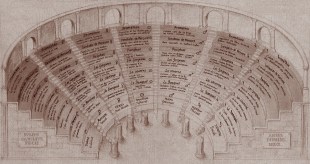
“One of the most striking manifestations of the Renaissance use of the art,” Yates explains, “is the Memory Theater of Giulio Camillo … based (so he believes) on archetypes of reality on which depend secondary images covering the whole realm of nature and of man.” Camillo, mostly forgotten in our age, was in his time a celebrity that attracted the attention of notable contemporaries including the King of France and Erasmus. It is in fact, from the hand of Erasmus’ secretary that we have the most complete record of Camillo’s memory theater.
This manifestation of the artificial memory, however, also included Hermetic and Cabalistic elements. Yates, in fact, describes Camillo’s lifetime work as an effort to the blend the Hermetic-Cabalist tradition founded by Pico della Mirandola with the classical art of memory. Camillo also links these esoteric traditions to the recently revived currents of Neoplatonism so that his memory theater would “represent the eternal order of truth.”
Camillo’s theater was a physical object large enough for two people to enter into in order to see the drawn image of a theater used to organize the whole range of human knowledge. Gone from Camillo’s theater is the space that at least implied a certain temporality, or at least sequentiality as it was navigated. Now the space itself is a fixed image that is immediately and simultaneously present to user. Temporality is overthrown by presence. Again Ricoeur: “The revenge of the Platonic, and especially Neoplatonic, reminiscence over the Aristotelian psychology of memory and recollection is complete, but at the price of the transformation of reasoned speculation into mystagogy.”
Memory, Databases, Narrative
Where memory is conceived in Aristotelian fashion as principally defined by its reference to a past in time, it shares a natural affinity with narrative. “Narrative is,” as Katherine Hayles has put it, “a temporal technology.” Where memory is divorced from temporality in Platonic fashion, narrative seems to fade from view. To represent memories visually is to render them present, but it may also mean abstracting them from their place in the narratives we tell about our lives. The artificial memory techniques, detached from temporality as they were, may be understood on the model of the database that, in Manovich’s analysis, is the “natural enemy of narrative.”
The architecture of the mental space in the artificial memory tradition functions similarly to an interface that allows for multiple arrangements of the images which are so many icons representing various types of data points. Like a database, what the artificial memory facilitated was principally random access and retrieval. As Manovich goes on to note, “a database can support narrative, but there is nothing in the logic of the medium itself that would foster its generation.” Likewise with the artificial memory; it could support a narrative, but it does not necessarily generate one.
In his brief discussion of the artificial memory, Ricoeur forcefully makes a similar point: “spatialization obliterates temporalization … the notion of place has chased away the mark of the past which had characterized memory since Aristotle’s De memoria et reminiscentia. Memory no longer consists in recalling the past but in actualizing what has been learned and stored away in mental space.”
In response to Manovich, Hayles sought to articulate a more symbiotic relationship between narratives and databases: “No longer singular, narratives remain the necessary others to database’s ontology, the perspectives that invest the formal logic of database operations with human meanings and that gesture toward the unknown hovering beyond the brink of what can be classified and enumerated.” Hayles offers an instructive reframing of the opposition between narrative and database. However, drawing artificial memory into the database/narrative polarity suggests that memories stored in databases may not be seeking narratives at all. While meaning can be secured by the deployment of narratives that bring order to the disorder of lived experience, the desire for meaning is not the only desire that memory answers to. Memory also desires presence.
Coming back to social networking sites, we might say then personal memories, of the sort archived by Facebook, yield presence rather than the sort of meaning that arises from narratives. Not unlike the mental constructs of the arts of memory, Facebook operates on the model of the database and the spatial montage. Like the artificial memory, it may sustain a narrative, but it does not necessarily generate one. Facebook backgrounds the narrative coherence of memory grounded in past experience in favor of the immediacy of spatially and visually mediated presence. We do well, however, not to frame this opposition too starkly. The introduction of Facebook’s Timeline interface may be seen as a tilt in the direction of Aristotelian memory and narrative. Nonetheless, memory, when anchored to spatially arranged databases of images, more readily answers to the desire for the immediacy of presence rather than the temporally inflected logic of narrative.
It may be helpful to consider Facebook alongside the diary, another form of externalized memory. The material form of the diary encourages a narrative posture toward experience. Writing already requires the narrativizing of one’s experience and the diary’s form elicits the sequential ordering of these narratives and suggests an anticipation of closure. Visual databases of memory, whether mental, analog, or digital, may invite commentary and explication, but not a linear narrative of one’s experience.
Conclusion
Returning to the story of Simonides, we remember that the artificial memory tradition had its roots in the trauma of death. In the face of great loss we may very well seek the consolations of a narrative that attempts to meaningfully frame our experience. But we may also seek to recover the presence of what is now absent.
In “A Photograph,” the poet, Czeslaw Milosz, observed:
“Few tasks more difficult
Than to write a treatise
On a man who looks
At an old photograph.
Why he does it
Is incomprehensible
And his feelings
Cannot be explained.
Seemingly it’s simple:
She was his love.
But here precisely
Questions begin.”
Then, toward the end of the poem, Milosz writes,
“And, inconceivable,
He addressed her,
Perfectly certain
That she hears him:
‘O maiden of the Lord,
Promised to me,
With whom I was to have
At least twelve children,
‘Obtain for me the grace
Of your strong faith.
We living are too weak
Without your assistance.
You are for me now
The mystery of time
i.e., of a person
Changing and the same,
Who runs in the garden
Fragrant after the rain
With a ribbon in your hair
And lives in the beyond.
You see how I try
To reach with words
What matters most
And how I fail.
Though perhaps this moment
When you are so close
Is precisely your help
And an act of forgiveness.’”
There is something about the image, the photograph — remember Barthes’ mother — that evokes the consolations of memory as presence. Life consists of countless separations and losses; in such instances we may also seek similar consolation. We know we will be parted and we know the present is ephemeral, so we build our archives of memories to later avail ourselves of the presence they offer.
According to Ivan Illich, “What anthropologists distinguish as ‘cultures’ the historian of mental spaces might distinguish as different ‘memories.’” What historians of media have classified as oral, literate, print, and electronic cultures were distinguished largely along the lines of what could be remembered, how, and by whom. It would be presumptuous to say that the same will be true of digital culture, but it would be surprising if such were not the case. We do well then to consider how digital media shapes our remembering, both what it allows us to remember and what it encourages us to remember.

 L.M. Sacasas