Choice and the Machine

“Choice manifests itself in society in small increments and moment-to-moment decisions as well as in loud dramatic struggles; and he who does not see choice in the development of the machine merely betrays his incapacity to observe cumulative effects until they are bunched together so closely that they seem completely external and impersonal. No matter how completely technics relies upon the objective procedures of the sciences, it does no form an independent system, like the universe: it exists as an element in human culture and it promises well or ill as the social groups that exploit it promise well or ill. The machine itself makes no demands and holds out no promises: it is the human spirit that makes demands and keeps promises. In order to reconquer the machine and subdue it to human purposes, one must first understand it and assimilate it. So far, we have embraced the machine without fully understanding it, or, like the weaker romantics, we have rejected the machine without first seeing how much of it we could intelligently assimilate.

The machine itself, however, is a product of human ingenuity and effort: hence to understand the machine is not merely a first step toward re-orienting our civilization: it is also a means toward understanding society and toward knowing ourselves.”

Lewis Mumford in the introduction to Technics and Civilization (1934).

What Are We Talking About When We Talk About Technology?

I’ve been of two minds with regards to the usefulness of the word technology. One of those two minds has been more or less persuaded that the term is of limited value and, worse still, that it is positively detrimental to our understanding of the reality it ostensibly labels. The most thorough case for this position is laid out in a 2010 article by the historian of technology Leo Marx, “Technology: The Emergence of a Hazardous Concept.

Marx worried that the term technology was “peculiarly susceptible to reification.” The problem with reified phenomenon is that it acquires “a ‘phantom-objectivity,’ an autonomy that seems so strictly rational and all-embracing as to conceal every trace of its fundamental nature: the relation between people.” This false aura of autonomy leads in turn to “hackneyed vignettes of technologically activated social change—pithy accounts of ‘the direction technology is taking us’ or ‘changing our lives.’” According to Marx, such accounts are not only misleading, they are also irresponsible. By investing “technology” with causal power, they distract us from “the human (especially socioeconomic and political) relations responsible for precipitating this social upheaval.” It is these relations, after all, that “largely determine who uses [technologies] and for what purposes.” And, it is the human use of technology that makes all the difference, because, as Marx puts it, “Technology, as such, makes nothing happen.”[1]

As you might imagine, I find that Marx’ point compliments a critique of what I’ve called Borg Complex rhetoric. It’s easier to refuse responsibility for technological change when we can attribute it to some fuzzy, incohate idea of technology, or worse, what technology wants. That latter phrase is the title of a book by Kevin Kelly, and it may be the best example on offer of the problem Marx was combatting in his article.

But … I don’t necessarily find that term altogether useless or hazardous. For instance, some time ago I wrote the following:

“Speaking of online and offline and also the Internet or technology – definitions can be elusive. A lot of time and effort has been and continues to be spent trying to delineate the precise referent for these terms. But what if we took a lesson from Wittgenstein? Crudely speaking, Wittgenstein came to believe that meaning was a function of use (in many, but not all cases). Instead of trying to fix an external referent for these terms and then call out those who do not use the term as we have decided it must be used or not used, perhaps we should, as Wittgenstein put it, ‘look and see’ the diversity of uses to which the words are meaningfully put in ordinary conversation. I understand the impulse to demystify terms, such as technology, whose elasticity allows for a great deal of confusion and obfuscation. But perhaps we ought also to allow that even when these terms are being used without analytic precision, they are still conveying sense.”

As you know from previous posts, I’ve been working through Langdon Winner’s Autonomous Technology (1977). It was with a modicum of smug satisfaction, because I’m not above such things, that I read the following in Winner’s Introduction:

“There is, of course, nothing unusual in the discovery that an important term is ambiguous or imprecise or that it covers a wide diversity of situation. Wittgenstein’s discussion of ‘language games’ and ‘family resemblances’ in Philosophical Investigations illustrates how frequently this occurs in ordinary language. For many of our most important concepts, it is futile to look for a common element in the phenomena to which the concept refers. ‘Look and see and whether there is anything common to all.–For if you look at them you will not see something that is common to all, but similarities, relationships, and a whole series of them at that.'”

Writing in the late ’70s, Winner claimed, “Technology is a word whose time has come.” After a period of relative neglect or disinterest, “Social scientists, politicians, bureaucrats, corporate managers, radical students, as well as natural scientists and engineers, are now united in the conclusion that something we call ‘technology’ lies at the core of what is most troublesome in the condition of our world.”

To illustrate, Winner cites Allen Ginsburg — “Ourselves caught in the giant machine are conditioned to its terms, only holy vision or technological catastrophe or revolution break ‘the mind-forg’d manacles.'” — and the Black Panthers: “The spirit of the people is greater than the man’s technology.”

For starters, this is a good reminder to us that we are not the first generation to wrestle with the place of technology in our personal lives and in society at large. Winner was writing almost forty years ago, after all. And Winner rightly points out that his generation was not the first to worry about such matters either: “We are now faced with an odd situation in which one observer after another ‘discovers’ technology and announces it to the world as something new. The fact is, of course, that there is nothing novel about technics, technological change, or advanced technological societies.”

While he thinks that technology is a word “whose time has come,” he is not unaware of the sorts of criticisms articulated by Leo Marx. These criticisms had then been made of the manner in which Jacques Ellul defined technology, or, more precisely, la technique: “the totality of methods rationally arrived at and having absolute efficiency (for a given stage of development) in every field of human activity.”

Against Ellul’s critics, Winner writes, “While Ellul’s addition of ‘absolute efficiency’ may cause us difficulties, his notion of technique as the totality of rational methods closely corresponds to the term technology as now used in everyday English. Ellul’s la technique and our technology both point to a vast, diverse, ubiquitous totality that stands at the center of modern culture.”

It is at this point that Winner references Wittgenstein in the paragraph cited above. He then acknowledges that the way in which technology tends to be used leads to the conclusion that “technology is everything and everything is technology.” In other words, it “threatens to mean nothing.”

But Winner sees in this situation something of interest, and here is where I’m particularly inclined to agree with him against critics like Leo Marx. Rather than seek to impose a fixed definition or banish the term altogether, we should see in this situation “an interesting sign.” It should lead us to ask, “What does the chaotic use of the term technology indicate to us?”

Here is how Winner answers that question: “[…] the confusion surrounding the concept ‘technology’ is an indication of a kind of lag in public language, that is, a failure of both ordinary speech and social scientific discourse to keep pace with the reality that needs to be discussed.”There may be a better way, but “at present our concepts fail us.”

Winner follows with a brief discussion of the unthinking polarity into which discussions of technology consequently fall: “discussion of the political implications of advanced technology have a tendency to slide into a polarity of good versus evil.” We might add that this is not only a problem with discussion of the political implications of advanced technology, it is also a problem with discussions of the personal implications of advanced technology.

Winner adds that there “is no middle ground to discuss such things,” we encounter either “total affirmation” or “total denial.” In Winner’s experience, ambiguity and nuance are hard to come by and any criticism, that is anything short of total embrace, meets with predictable responses: “You’re just using technology as a whipping boy,” or “You just want to stop progress and send us back to the Middle Ages with peasants dancing on the green.”[2]

While it may not be as difficult to find more nuanced positions today, in part because of the sheer quantity of easily accessible commentary, it still seems generally true that most popular discussions of technology tend to fall into either the “love it” or “hate it” category.

In the end, it may be that Winner and Marx are not so far apart after all. While Winner is more tolerant of the use of technology and finds that, in fact, its use tells us something important about the not un-reasonable anxieties of modern society, he also concludes that we need a better vocabulary with which to discuss all that gets lumped under the idea of technology.

I’m reminded of Alan Jacobs’ oft-repeated invocation of Bernard Williams’s adage, “We suffer from a poverty of concepts.” Indeed, indeed. It is this poverty of concepts that, in part, explains the ease with which discussions of technology become mired in volatile love it or hate it exchanges. A poverty of concepts short circuits more reasonable discussion. Debate quickly morphs into acrimony because in the absence of categories that might give reason a modest grip on the realities under consideration the competing positions resolve into seemingly subjective expressions of personal preference and, thus, criticism becomes offensive.[3]

So where does this leave us? For my part, I’m not quite prepared to abandon the word technology. If nothing else it serves as a potentially useful Socratic point of entry: “So, what exactly do you mean by technology?” It does, to be sure, possess a hazardous tendency. But let’s be honest, what alternatives do we have left to us? Are we to name every leaf because speaking of leaves obscures the multiplicity and complexity of the phenomena?

That said, we cannot make do with technology alone. We should seek to remedy that poverty of our concepts. Much depends on it.

Of course, the same conditions that led to the emergence of the more recent expansive and sometimes hazardous use of the word technology are those that make it so difficult to arrive at a richer more useful vocabulary. Those conditions include but are not limited to the ever expanding ubiquity and complexity of our material apparatus and of the technological systems and networks in which we are enmeshed. The force of these conditions was first felt in the wake of the industrial revolution and in the ensuing 200 years it has only intensified.

To the scale and complexity of steam-powered industrial machinery was added the scale and complexity of electrical systems, global networks of transportation, nuclear power, computers, digital devices, the Internet, global financial markets, etc. To borrow a concept from political science, technical innovation functions like a sort of ratchet effect. Scale and complexity are always torqued up, never released or diminished. And this makes it hard to understand this pervasive thing that we call technology.

For some time, through the early to mid-twentieth century we outsourced this sort of understanding to the expert and managerial class. The post-war period witnessed a loss of confidence in the experts and managers, hence it yielded the heightened anxiety about technology that Winner registers in the ’70s. Three decades later, we are still waiting for new and better forms of understanding.

______________________________________

[1] I’m borrowing the bulk of this paragraph from an earlier post.

[2] Here again I found an echo in Winner of some of what I had also concluded.

[3] We suffer not only from a poverty of concepts, but also, I would add, from a poverty of narratives that might frame our concepts. See the end of this post.

Tip the Writer

$1.00

Technology, Moral Discourse, and Political Communities

According to Langdon Winner, neither ancient nor modern culture have been able to bring politics and technology together. Classical culture because of its propensity to look down its nose, ontologically speaking, at the mechanical arts and manual labor. Modern culture because of its relegation of science and technology to the private sphere and its assumptions about the nature of technological progress. (For more see previous post.)

The assumptions about technological progress that Winner alludes to in his article are of the sort that I’ve grouped under the Borg Complex. Fundamentally, they are assumptions about the inevitability and unalloyed goodness of technological progress. If technological development is inevitable, for better or for worse, than there is little use deliberating about it.

Interestingly, Winner elaborates his point by reference to the work of moral philosopher Alasdair MacIntyre. In his now classic work, After Virtue: A Study in Moral Theory, MacIntyre argued that contemporary moral discourse consistently devolves into acrimonious invective because it proceeds in the absence of a shared moral community or tradition.

Early in After Virtue, MacIntyre imagines a handful of typical moral debates that we are accustomed to hearing about or participating in. The sort of debates that convince no one to change their minds, and the sort, as well, in which both sides are convinced of the rationality of their position and the irrationality of their opponents’. Part of what MacIntyre argues is that neither side is necessarily more rational than the other. The problem is that the reasoning of both sides proceeds from incommensurable sets of moral communities, traditions, and social practices. In the absence of a shared moral vision that contextualizes specific moral claims and frames moral arguments there can be no meaningful moral discourse, only assertions and counter-assertions made with more or less civility.

Here is how Winner brings MacIntyre into his discussion:

“Another characteristic of contemporary discussion about technology policy is that, as Alasdair MacIntyre might have predicted, they involve what seem to be interminable moral controversies. In a typical dispute, one side offers policy proposals based upon what seem to be ethically sound moral arguments. The the opposing side urges entirely different policies using arguments that appear equally well-grounded. The likelihood that the two (or More) sides can locate common ground is virtually nil.”

Winner then goes on to provide his own examples of how such seemingly fruitless debates play out. For instance,

“1a. Conditions of international competitiveness require measures to reduce production costs. Automation realized through the computerization of office and factory work is clearly the best way to do this at present. Even though it involves eliminating jobs, rapid automation is the way to achieve the greatest good for the greatest number in advanced industrial societies.

b. The strength of any economy depends upon the skills of people who actually do the work. Skills of this kind arise from traditions of practice handed down from one generation to the next. Automation that de-skills the work process ought to be rejected because it undermines the well-being of workers and harms their ability to contribute to society.”

“In this way,” Winner adds, “debates about technology policy confirm MacIntyre’s argument that modern societies lack the kinds of coherent social practice that might provide firm foundations for moral judgments and public policies.”

Again, the problem is not simply a breakdown of moral discourse, it is also the absence of a political community of public deliberation and action in which moral discourse might take shape and find traction. Again, Winner:

“[…] the trouble is not that we lack good arguments and theories, but rather that modern politics simply does not provide appropriate roles and institutions in which the goal of defining the common good in technology policy is a legitimate project.”

The exception that proves Winner’s rule is, I think, the Amish. Granted, of course, that the scale and complexity of modern society is hardly comparable to an Amish community. That said, it is nonetheless instructive to appreciate Amish communities as tangible, lived examples of what it might look like to live in a political community whose moral traditions circumscribed the development of technology.

By contrast, as Winner put it in the title of one of his books, in modern society “technics-out-of-control” is a theme of political thought. It is a cliché for us to observe that technology barrels ahead leaving ethics and law a generation behind.

Given those two alternatives, it is not altogether unreasonable for someone to conclude that they would rather live with the promise and peril of modern technology rather than live within the constraints imposed by an Amish-style community. Fair enough. It’s worth wondering, however, whether our alternatives are, in fact, quite so stark.

In any case, Winner raises, as I see it, two important considerations. Our thinking about technology, if it is to be about more than private action, must reckon with the larger moral traditions, the sometimes unarticulated and unacknowledged visions of the good life, that frame our evaluations of technology. It must also find some way of reconstituting a meaningful political contexts for acting. Basically, then, we are talking not only about technology, but about democracy itself.

Walter Ong on Romanticism and Technology

The following excerpts are taken from an article by Walter Ong titled, “Romantic Difference and Technology.” The essay can be found in Ong’s Rhetoric, Romance, and Technology: Studies in the Interaction of Expression and Culture.

Ong opens by highlighting the lasting significance of the Romantic movement:

“Romanticism has not been a transient phenomenon. Most and perhaps even all literary and artistic, not to mention scientific, movements since the romantic movement appear to have been only further varieties of romanticism, each in its own way.”

He follows by characterizing subsequent literary and cultural movements as variations of romanticism:

“Early Victorian is attenuated romantic, late Victorian is recuperated romantic, fed on Darwin, Marx, and Comte, the American frontier and the American Adam are primitivist romantic, imagism and much other modern poetry is symbolist romantic, existentialism is super-charged or all-out romantic, programmatic black literature is alien-selfhood romantic, and beatnik and hippie performance is disenfranchized [sic] romantic. Insofar as it is an art form or a substitute for literature, and in other guises, too, activism is most certainly idealist romantic.”

Here is how Ong construes the link between Romanticism and technology, specifically technologies of the word:

“Romanticism and technology, as we shall be suggesting, are mirror images of each other, both being products of man’s dominance over nature and of the noetic abundance which had been created by chirographic and typographic techniques of storing and retrieving knowledge and which had made this dominance over nature possible.”

In other words, print acted as a kind of safety-net that encouraged intellectual daring, both technologically and literarily. This hypothesis depends upon Ong’s understanding of thought and knowledge in oral cultures. The first sentence is about as close to Ong in a nutshell as you’re going to get:

“Any culture knows only what it can recall. An oral culture, by and large, could recall only what was held in mnemonically serviceable formulas. In formulas thought lived and moved and had its being. This is true not only of the thought in the spectacularly formulary Homeric poems but also of the thought in the oratorically skilled leader or ordinarily articulate warrior or householder of Homeric Greece. In an oral culture, if you cannot think in formulas you cannot think effectively. Thought totally oral in implementation has specifically limited, however beautiful, configurations. A totally oral folk can think some thoughts and not others. It is impossible in an oral culture to produce, for example, the kind of thought pattern in Aristotle’s Art of Rhetoric or in any comparable methodical treatises….”

Here are some highlights of what follows for Ong:

“A typical manifestation of romanticism on which we have focused is interest in the remote, the mysterious, the inaccessible, the ineffable, the unknown. The romantic likes to remind us of how little we know. If we view romanticism in terms of the development of knowledge as we are beginning to understand this development, it is little wonder that as a major movement romanticism appeared so late. From man’s beginnings perhaps well over 500,000 years ago until recent times […] knowledge had been in short supply. To keep up his courage, man had continually to remind himself of how much he knew, to flaunt the rational, the certain, the definite and clear and distinct.”

Further:

“Until print had its effect, man still necessarily carried a heavy load of detail in his mind [….] With knowledge fastened down in visually processed space, man acquired an intellectual security never known before [….] It was precisely at this point that romanticism could and did take hold. For man could face into the unknown with courage or at least equanimity as never before.”

Finally:

“[…] romanticism and technology can be seen to grow out of the same ground, even though at first blush the two appear diametrically opposed, the one, technology, programmatically rational, the other, romanticism, concerned with transrational or arational if not irrational reality [….] romanticism and technology appear at the same time because each grows in its own way out of a noetic abundance such as man had never known before. Technology uses the abundance for practical purposes. Romanticism uses it for assurance and as a springboard to another world.”

This strikes me as a bold and elegant thesis. Does it hold up? Ong paints with some broad strokes, and particularly where he discusses what oral culture could and could not have thought we may want to consider how sure we could ever be of such a claim. That said, Ong’s thesis naturally encourages us to explore what transformations of thought and culture are encouraged by digital archives, databases, and artificial memories.

More on Ong: “Memory, Writing, Alienation.”


You can subscribe to The Convivial Society, my newsletter about technology and society,  here.

Promethean Shocks

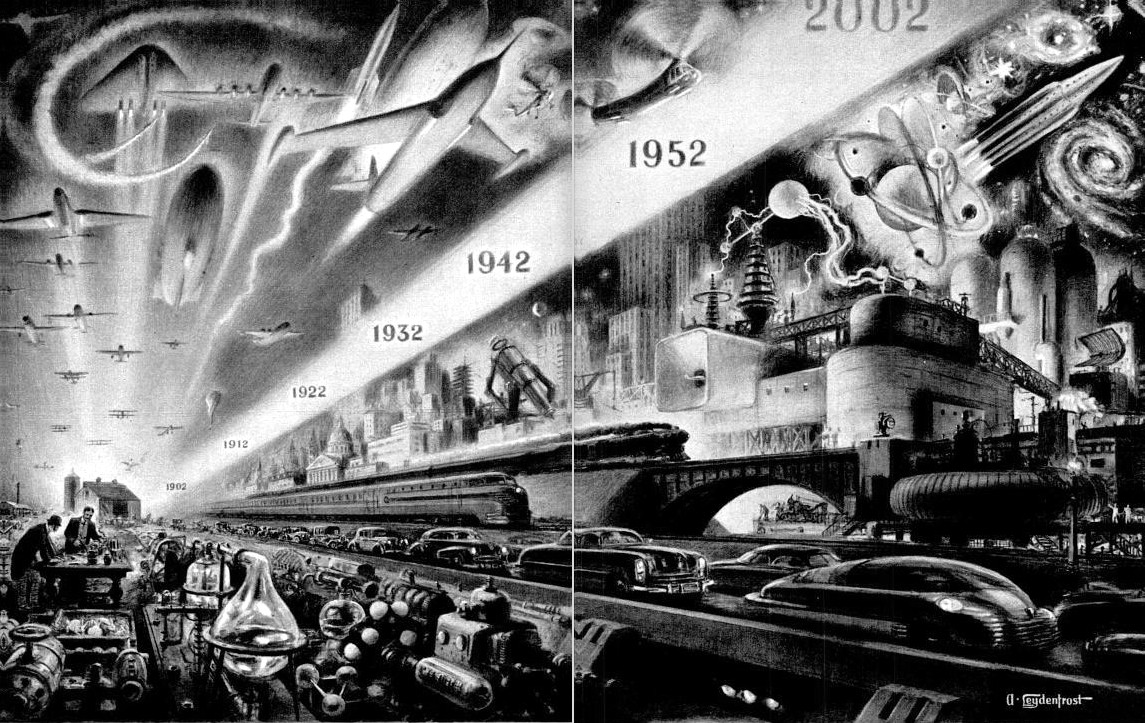
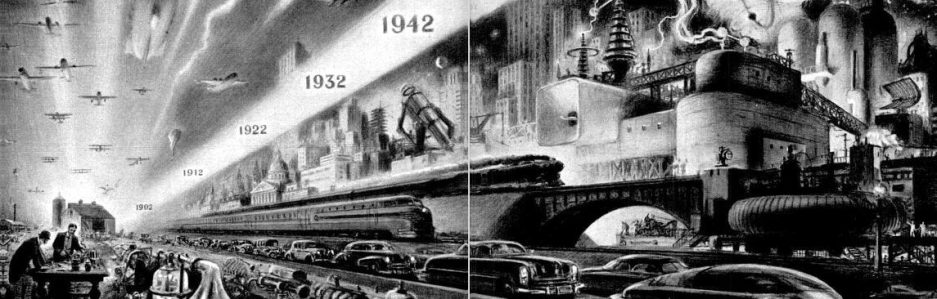
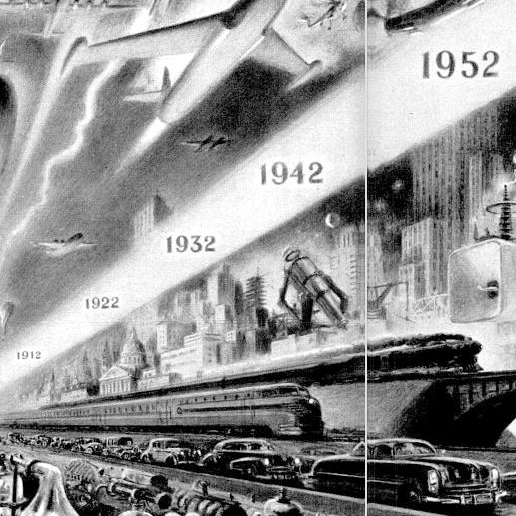
Consider the image below. It was created in 1952 by Alexander Leydenfrost for the 50th anniversary issue of Popular Mechanics.

Alexander Leydenfrost - March of Science 3WifC

I thought of this image as I read Thomas Misa’s brief discussion of the wide-spread perception that the pace of technological change is ever-quickening. “At least since Alvin Toffler’s best-selling Future Shock (1970),” Misa writes, “pundits perennially declare that the pace of technology is somehow quickening and that technology is forcing cultural changes in its wake, that our plunge into the future is driven by technology gone out of control.”

Misa, a historian of technology, is not altogether certain that the pace of technological change has in fact quickened. He is certainly opposed to the “crude technological determinism” inherent in the idea that technology is forcing cultural changes. He does, however, give merit to the experience that is often described using this language. He attributes the perception of quickening to “a split between our normative expectations for technology and what we observe in the world around us.” “It is not so much that our technologies are changing especially quickly,” he explains, “but that our sense of what is ‘normal,’ about technology and society, cannot keep pace.”

According to Misa, developments in cloning, biotechnology, surveillance technologies, and nanotechnology are outstripping regulatory laws and ethical norms. This seems true enough. We might even describe the condition of modernity (and/or post-modernity, or hyper-modernity, or reflexive modernity, or whatever) as one of perpetual Promethean shock. This way of putting it seems more apt than “future shock.” One way of telling the story of modernity, after all, is to order it as a series of startling realizations of what we suddenly acquired the power to do. As Auden wrote of the modern Mind,

“Though instruments at Its command
Make wish and counterwish come true,
It clearly cannot understand
What It can clearly do.”

Clearly certain technological innovations yield this dizzying experience of Promethean shock more than others. The advent of human flight, the atomic bomb, and putting a man on the moon are just some of the more simultaneously startling, awe-inspiring, disconcerting examples. When these technologies arrived, in rather quick succession, they rattled and unsettled reigning cultural and moral frameworks, tacit as they may have been, for incorporating new technologies into existing society.

These normative cultural expectations for technology were set, Misa suggests, during the “longer-duration ‘eras'” of technology which he identifies in his history of the relationship between technology and culture. These eras included, for example, the age of the Renaissance, when the demands of Renaissance court culture set the agenda for technological change, and the age of imperialism, when the imperatives of empire dictated the dominant agenda. The former era, in Misa’s analysis, spanned nearly two centuries, and the latter the better part of one; but the 20th century is home to at least four different eras, which Misa labels the eras of systems, modernism, war, and global culture respectively.

Misa is on to something here, but he seems to push the question back rather than answering it directly. Why then are these eras, tentative and suggestive as he acknowledges them to be, getting progressively shorter? He is closer to the mark, I think, when he also suggests that the sense of quickening is linked to another “quickening” in  the “self-awareness of societies,” which he further defines as “our capacities to recognize and comprehend change.”

His brief illustration of this development is initially compelling. Two centuries elapsed before the Renaissance was named. Within 50 years of the appearance of factories in Manchester, the phrase industrial revolution was in usage. Just four years after the telephone arrived in Moscow, Chekhov published a short story, “On the Telephone,” about the travails of an early adopter trying to make a restaurant reservation over the phone (fodder for a Seinfeld plot, if you ask me). Most recently, William Gibson gives us the term cyberspace “almost before the fact of cyberspace.” This sequences suggests to Misa that Western society has become increasingly self-aware of technological change and its consequences.

I think this claim has merit. The Modern mind that, according to Auden “cannot understand/what it can clearly do” he described as the “self-observed, observing Mind.”  But, again, we might be tempted to ask why our “self-awareness” is accelerating in this way. Might it not be attributed, at least in part, to an increase in the rapidity of technological development? The two seem inseparable. I’m reminded of Walter Ong’s dictum about writing: “Writing heightens consciousness.” In a slightly different way, might we not argue that technological change heightens societal self-awareness?

Consider again that Leydenfrost image above. It captures an important aspect of how we’ve come to understand our world: we have aligned our reckoning of the passage of time with the development of technology. We have technologies that mark time, but in another sense the advent of new technologies mark time by their appearance, iteration, and obsolescence.

Human beings have long sought markers to organize the experience of time, of course. For a day sunrise and sunset served just fine. The seasons, too, helped order the experience of a year. For longer periods, however, cultural rather than natural markers were needed. Consider, for instance, the common practice in the ancient world of reckoning time by the reigns of monarchs. “In the x year of so-and-so’s reign” is a recurring temporal formula.

Without achieving that sort of verbal formality or precision, I’d suggest that the development of technology–the reign, if you will, of certain technologies and artifacts–now does similar work for modern societies. Records, 8-tracks, tapes, CDs, MP3s. Desktops, laptops, tablets. Landline, portable landline, cellphone, smartphone. Black and white TV, color TV, projection TV, flatscreen TV. Pre-Internet/post-Internet. Dial-up/broadband/wireless. I suspect you can supply similar artifactual chronologies that have structured our recollection of the past. We seem to have synchronized our perception and experience of time to the cycles of technological innovation.

The Leydenfrost image also reminds us that insofar as the notion of progress exists at all today, it is clearly bound up with the advance of technology. All other forms of progress that we might imagine  or aspire to– moral, economic, social–these are subsumed under the notion of technological progress. For that reason, rumors or suggestions that technological innovation might be slowing down unnerve us. We need the next big thing  to keep coming on schedule, however trivial that next big thing might be, to distract us from our economic, political, and personal woes.

This was illustrated nicely by the minor tech-media freakout occasioned recently by a Christopher Mims’ piece at Quartz arguing that 2013 was a lost year for tech. It was received as a heretical claim, and it was promptly and roundly condemned. “I, too, constantly yearn for mind-blowing new tech,” Farhad Manjoo tells us in his reply to Mims before re-assuring us: “I think we’re witnessing the dawn of a new paradigm in machine-human cooperation: Combining machine intelligence with biological intelligence will always trump one or the other. Machines make us better, and we make machines better. There’s still hope for us. Welcome to the bionic future.”

The world may be falling apart around us, but we can bear it so long as we can project our hopes on the amorphous promise of technological advance. The prospect of a host of Promethean shocks that we seemed poised to receive–from drones, robotics, AI, bioengineer, geo-engineering, nanotechnology–makes us nervous, they unsettle our moral frameworks; but their absence would worry us more, I suspect.