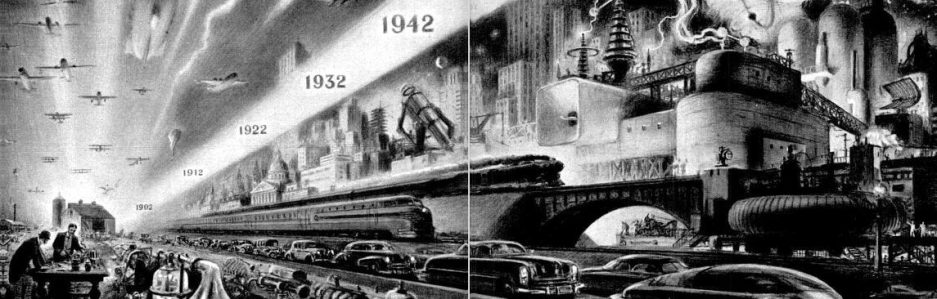
Does Technology Evolve More Quickly Than Ethical and Legal Norms?

It is frequently observed that developments in technology run ahead of law and ethics, which never quite catch up. This may be true, but not in the way it is usually imagined. What follows is a series of loosely related considerations that might help us see the matter more clearly.

When people claim that technology outstrips law and ethics, they are usually thinking more about the rapid advance of technology than they are about the structures of law and ethics. If we were to unpack the claim, it would run something like this: new technologies which empower us in novel ways and introduce unprecedented capacities and risks emerge so quickly that existing laws and ethical principles, both of which are relatively static, cannot adapt fast enough to keep up.

Thought of in this way, the real pressure point is missed. It is not merely the case that new technologies emerge for which we have no existing moral principles or laws to guide and constrain their use; this is only part of the picture. Rather, it is also the case that modern* technologies, arising in tandem with modern political and economic structures, have undermined the plausibility of ethical claims and legal constraints, weakened the communities that sustained and implemented such claims and constraints, and challenged the understanding of human nature upon which they depended.

To put the matter somewhat more succinctly, contemporary technologies emerge in a social context that is ideal for their unchecked and unconstrained development and deployment. In other words, technology appears to outstrip ethics and law only because of a prior hollowing out of our relevant moral infrastructure.

Social and technological forces have untethered and deracinated the human person, construing her primarily and perhaps even exclusively as an individual. However, valuable this construal may be, it leaves us ill equipped to cope with technologies that  necessarily involve us in social realities.

From the ethics side of the ledger, it is also the case that modern ethics (think Kant, for example) also construed ethics chiefly as a matter of the individual will. A project undertaken by autonomous and rational actors without regard for moral and political communities. Political philosophy (Locke, et al) and economic theory (Smith, etc.) follow similar trajectories.

So, in theory (political, philosophical, and economic) the individual emerges as the basic unit of thought and action. At the center of this modern theoretical picture is a novel view of freedom as individual autonomy. The individual no longer bends their will to the shape of a moral and communal order; they now bend the world to the shape of their will.

In practice, material conditions, including new technologies, sustain and reinforce this theoretical picture. Indeed, the material/technological conditions likely preceded the theory. Moreover, technology evolves as a tool of empowerment that makes the new understanding of freedom plausible and seemingly attainable. Technology is thus not apprehended as an object of moral critique; it is perceived, in fact, as the very thing that will make possible the realization of the new vision of the good life, one in which the world is the field of our own self-realization.

While certain social and material realities were isolating and untethering the individual, by the mid-19th century technologies arose that were, paradoxically, embedding her in ever more complex technical systems and social configurations.

Paradoxically, then, the more we took for granted our own agency and assumed that technology was a neutral tool of the individual autonomous will, the more our will and agency was being compromised and distributed by new technologies.

Shortest version of the preceding: Material conditions untether the individual. Modern theoretical accounts frame this as a benign and desirable development. Under these circumstances, technology is unbridled and evolves to a scale that renders individual ethical action relatively inconsequential.

Moreover, the scale of these new technologies eclipsed the scale of local communities and traditional institutions. The new institutions that arose to deal with the new scale of operation were bureaucracies, that is to say that they themselves embodied the principles and values implicit in the emerging technological milieu.

It may be better, then, to say that it is the scale of new technologies that transcends the institutions and communities which are the proper sites for ethical reflection about technology. The governing instinct is to scale up our institutions and communities to meet the challenge, but this inevitably involves a reliance on the same technologies that generate the problems. It never occurs to us that the answer may lie in a refusal to operate at a scale that is inhospitable to the human person.

Something other than individual choices and laws are necessary. Something more akin to a renewal of cultural givens about what it means to be a human being and how the human relates to the non-human, givens which inform ethical choices and laws but cannot be reduced to either, and the emergence of institutions that embody and sustain individual lives ordered by these givens. It is hard, however, to see how these emerge under present circumstances.


*Throughout the post I use “modern” to refer to Western modernity emerging c. 1600 or so (which date is certainly subject to a great deal of debate).

E.B. White, Prophetic Media Critic

My wife is a fan of E.B. White’s, and with good reason. Each time she has read me a passage of his prose, mostly from his essays, I have found his voice to be unfailingly wise and humane. Below is a passage my wife shared with me this morning, knowing that I would find it especially interesting. It is from a 1938 essay titled “Removals” included in the collection One Man’s Meat. It is an astute analysis of television when television was in its infancy.

The news of television, however, is what I particularly go for when I get a chance at the paper, for I believe television is going to be the test of the modern world, and that in this new opportunity to see beyond the range of our vision we shall discover either a new and unbearable disturbance of the general peace or a saving radiance in the sky. We shall stand or fall by television—of that I am quite sure [….]

Clearly the race today is between loud speaking and soft, between the things that are and the things that seem to be, between the chemist of RCA and the angel of God. Radio has already given sound a wide currency, and sound “effects” are taking the place once enjoyed by sound itself. Television will enormously enlarge the eye’s range, and, like radio, will advertise the Elsewhere. Together with the tabs, the mags, and the movies it will insist that we forget the primary and the near in favor of the secondary and the remote. More hours in every twenty-four will be spent digesting ideas, sounds, image—distant and concocted. In sufficient accumulation, radio sounds and television sights may become more familiar to us than their originals. A door closing, heard over the air; a face contorted, seen in a panel of light—these will emerge as the real and the true; and when we bang the door of our own cell or look into another’s face the impression will be of mere artifice [….]

When I was a child people simply looked about them and were moderately happy; today they peer beyond the seven seas, bury themselves waist deep in tidings, and by and large what they see and hear makes them unutterably sad.

a8bfb560fae2c9a9aca8172b45001f37--writing-motivation-work-spaces

I suspect most people will respond to this sort of thing in one of two ways. Some will see it as evidence that what we worry about today people worried about in years past, and from this they will draw the conclusion that, the race having survived to worry again, it may be best not to worry about such things at all. Others will see evidence of a historical trajectory, an antecedent to our present condition, the first steps down an unfortunate path, or, at least, evidence of perennial struggles, which each generation must face on their own terms.

It will, in short, seem like either reactionary nostalgia for an age that never existed—when in want of an argument charge opponent with Nostalgia—or part of any viable explanation for how we end up with a reality TV host for a president and somehow itching for another celebrity television personality to take his place.

I would encourage us simply to ask, “What if he’s right?” Or, to approach our reflections from a slightly different angle, “If he was wrong, how would we know?”

Relatedly, there was one other line that caught my attention. This one, however, is taken from Roger Angell’s 1997 preface to the collection of essays. Angell was White’s stepson and a consummate prose stylist in his own right. In recalling his stepfather’s virtues, he noted that White somewhere wrote that “the hardest thing about the war was to maintain a decent sense of indignation about its deadly details.”

White was speaking about World War 2, and, of course, he was speaking as a civilian on the home front. We are not in the midst of anything like the Second World War, but, nonetheless, I found the idea of struggling “to maintain a decent sense of indignation” somehow resonant and timely.

The Furies Within

Nearly four years ago, I posted the following paragraphs from Edward Mendelson’s essay, “The Secret Auden.” I come back to these lines frequently. They, in my view, articulate an urgent truth we need to hear and embrace.

“By refusing to claim moral or personal authority, Auden placed himself firmly on one side of an argument that pervades the modern intellectual climate but is seldom explicitly stated, an argument about the nature of evil and those who commit it.

On one side are those who, like Auden, sense the furies hidden in themselves, evils they hope never to unleash, but which, they sometimes perceive, add force to their ordinary angers and resentments, especially those angers they prefer to think are righteous. On the other side are those who can say of themselves without irony, ‘I am a good person,’ who perceive great evils only in other, evil people whose motives and actions are entirely different from their own. This view has dangerous consequences when a party or nation, having assured itself of its inherent goodness, assumes its actions are therefore justified, even when, in the eyes of everyone else, they seem murderous and oppressive.”

Simone Weil: “Everything is in disequilibrium”

Perusing my long ago moth-balled Tumblr, I was reminded of the following passage from Simone Weil’s Oppression and Liberty (1955).

Never has the individual been so completely delivered up to a blind collectivity, and never have men been less capable, not only of subordinating their actions to their thoughts, but even of thinking. Such terms as oppressors and oppressed, the idea of classes–all that sort of thing is near to losing all meaning, so obvious are the impotence and distress of all men in face of the social machine, which has become a machine for breaking hearts and crushing spirits, a machine for manufacturing irresponsibility, stupidity, corruption, slackness and, above all, dizziness. The reason for this painful state of affairs is perfectly clear. We are living in a world in which nothing is made to man’s measure; there exists a monstrous discrepancy between man’s body, man’s mind and the things which at present time constitute the elements of human existence; everything is in disequilibrium.

I initially stumbled upon this passage in Henry Finch’s Simone Weil and the Intellect of Grace (1999). Finch adds, “We are crushed by paradoxes: never was our power so great and never were we so powerless; never was there so much control and never were we so vulnerable to accidents; never so much interdependence and so much fragmentation.”

It would be hard, I think, for us to overestimate the problem of scale.

Jacques Ellul on Technique As An Obstacle To Ethics

The following excerpts are taken from “The Search for Ethics In a Technicist Society” (1983) by Jacques Ellul. In this essay, Ellul considers the challenges posed to traditional morality in a society dominated by technique.

James Fowler on what Ellul meant by technique: “Ellul’s issue was not with technological machines but with a society necessarily caught up in efficient methodological techniques. Technology, then, is but an expression and by-product of the underlying reliance on technique, on the proceduralization whereby everything is organized and managed to function most efficiently, and directed toward the most expedient end of the highest productivity.

In Ellul’s view, “The ethical problem, that is human behavior, can only be considered in relation to this system, not in relation to some particular technical object or other.” “If technique is a milieu and a system, ” he adds, “the ethical problem can only be posed in terms of this global operation. Behavior and particular choices no longer have much significance. What is required is thus a global change in our habits or values, the rediscovery of either an existential ethics or a new ontology.”

Emphasis in boldface below is mine.

On the call to subordinate means to ends:

“It is quite right to say that technique is only made of means, it is an ensemble of means (We shall return to this later), but only with the qualification that these means obey their own laws and are no longer subordinated to ends. Besides, one must distinguish ideal ends (values, for example), goals (national, for example), and the objectives (immediate objectives: a researcher who tries to solve some particular problem). Science and technique develop according to objectives, rarely and accidentally in relation to more general goals, and never for ethical or spiritual ideals. There is no relation between the proclamation of values (justice, freedom, etc.) and the orientation of technical development. Those who are concerned with values (theologians, philosophers, etc.) have no influence on the specialists of technique and cannot require, for example, that some aspect of current research or other means should be abandoned for the sake of some value.

On the difficulty of determining who exactly must act to subordinate technique to moral ends:

To adopt one of these first two ethical orientations is to argue that it is human beings who must create a good use for technique or impose ends on it, but always neglecting to specify which human beings. Is the “who” not important? Is technique able to be mastered by just any passer-by, every worker, some ordinary person? Is this person the politician? The public at large? The intellectual and technician? Some collectivity? Humanity as a whole? For the most part politicians cannot grasp technique, and each specialist can understand an infinitesimal portion of the technical universe, just as each citizen only makes use of an infinitesimal piece of the technical apparatus. How could such a person possibly modify the whole? As for the collectivity or some class (if they exist as specific entities) they are wholly ignorant of the problem of technique as a system. Finally, what might be called “Councils of the Wise” […] have often been set up only to demonstrate their own importance, just as have international commissions and international treaties [….] Who is supposed to impose ends or get hold of the technical apparatus? No one knows.

On the compromised position from which we try think ethically about technique:

At the same time, one should not forget the fact that human beings are themselves already modified by the technical phenomenon. When infants are born, the environment in which they find themselves is technique, which is a “given.” Their whole education is oriented toward adaptation to the conditions of technique (learning how to cross streets at traffic lights) and their instruction is destined to prepare them for entrance into some technical employment. Human beings are psychologically modified by consumption, by technical work, by news, by television, by leisure activities (currently, the proliferation of computer games), etc., all of which are techniques. In other words, it must not be forgotten that it is this very humanity which has been pre-adapted to and modified by technique that is supposed to master and reorient technique. It is obvious that this will not be able to be done with any independence.

On the pressure to adapt to technique:

Finally, one other ethical orientation in regard to technique is that of adaptation. And this can be added to the entire ideology of facts: technique is the ultimate Fact. Humanity must adapt to facts. What prevents technique from operating better is the whole stock of ideologies, feelings, principles, beliefs, etc. that people continue to carry around and which are derived from traditional situations. It is necessary (and this is the ethical choice!) to liquidate all such holdovers, and to lead humanity to a perfect operational adaptation that will bring about the greatest possible benefit from the technique. Adaptation becomes a moral criterion.