The Bookshelf as Memory Theater

Nathan Schneider’s “In Defense of the Memory Theater” begins thus:

What concerns me about the literary apocalypse that everybody now expects—the at least partial elimination of paper books in favor of digital alternatives—is not chiefly the books themselves, but the bookshelf. My fear is for the eclectic, personal collections that we bookish people assemble over the course of our lives, as well as for their grander, public step-siblings. I fear for our memory theaters.

And concludes as follows:

As the business of reading technology continues along its trajectory, whether apocalyptic or utopian or both, perhaps those of us who continue to fancy ourselves concerned readers—however much we give in to the new and shiny—might turn our attention anew to what one might call “inner work.” In the part of ourselves which is not technological, we could rediscover the tautology that what makes knowledge so precious is its precariousness, not the surety of our control over it. We’ll need to cultivate the arts of memory and forgetting alluded to in these lines by William Blake, which came to me in a letter from a friend, a librarian who, for years now, has been slowly dying in a monastery:

He who binds to himself a joy
Doth the winged life destroy.
He who kisses the joy as it flies,
Lives in eternity’s sunrise.

Even among these wonders now available to us and still to come, all having remains no less a preparation for loss.

Ready? Because that’s what is at stake.

Read everything in between at Open Letters Monthly.

In case you don’t, here is at least one more dose:

Modern life, if we can still call it that, occurs as a sequence of gleeful apocalypses. One world constantly gives way to another. If it doesn’t, “consumers”—as people now call themselves—get anxious. We’re familiar with the drill: new audio/video formats arrive every decade; a new “generation” of cell phone every couple years; and, on a rolling basis, there’s the expectation that several totally unexpected paradigm shifts are in the works—the internet, global climate change, a new fundamental particle, and that sort of thing.

Augustine’s Secret

James K. A. Smith on marketing, desire, and the erotic:

“In a culture whose civic religion prizes consumption as the height of human flourishing, marketing taps into our erotic religious nature and seeks to shape us in such a way that this passion and desire is directed to strange gods, alternative worship, and another kingdom.  And it does so by triggering and tapping into our erotic core — the heart.  Thus in marketing one finds the promise of a kind of transcendence that is linked to a certain bastardization of the erotic.  Certain modes of advertising appeal more directly to eros, to sexual desire and romantic love, and then in a  move of substitution, channel our desire into a product — or at least associate the product with that desire and promise a kind of fulfillment ….

… I think we should first recognize and admit that the marketing industry — which promises an erotically charged transcendence through media that connects to our heart and imagination — is operating with a better, more creational, more incarnational, more holistic anthropology than much of the (evangelical) church.  In other words, I think we must admit that the marketing industry is able to capture, form, and direct our desires precisely because it has rightly discerned that we are embodied, desiring creatures whose being-in-the-world is governed by the imagination.  Marketers have figured out the way to our heart because they ‘get it’:  they rightly understand that, at root, we are erotic creatures — creatures who are oriented primarily by love and passion and desire.  In sum, I think Victoria is in on Augustine’s secret.”    (Desiring the Kingdom, 76)

The Victoria in question is, of course, the purveyor of a certain line of woman’s attire.  Augustine’s secret, as Smith puts it, is the recognition that human beings are embodied, desiring animals before they are thinking, rational beings.  We aim at life with our heart, not with our mind — the heart here standing for all the emotional, affective, visceral and bodily dimensions of the human person.

Religion in The Shallows

Nicholas Carr’s The Shallows has been a recurring topic here the last few weeks.  Jonathan Walton takes an important angle on Carr’s thesis in his post, “This is Your Brain (and God) Online,” at Religion Dispatches:

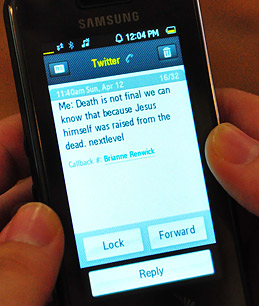
Carr did not broach the topic of religion (well, maybe his chapter on the “Church of Google”), but I couldn’t help but think of the growing number of congregations that have embraced texting and twittering during worship. What does this mean for deep theological reflection and nuanced notions of the sacred?

If we can barely breathe without compulsively checking email and status updates 24/7, shouldn’t there be a time and space where we disengage and disconnect from our “networks”? It seems to me that when discussing matters of ultimate value and concern, this is the one area we can ill afford shallow, superficial engagement and hurried and distracted thoughts!

Here are some related links:

“Twittering in Church, with the Pastor’s O.K.” from Time

“US Churches use Twitter to reach a wider audience” from the UK’s Telegraph

“The State of Social Media, Part 1 and Part 2” from Christianity Today

“Are People More Likely to Interact with Religious Leaders on Facebook?” from Science and Religion Today

Briefly, two things come to mind.  First, Marshall McLuhan famously observed, “The medium is the message.”  Churches have traditionally believed themselves to be, among other things, the bearers of a message.  It may be worth their time to consider what new media will do to that message.  Secondly, churches are also, among other things, communities of moral formation or discipleship.  Social media, like all tools, are not merely used; they also shape the users.  Churches should also consider what sorts of communities are formed by social media, what habits (virtues/vices even) they inculcate in participants, and how these relate to their vision of a faithful and well-formed life.

Shared Sensibilities

Rochelle Gurstein captures in lovely prose a handful of thoughts I have attempted, with less eloquent results, to express in recent days.  “The Perils of Progress”, a brief essay appearing in The New Republic, opens with a story about “a lecture by an exquisitely sensitive, painfully alert poet friend of ours about how we live today” which elicits tired labels contemptuously applied.  As Gurstein puts it:

These days, even a few well-considered, measured reservations about digital gadgetry apparently cannot be tolerated, and our poet friend was informed by forward-looking members of the audience that she was fearful of change, nostalgic, in short, reactionary with all its nasty political connotations.

And this presumably from a learned and sophisticated audience.

Gurstein goes on to challenge the same NY Times editorial by Steven Pinker which drew some of my own comments a few days ago.  She observes that in …

… disputes about the consequences of innovation, those on the side of progress habitually see only gains. They have no awareness that there are also losses—equally as real as the gains (even if the gain is as paltry as “keeping us smart”)—and that no form of bookkeeping can ever reconcile the two.

Gurstein concludes with some poignant reflections on the materiality of the book and the difference it makes to the experience of reading and the reader’s relationship to the author.  The essay truly is worth a few minutes of your time to read.  Also reading the few comments posted in response to Gurstein’s essay tends to reinforce her concerns.

At one point in the essay Gurstein spoke of Pinker’s “stacking the deck against” her sensibility.  That word, sensibility, struck me.  This is I think near to the heart of matter.  What Gurstein and others like her attempt to defend and preserve is not merely a point of view or a particular truth.  It is more subjective than that, but is not merely preference.  It is not at all like a preference, which, I suspect, is precisely what those who do not understand it will try to label it.  It is, well, a sensibility — a certain disposition or way of being in the world.  It is an openness and a sensitivity to certain kinds of experience and to certain dimensions of reality.  Because of this it resists description and facile reduction to the terms of a cost/benefit analysis.  Consequently, it can be difficult to convincingly defend a sensibility to those who know nothing of it.  Maybe it is best described as a “seeing the world as” or, perhaps better still, a “feeling the world as.”  A sensibility is a posture toward life, a way of inhabiting the world.

What all of this groping for words may have at its center is the experiential quality of a sensibility, and experience is, after all, incommunicable.   Unless, that is, two people share the sensibility and then words may even seem superfluous.  In this sense, those who share a sensibility, share the world.  Those who lack or fail to appreciate the sensibility Gurnstein articulates know only to shake their heads in condescending bemusement.  What those, like Gurnstein and her poet friend, who grieve the passing of a culture that nurtured their sensibility fear may be the onset of a long loneliness.