The debate is said to be between science and religion. It would be more accurate to call the contending sides atheism and faith, since neither science nor religion in any classic sense is represented in the present struggle.
And another point well made:
I don’t claim to know what it means to say that we are made in the image of God, but I profoundly and instinctively believe it and all that it implies. Therefore it appalls me that some people who call themselves Christian are willing to hate and insult and deprive other human beings, and even carry guns so they will be ready to kill one or two of them on short notice. And it appalls me that people who claim for their views the authority of science routinely and arbitrarily insist on a brutally reductionist notion of what a human being is, what the human mind is, that justifies as inevitable every sort of meagerness and rapacity. As is so often the case when controversy turns bilious, the two sides have entirely too much in common.
One commenter on yesterday’s post noted that science fiction “can also be used as a formidable stock of thought experiments, with profound philosophical implication.” I have hardly read any science fiction (I am currently working on Lewis’ Space Trilogy) yet I have no doubt this is the case. Another commenter made note of Ray Bradbury. Kurt Vonnegut and Aldous Huxley also come to mind as well as Jules Vernes and H. G. Wells as early practitioners. It seems to me that Mary Shelley deserves recognition at least as a forerunner. I’m sure those familiar with the field can fill out the list quite a bit.
Hannah Arendt, writing in the mid-twentieth century, appears to be one of the few intellectuals of the time to have recognized the value of science fiction. Writing in The Human Condition she notes that the “respectable newspapers” were only just then catching up on implications of science which,
up to then had been buried in the highly non-respectable literature of science fiction (to which, unfortunately, nobody yet has paid the attention it deserves as a vehicle of mass sentiments and mass desires).
Perhaps someone can correct me on this, but it seems the most profound science fiction also tends to be of the dystopian variety.
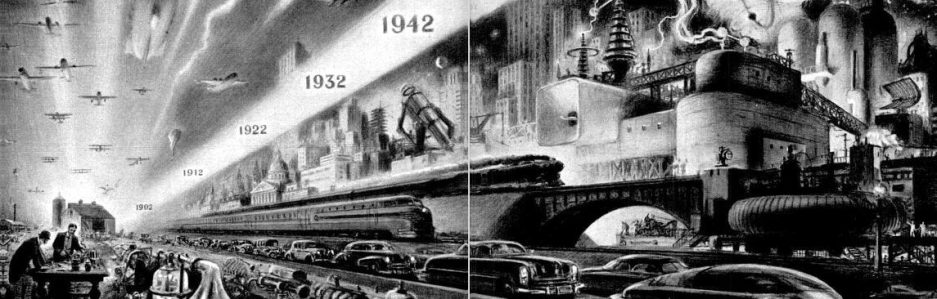
Well, right here actually. Unfortunately, in case you hadn’t noticed, they’re not zipping through some highway in the sky. This despite the hopes fanned by science fiction, cartoons, and science magazines from an earlier generation. The flying car has become the emblem of a future that never was, one that actually seems quite silly now.
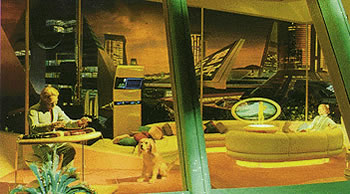
As a kid the future fascinated me, I just had no idea it was an already dated image of the future that took me in. My favorite ride at Disney World was The Carousel of Progress (say that with a straight face) and later its sequel at Epcot, Horizons. Both gave us a sense of steady, inexorable movement towards … underwater cities and farms in the desert, and sitting around watching … television.
It wasn’t just Disney either. I am just old enough to have had libraries rather than media centers in school as I was growing up. In these libraries with actual books and magazines, I would pull out back issues of Popular Science and Popular Mechanics scouring them for even more images of a future that would never quite materialize. Of course, its not just a matter of not having the know-how, looking back one wonders why some of this stuff was attractive to begin with. Again, underwater cities?
All of this to say that it is hard work imagining the future (although Star Trek had better luck than Disney). William Halal should know,
Forecasting anything is an enormous challenge, much less “predicting” the state of the world decades from now. My TechCast project is in the business of forecasting, but we make a point of avoiding the word “prediction” for that very reason.
For more than a decade, TechCast has scanned the literature and surveyed 100 experts worldwide to forecast technology breakthroughs and their social impact. We identify trends driving a forecast and obstacles opposing it, summarize other forecasts made by other sources, and have our experts review all this background data to reach their best estimates. Although I think this approach provides the best possible answers to tough questions, we miss the mark by about plus or minus three years for forecasts a decade out, and sometimes a lot more. For anything beyond two decades out, the sources of error mount dramatically, especially because the world is changing so quickly that present assumptions will soon prove invalid.
So what is Halal betting on these days,
Our forecasts suggest that most of the big breakthroughs now anticipated—green technologies, alternative energy, artificial intelligence, biogenetic medical care—are likely to arrive well before 2050. In fact, exploding information technology and knowledge are likely to unify the globe into some type of coherent world system between 2020 and 2030 out of sheer necessity. The mounting threats of climate change, energy shortages, environmental collapse, WMDs, terrorism, and other elements of the “Global Megacrisis” are forcing this historic transition, and global gross domestic product will double about 2020, making the present global order unsustainable and demanding a form of “global consciousness.” Our surveys of the megacrisis show that the next decade or two will either see a crucial turning point to a “mature” global society or we are likely to witness the collapse of civilization in major parts of the world.
So basically we are heading toward a “mature” global society (exciting!) or the end of the world as we know it.
In her essay, “Medieval Multitasking: Did We Ever Focus?”, Elizabeth Drescher addresses the Nicolas Carr/Clay Shirky debate on the relative merits of the Internet. Drescher’s piece distinguishes itself by taking, as her title suggests, a long view of the issue and by its breezy, phenomenological style. I think she is right to look for historical antecedents that shed light on our use of new media, however, I have reservations about where she ends up. I tend to see more discontinuity than she does, particularly in the kind of relationship with the text encouraged by certain features of new media. You can read some of my thoughts in the Letters section below Drescher’s essay or here. Quick excerpt:
Modularity, or what Manovich also calls the “fractal structure of new media,” allows for individual elements of a hypertext (text, image, video, chart, audio, etc.) to retain their integrity and be easily abstracted and recombined in another setting. Now to get a sense of the significance of this development, imagine a medieval monk attempting to easily abstract the graphic elements of an illuminated manuscript for use in another setting.
I single out modularity because it gets at an important distinction the gets lost if we lay all the emphasis on continuity. Modularity has contributed to a massive reconfiguration of the relationship between the media artifact and the user. The conditions of new media have allowed us to approach texts (and I use that term in the widest possible sense) on the Internet as potential creators, as well, users . . .
We now seem less apt at receiving a text and, at least to begin with, submitting ourselves to it. This is a particularly important development in religious contexts. We are now more likely to jump into the creation of our own meaning and our own texts without first allowing the texts to read us as it were. We are less likely to listen to the text before wanting to speak back to it or speak it anew. We are first disposed to shape the text rather than being open to how the text may shape us.
Along the way Drescher links to the op-ed piece by Steven Pinker that we noted here earlier, but she also links to an op-ed by David Brooks, “The Medium is the Medium”, which I had missed. In his piece Brooks makes some interesting distinctions and observations, yet my initial response is mixed. Perhaps more on that later.
I’m not sure yet whether to think of the weblog as a genre unto itself, or whether it is more helpful to conceive of the weblog as a writing space in which a variety of genres manifest themselves. In any case, one of the uses to which I find a blog post particularly suited is the juxtaposition of two or more passages that seem to benefit from being placed in conversation with one another. It may be that I’m not entirely sure how best to articulate the relationship, but an intuition leads me to set ideas side by side to see what may emerge. Or, it could be that I have already some sense of how the ideas relate. It could also be that the intuition ends up being a blind alley and it is not until I write through it that the dead end emerges. So with this in mind let me lay two passages side by side for your consideration and mine.
The first from the prologue to Hannah Arendt’s The Human Condition. She is addressing “the advent of automation, which in a few decades [she is writing in the late 1950’s] probably will empty the factories and liberate mankind from its oldest and most natural burden, the burden of labouring and the bondage to necessity.” This development, however, will not yield what it seems to promise. Arendt continues:
The modern age has carried with it a theoretical glorification of labor and has resulted in a factual transformation of the whole of society into a laboring society. The fulfillment of the wish, therefore, like the fulfillment of wishes in fairy tales, comes at a moment when it can only be self-defeating. It is a society of laborers which is about to be liberated from the fetters of labor, and this society does no longer know of those other higher and more meaninfgul activities for the sake of which this freedom would deserve to be won. Within this society, which is egalitarian because this is labor’s way of making men live together, there is no class left, no aristocracy of either a political or spiritual nature from which a restoration of the other capacities of man could start anew . . . What we are confronted with is the prospect of a society of laborers without labor, that is, without the only activity left to them. Surely, nothing could be worse.
Alongside that observation consider an excerpt from an essay by Walker Percy that I recently came across thanks to Alan Jacobs at Text Patterns. The essay is titled simply “Bourbon, Neat” and you should read it on its own terms, but here’s the part to consider in light of Arendt’s analysis:
Not only should connoisseurs of bourbon not read this article, neither should persons preoccupied with the perils of alcoholism, cirrhosis, esophageal hemorrhage, cancer of the palate, and so forth—all real enough dangers. I, too, deplore these afflictions. But, as between these evils and the aesthetic of bourbon drinking, that is, the use of bourbon to warm the heart, to reduce the anomie of the late twentieth century, to cure the cold phlegm of Wednesday afternoons, I choose the aesthetic. What, after all, is the use of not having cancer, cirrhosis, and such, if a man comes home from work every day at five-thirty to the exurbs of Montclair or Memphis and there is the grass growing and the little family looking not quite at him but just past the side of his head, and there’s Cronkite on the tube and the smell of pot roast in the living room, and inside the house and outside in the pretty exurb has settled the noxious particles and the sadness of the old dying Western world, and him thinking: “Jesus, is this it? Listening to Cronkite and the grass growing?”
 she notes that the “respectable newspapers” were only just then catching up on implications of science which,


 L.M. Sacasas