Don Draper on Prozac

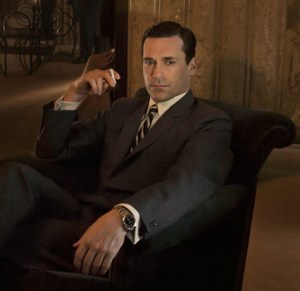
John Hamm plays Don Draper (amctv.com)

That is the image that comes to mind while reading Ronald W. Dworkin’s “The Rise of the Caring Industry.” The caring industry consists of the “77,000 clinical psychologists, 192,000 clinical social workers, 105,000, mental health counselors, 50,000 marriage and family therapists, 17,000 nurse psychotherapists, and 30,000 life coaches” at work in the US today and the additional “400,000 nonclinical social workers and 220,000 substance abuse counselors working outside the official mental health system yet offering clients informal psychological advice nonetheless”  According to Dworkin this represents “more than a 100-fold increase in the number of professional caregivers over the last 60 years, although the general population has only doubled.”

Most conversations about what Dworkin has neatly labeled the caring industry eventually come around to Christopher Lasch’s The Culture of Narcissism (1979) and Philip Rieff’s The Triumph of the Therapeutic (1965).  Both make the obligatory appearance, but in Dworkin’s view both are inadequate.  Regarding Lasch he writes,

Many people who go to counselors share nothing with the stereotypical self-absorbed neurotic.  On the contrary, they are average people with conventional values who face real-life problems but have no one to talk to.  Fully a third of the American population has undergone some form of psychotherapy.  It strains the imagination to think that the majority of them are narcissists.

Rieff was simply writing too soon to know the full import of the unfolding sea change in Western culture:

What Rieff had observed were the first stirrings of a new social order, one that would rest on a nation-spanning network of caring professionals.  Today, countless institutions and millions of people  are dependent to one degree or another on the caring industry.  Therapy is no longer just a “culture.”  In the form of professional caring, it has become our way of life.

Now we might question whether Dworkin’s take on Lasch and Rieff is itself adequate, but the main point he makes in bringing them up seems sound:  the profound transition in American life that gave rise to the caring industry predates the 1960’s and 1970’s.  The caring industry is rooted in the “seemingly placid 1950’s, when mass unhappiness and mass loneliness began.”  Dworkin goes on to remind us that

So great was people’s unhappiness during the 1950’s, and so suddenly did it emerge, that both the political and medical authorities called it a “mental health crisis.”  Rates of alcoholism and juvenile delinquency skyrocketed during the decade, which popular magazines dubbed the “Age of Anxiety.”

If you’re familiar with Mad Men, and just now it seems few are not, you’re probably taking exception to my title since Mad Men is set in the early 1960’s, not the 1950’s.  But keep in mind that the early sixties were much closer to the 1950’s than they were to “The Sixties” which really start up mid-decade and spill over into the 1970’s.  In a fascinating essay titled “The Other Sixties,” Bruce Bawer argued that the early sixties as a period had a certain integrity of its own, but it was still a period when “men wearing ties and neatly pressed suits on all occasions” was the norm.

Freud's Couch

And so the image of Draper on Prozac, or perhaps Draper on the couch, to imaginatively capture the period in which far-reaching transformations in American life gave rise to the caring industry.  This is, in fact, a connection made explicit in the first few episodes of the first season in which Betty, not Don, Draper ends up going to a psychiatrist for her “nerves.”  Part of Mad Men’s brilliance derives from its poignant, and sometimes painful, explorations of the growing  unhappiness and loneliness of the era that Dworkin identifies with the birth of the caring industry.  If this were all Dworkin was intending to drive home, that the caring industries roots go back to the 1950’s, then it would be merely an interesting and compelling historical narrative.  But there is more, Dworkin argues that the rise of the caring class was necessitated by the breakdown of peer groups which had previously provided the resources and support ordinary people relied upon to navigate the difficulties and hardships of life.

Today’s caring professionals offer the same service to lonely, unhappy people that friends and relatives once did . . .   People want to be able to go about their daily lives with the knowledge that someone is there for them.  This basic truth led to the rise of the caring industry.  Millions of unhappy people use professional counselors to compensate for having no one to talk to about their everyday problems.

Dworkin details a number of factors contributing to this sad state of affairs:  Americans were increasingly moving to new towns alone, “urban renewal projects that tore down impoverished but vibrant inner city neighborhoods,” decreasing attendance at church or synagogue, longer work hours, a loosening of family ties, and more.  The end result:  “many people found themselves with neither the time nor the energy to listen sympathetically to a friend’s problems.”

We were becoming, as a classic work of sociology from the 1950’s put it, The Lonely Crowd.

Dworkin concludes his essay by arguing that the rise of the caring industry is most significant because it marks the end of a civilization based on an ideology of love.  This is Dworkin’s most expansive and sweeping argument and, consequently, the most controversial and debatable; but there is a certain plausibility to it.  In his view,

Many people today meet their basic psychological needs, including self-esteem, fulfillment, and identity, not through a social system of friends, intimates, and communities, as people did in the age of love, but by working directly with a caring professional.  Although lonely, they are psychological stable, and society is spared the tumult of an earlier era when people satisfied these needs through loving communities.

Dworkin’s thesis possesses a certain explanatory elegance, but it also raises a number of questions.  I wonder, for example, what difference the rise of social media might make to his analysis.  Nonetheless, there is one claim Dworkin makes that strikes me as being quite right.  The chief problem with the ideology of love, as Dworkin describes it, is that it finally encouraged people to love humanity.  “But it is impossible to know humanity in the concrete; humanity is a fiction, it cannot be loved.”

We cannot love an abstraction.  But we can love and befriend the particular people that are our families, friends, and neighbors.  It is a messy business, loving real people; but apart from it, we become faceless members of the lonely crowd.

The Metaphysics of Baseball

America’s greatest contribution to human civilization?  According to David B. Hart:  baseball.

I know there are those who will accuse me of exaggeration when I say this, but, until baseball appeared, humans were a sad and benighted lot, lost in the labyrinth of matter, dimly and achingly aware of something incandescently beautiful and unattainable, something infinitely desirable shining up above in the empyrean of the ideas; but, throughout most of the history of the race, no culture was able to produce more than a shadowy sketch of whatever glorious mystery prompted those nameless longings.

Read the rest of Hart’s Platonic reflections in “A Perfect Game” at First Things.

Apple School of Witchcraft and Wizardry

Here is one more reason to bookmark Big Questions Online (despite the somewhat silly name), Alan Jacobs will be contributing a monthly column.  His first piece, “Steve Jobs:  Shaman and Sorcerer,” posted yesterday includes this observation:

To turn back the cultural clock, as it were, to take a set of technologies that Apple had already deployed in the iPhone and improve them, repackage and repurpose them in a way that functions with near-absolute smoothness: this is the goal of the iPad. It’s a device meant to mediate the web flawlessly, and to do so — and this is perhaps the most important thing — not primarily by altering what you see or hear but rather by giving you manual control. On the iPad you make things happen by moving your hands around, like a wizard, except you don’t need either a mouse or a wand. You don’t even need those funky gloves that Tom Cruise wore in Minority Report. You touch the Internet: you stroke it, swipe it, pinch it. And it responds precisely to your will. And only Apple can give you that.

I’m not exactly vested in the whole PC/Apple thing, but I thought this was an insightful and elegant observation by Jacobs.  Read the whole piece to get the full context for the analogy.

Given my current interest in embodiment, I found Jacobs’ emphasis on “manual control” and “touch” particularly intriguing.  Forgive the pun, but I think he has put his finger on an important source of the iPad’s appeal.  The iPad exercises its uncanny appeal despite the fact that many believe it is not much more than a glorified iTouch with little that is new or otherwise groundbreaking.  I suspect the uncanny appeal lies precisely in the way it engages the sense of touch to give the user seemingly immediate (without the mediation of keyboard, mouse, etc.) interaction with the Internet.  Or to look at it another way, it moves us closer to experiencing the Internet as a kind prosthesis which blurs the boundary between body and  information.

Random, Assorted, Miscellaneous, Etc.

A couple of items for your consideration.  Actually make that three.

First off, sociologist Peter Berger has recently begun blogging at The American Interest Online.  His blog, Religion and Other Curiosities, has been up since early July and features longer, less frequent and consistently thoughtful posts.

Secondly, two blogs I follow, Science and Religion Today and Rob Dreher’s old blog on Beliefnet, have both moved to Big Questions OnlineBQO, a publication of the John Templeton Foundation, just launched today and focuses on science, religion, market, and morals.  Check it out.  Already up today are pieces by a wide array of writers including David Bentley Hart (reviewing Marilynne Robinson’s Absence of Mind), Susan Jacoby, Roger Scruton, and Josef Joffe on topics ranging from freedom of conscience at Catholic hospitals, the significance of evolutionary theory for all disciplines, and Islam’s teaching on debt.  This promises to be a rich resource for serious thinking about several critical dimensions of society.  Make sure read to Hart’s review.

Lastly, we’ve commented a good bit on here about the impact of the Internet on our thinking.  Nicholas Carr and his critics have been the subject of more than a few posts.  Well, that being the case I’m a little embarrassed to report that I just recently came across this year’s World Question on The EdgeThe Edge, which is itself a mine of interesting material, solicits responses to its question of the year from leading thinkers, scientists, artists, writers, etc.  This year’s question:  How is the Internet Changing the Way You Think? Responses were posted in January.  I realize that in Internet time that might as well have been a lifetime ago, but there it is, better late than never.

Some of the usual suspects that we’ve noted here before have contributed responses including Nicholas Carr, Clay Shirky, and Steven Pinker.  You may also want to take a look at responses from Jaron Lanier, Richard Foreman, James O’Donnell, and Sherry Turkle.

Enjoy.  If you get through all that and still need to be intellectually stimulated you can check out 15 Google Interview Questions That Will Make You Feel Stupid.

Ebert on Architecture

Yes, that Ebert.  Roger Ebert the film critic turns his attention to architecture.  The result is a lovely post on his blog, “The image of a man you do not see.” Here are a couple of excerpts:

Much modern architecture has grown tiresome to me. It does not gladden the heart. It doesn’t seem to spring from humans. It seems drawn from mathematical axioms rather than those learned for centuries from the earth, the organic origins of building materials, the reach of hands and arms, and that which is pleasing to the eye. It is not harmonious. It holds the same note indefinitely.

And,

One of the most intriguing classes I took at the University of Illinois was devoted to the Green Tradition in America. It was taught by Sherman Paul, a famous English professor, who identified a theme running through literature, architecture, design, art, music. He wasn’t using “Green” in the current sense. For him it was interchangeable with “Organic.” His starting point was Emerson. He taught us Thoreau, Walt Whitman, William Carlos Williams, Ezra Pound, Edmund Wilson, Charles Olson, Robert Creeley.

In that class we read Louis Sullivan’s Kindergarten Chats, written for a younger generation of architects. Sullivan wrote it on a desk that still stands in the Cliff Dwellers Club of Chicago, where he lived some of his later years in bankruptcy. He imagined his Chats addressed to a recent university graduate who might come to him for study “of those natural, spontaneous powers which had been ignored during his academic training.” He began by telling this student: “Every building you see is the image of a man you do not see.”

That image is shaped by the man’s values, he said. If you want roses in your garden you must have them in your heart.

The post is also accompanied by a stunning set of images.